A dining room wall with no mirror on it is quietly missing one of the cheapest tricks in the book. Dining room mirror ideas solve that in minutes, bouncing light around the room and making even a small, dim space feel noticeably bigger and brighter. Most dining rooms don’t actually need more furniture or a fresh coat of paint to feel finished, they just need one reflective surface placed in the right spot. I’ve noticed that a single well-chosen mirror often does more for a room’s overall mood than an entire new light fixture would. This guide covers 23 ways to use mirrors, from an oversized arched statement piece to a fully mirrored accent wall, so you can find whichever fits your space and budget. Save your favorites to Pinterest and see which one transforms your dining room first.
1. Oversized Arched Mirror
- Softens a room full of straight, rectangular lines
- Adds height through its tall, rounded top
- Works as a single, uncomplicated focal point
- Suits both traditional and modern dining rooms
- Scales up easily to fill a large stretch of wall
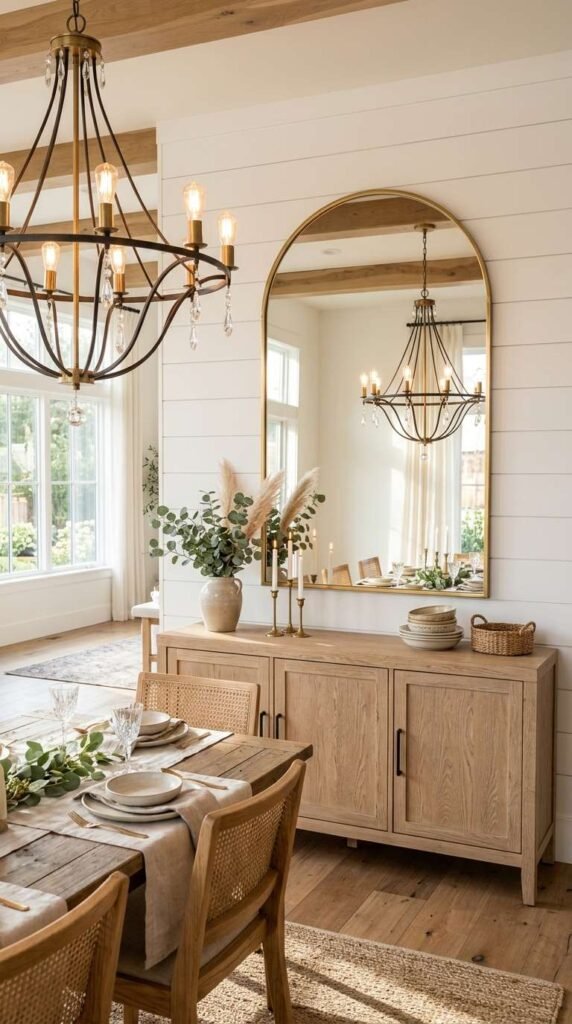
An arched top gives a mirror a softer silhouette than a standard rectangle, borrowing its shape from old doorways and architectural windows. Hung across from a window or light source, an oversized version becomes an instant focal point, one of the simplest dining room mirror ideas to execute since the shape alone does most of the visual work without needing any additional decor nearby. The height created by the arch also draws the eye upward, making a room with slightly lower ceilings feel a touch more spacious than it actually measures.
Choosing a frame finish that complements the room’s existing metals, brass, black, or simple wood, keeps the piece feeling intentional rather than randomly selected. I’ve noticed that hanging this style slightly taller than a standard rectangular mirror, closer to 65 or 70 inches overall, emphasizes the arch and gives the piece the vertical presence it needs. Secure mounting matters here too, since larger arched mirrors often weigh more than their slim profile suggests at first glance.
2. Round Mirror Cluster
- Adds movement across the wall a single mirror can’t achieve
- Mismatched sizes feel gathered rather than purchased as a set
- Multiplies reflected light from several angles at once
- Fills a large wall gradually without one big purchase
- Lightweight pieces are simpler to hang than one heavy mirror
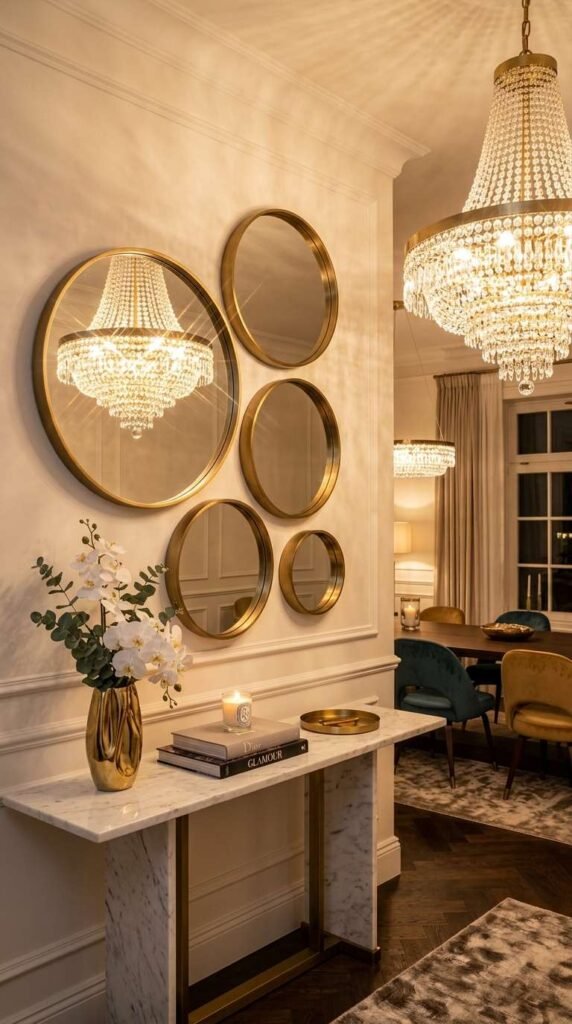
Grouping five or seven round mirrors in varying sizes and frame finishes creates a wall that shifts depending on where you’re standing in the room. Rather than reflecting one fixed view, a cluster catches light from multiple angles at once, so the wall reads differently throughout the day. This is one of the more flexible dining room mirror ideas, since a large wall can be filled gradually, picking up one or two mirrors at a time rather than needing to plan and purchase the whole arrangement in a single trip.
Laying every piece out on the floor first prevents unnecessary nail holes from constant rearranging once mirrors are already on the wall. I’ve found that anchoring the composition with the largest mirror slightly off-center, then building smaller ones outward in a loose, uneven pattern, looks more natural than a strict grid. Leaving two to three inches of space between each piece keeps individual shapes distinct rather than blurring into one busy, overcrowded mass.
3. Sunburst Mirror Statement
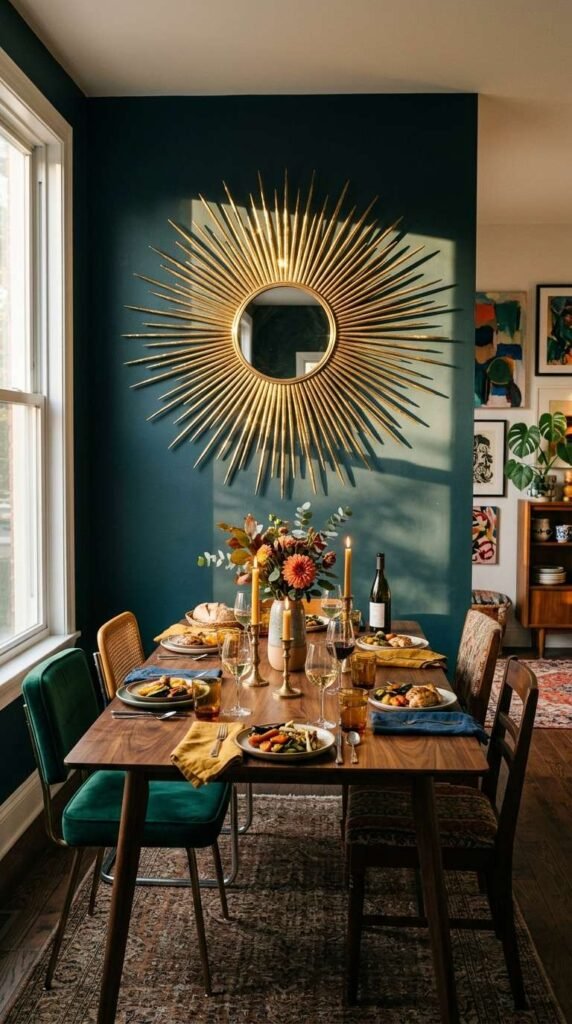
- Adds a sculptural, three-dimensional element to a flat wall
- Metal rays catch and scatter light throughout the day
- Works as a single bold piece above furniture
- Suits mid-century, eclectic, and transitional dining rooms
- Available in sizes small enough for a narrow wall
A sunburst mirror projects outward from the wall rather than sitting flush against it, creating genuine shadow and dimension that a flat frame simply can’t produce. The radiating metal rays catch afternoon light and scatter small glints across the ceiling, adding a subtle, shifting quality throughout the day. Among dining room mirror ideas, this shape works particularly well as a lone statement piece above a sideboard, since the visual energy it creates rarely needs much additional decor competing for attention nearby.
Longer, widely spaced rays read as more dramatic and mid-century, while shorter, tightly packed ones feel more delicate and traditional. I’ve tried both styles in different rooms, and the tighter version tends to suit smaller walls better, keeping the piece proportional without overwhelming the space. Gold and brass remain the most common finishes, though a matte black sunburst offers a moodier, more contemporary alternative worth considering for a different overall feel.
4. Mirror Above a Sideboard
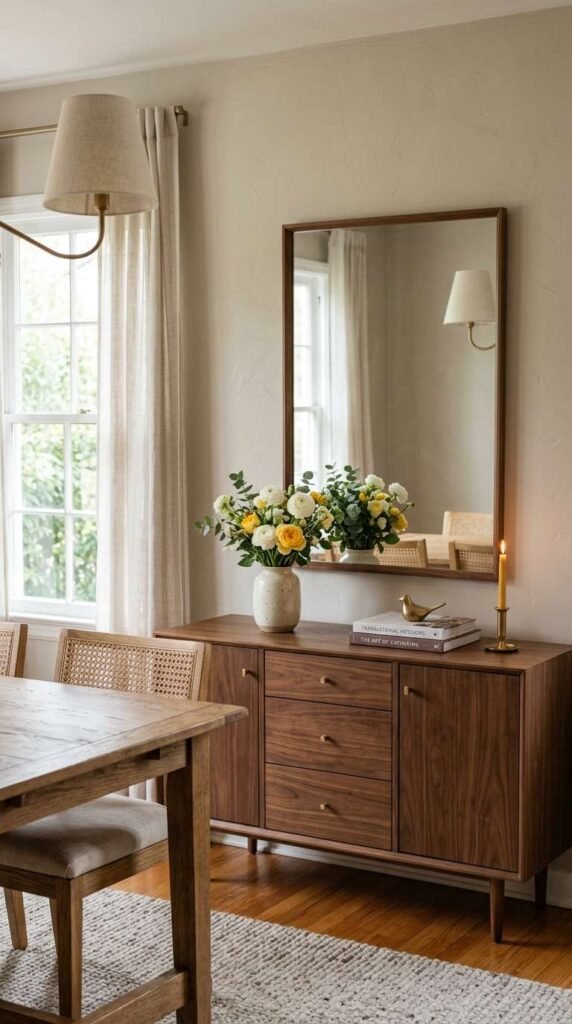
- Anchors the wall directly above a piece of furniture
- Reflects serving dishes and centerpieces during meals
- Balances the visual weight of a substantial sideboard
- Suits traditional and transitional dining rooms alike
- Ties the wall and furniture into one connected feature
Placing a mirror directly above a sideboard gives that stretch of wall a clear sense of purpose rather than leaving an awkward gap above the furniture. The mirror reflects whatever gets set out on the surface below, from serving platters to a seasonal centerpiece, adding a layer of visual interest that shifts depending on what’s actually happening in the room. This pairing ranks among the more dependable dining room mirror ideas, since it balances the visual heaviness of a substantial sideboard by lightening the wall space directly above it.
Sizing the mirror to roughly two-thirds the width of the sideboard beneath it keeps the two pieces feeling proportional rather than mismatched. I’ve noticed that leaving only four to six inches of space between the mirror’s bottom edge and the sideboard’s top creates the tightest, most connected look, while a larger gap starts to feel like two unrelated pieces simply sharing the same wall.
5. Full Mirror Wall Feature
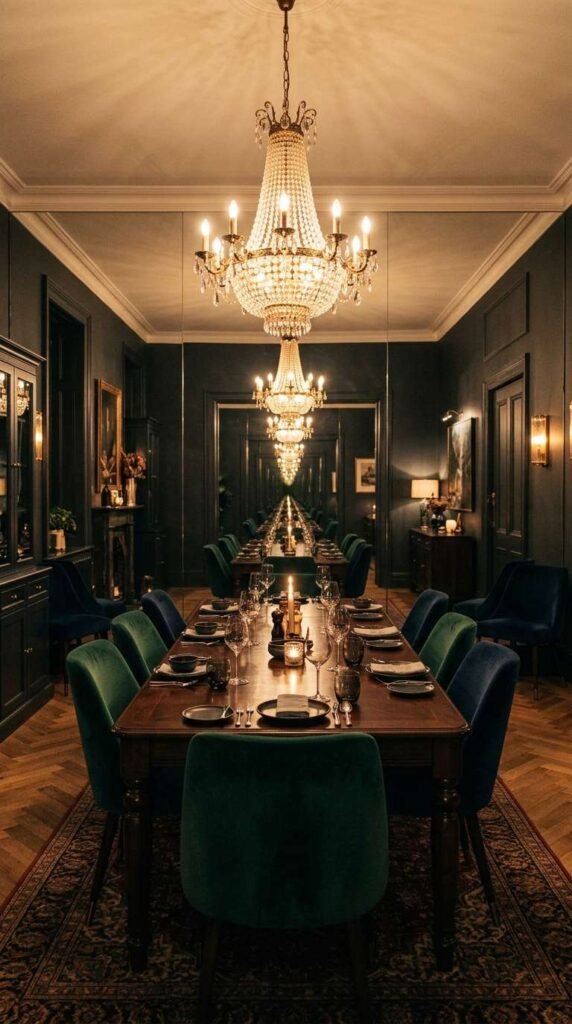
- Covers an entire wall rather than a single frame
- Multiplies the room’s apparent size dramatically
- Works well behind a long dining table
- Suits modern, glam, and maximalist dining rooms
- Requires professional installation for a seamless finish
Rather than hanging one mirror, covering a full wall in mirrored panels creates a genuinely dramatic sense of expanded space. This approach essentially doubles the visible dining room, reflecting the table, chandelier, and opposite wall across the entire surface. Among the boldest dining room mirror ideas on this list, a full mirrored wall suits rooms already leaning toward a glam or maximalist aesthetic, since it reads as a serious design statement rather than a subtle accent.
This is one project best left to professional installers, given the precision needed to align panel seams invisibly and the weight involved in covering an entire wall. Antiqued or smoked panels tend to feel less stark than perfectly clear glass, softening the reflection so it reads as intentional rather than overwhelming. I’ve seen homeowners hesitate over the cost, but a mirrored feature wall genuinely changes how a room photographs and feels, especially under warm evening lighting.
6. Vintage Gilded Mirror
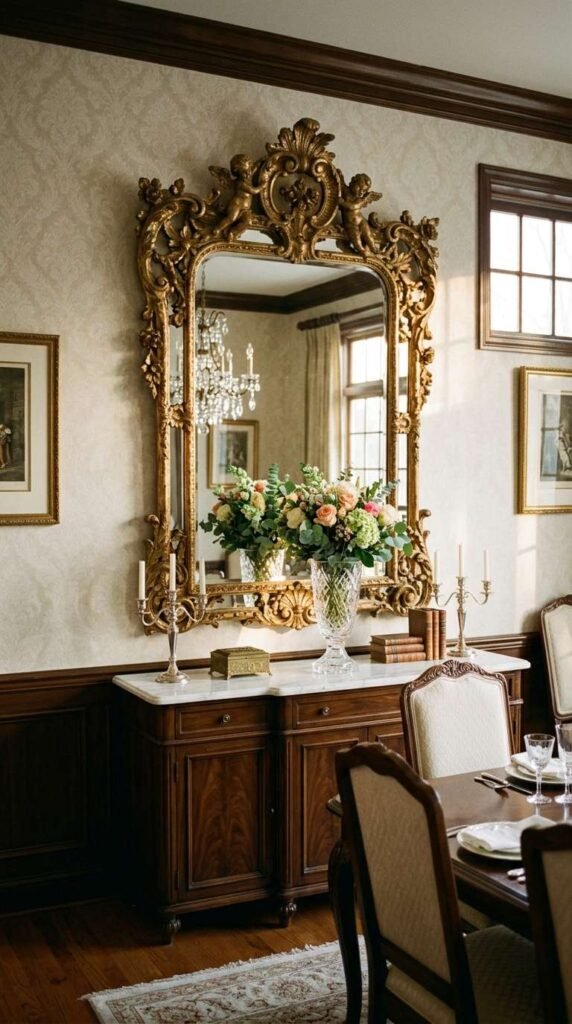
- Adds old-world detail without needing extra wall art
- Gold tone warms up cooler paint colors nearby
- Carved edges catch shadow and light differently throughout the day
- Suits traditional and transitional dining rooms particularly well
- Estate sales often carry these for a fraction of retail price
An ornate gold frame carries enough carved detail on its own that it rarely needs company on the wall. The scrollwork or beaded rim catches light differently depending on the time of day, so the piece never looks quite static from one hour to the next. This idea works especially well among dining room mirror ideas for rooms where the rest of the furniture stays fairly plain, since the mirror becomes the one element doing something visually interesting without competing against other bold choices nearby.
Checking the backing and glass condition before buying secondhand matters, since foxing, the cloudy speckling that develops on old mirror backing, can either ruin the reflection or add exactly the aged character being sought, depending on how much is actually present. I’ve noticed that gold responds particularly well to warm afternoon light, so hanging the piece where that light will hit the frame directly brings out its detail far more than flat overhead lighting ever could.
7. Leaning Floor Mirror
- Requires no drilling or wall damage
- Easy to reposition whenever the room’s layout changes
- Adds height and presence without hanging hardware
- Reflects the room from a lower, more dramatic angle
- A practical choice for renters
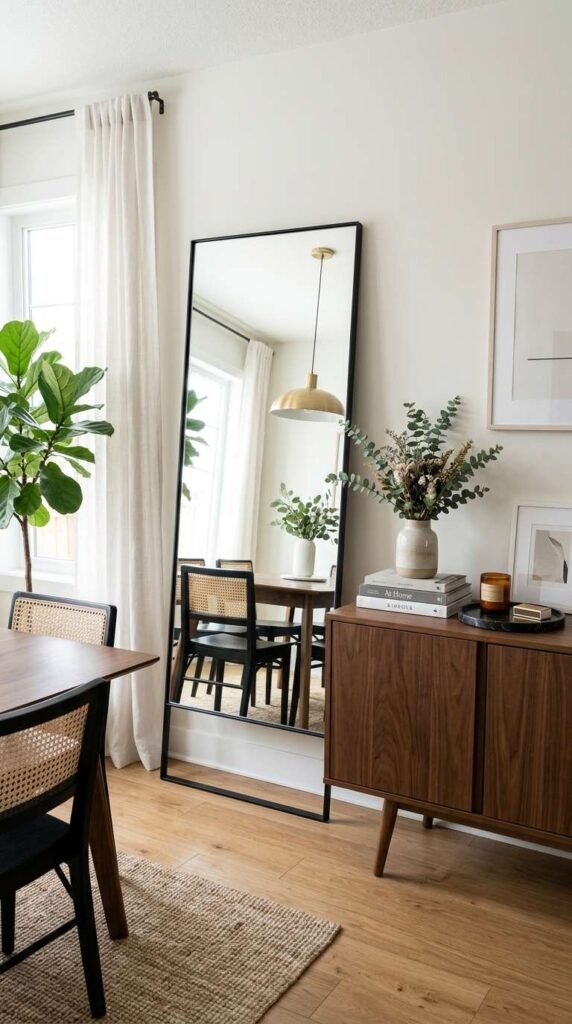
Not every mirror needs a nail. A tall floor mirror propped against the wall behind a console or in an empty corner adds scale and reflection without a single hole drilled into plaster. Because it leans rather than hangs, repositioning takes seconds, which matters if furniture gets rearranged often. This is one of the more renter-friendly dining room mirror ideas, since the lower vantage point also reflects the room differently than a wall-mounted piece, catching table legs, chair details, and flooring that a higher mirror typically misses.
Stability matters more here than with a hung mirror, so choosing one with a sturdy base or adding a simple wall strap prevents tipping without requiring permanent installation. A frame around 60 to 70 inches tall generally reads as substantial without looking out of place. I’ve noticed leaning mirrors work particularly well in dining rooms that double as a hallway pass-through, since the reflection adds interest to what’s otherwise just a walkway.
8. Mirror Paired with Wall Sconces
- Creates instant symmetry on either side of the mirror
- Adds warm light directly onto the reflective surface
- Suits traditional and transitional dining rooms
- Balances a single mirror with additional visual weight
- Works well above a console or sideboard
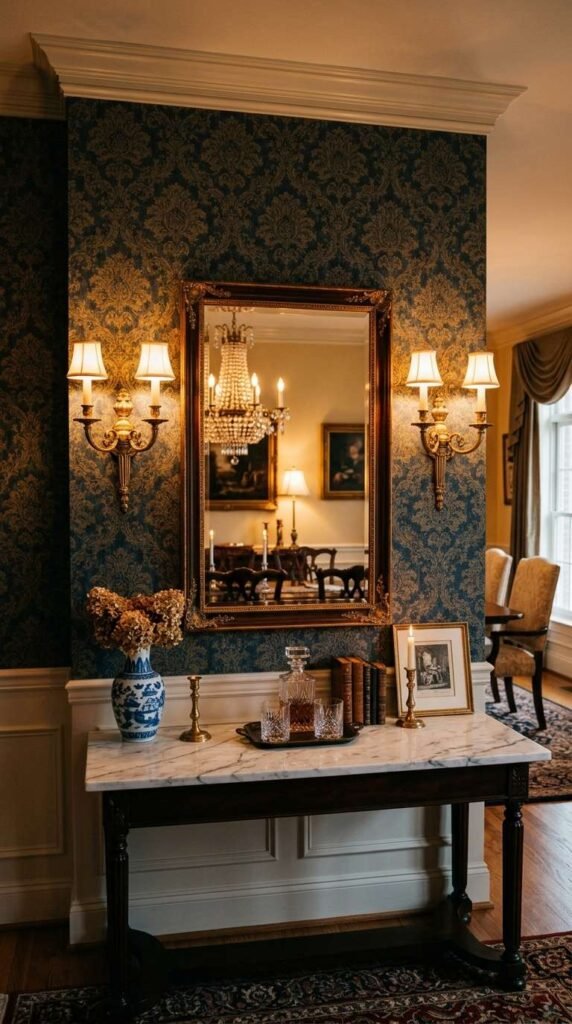
A single mirror can sometimes look a little lonely on a large wall, and flanking it with two matching sconces solves that immediately. The symmetry created by identical fixtures on either side gives the eye a clear, balanced point to rest on, while the sconces add warm light that reflects directly off the mirror’s surface. This combination suits more traditional dining room mirror ideas particularly well, echoing a layout often seen above fireplace mantels, adapted here for a dining room wall instead.
Mounting the sconces at the same height on either side, roughly level with the mirror’s midpoint, keeps the arrangement reading as deliberately matched. I’ve seen this pairing used above a sideboard to particularly good effect, since the combined light and reflection make the serving area feel like an intentional, styled feature rather than storage furniture simply pushed against a plain wall.
9. Geometric Mirror Shapes
- Adds a modern, graphic edge to the wall
- Hexagons, diamonds, or angular cuts feel distinctly contemporary
- Reflects light from several angles within one arrangement
- Suits modern and transitional dining rooms
- Easier to source affordably as a pre-packaged set
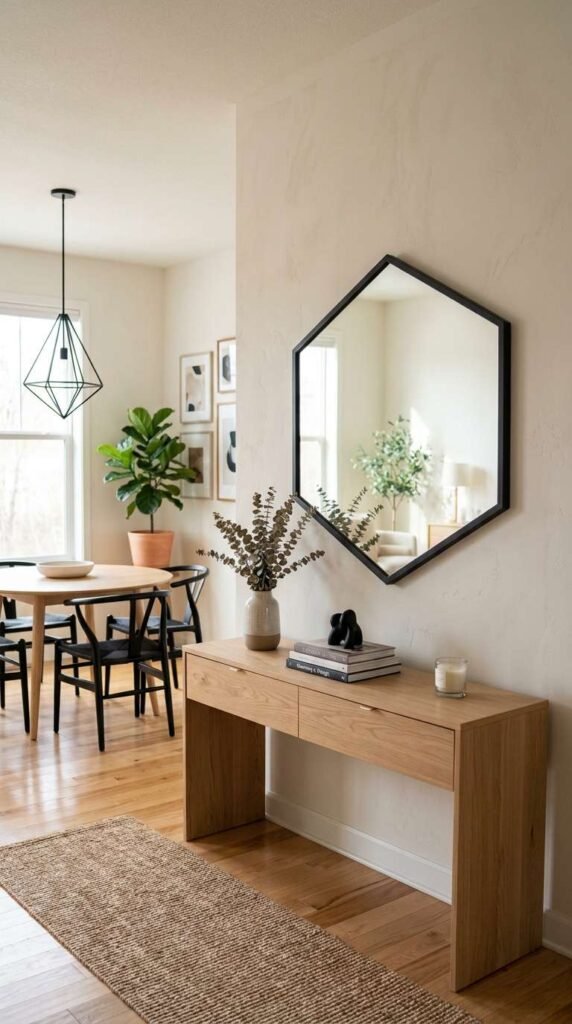
A cluster of hexagonal or diamond-shaped mirrors brings a distinctly modern, geometric edge to a dining room wall. The angular edges create sharp, defined boundaries between pieces, so even when several are grouped together, the overall pattern reads as structured rather than busy. This shape fits naturally among dining room mirror ideas for rooms already featuring other geometric details, like patterned tile or an angular light fixture, since the mirrors echo that same visual language elsewhere in the space.
Planning the arrangement on paper first helps, since these shapes interlock most successfully when the point of one piece aligns closely with the flat edge of its neighbor. I’ve seen this style used well in sets of five or seven, arranged in a loose honeycomb pattern rather than a strict grid. Buying a pre-packaged set typically costs less than sourcing individual pieces separately, and it guarantees consistent sizing throughout the arrangement.
10. Mirrored Furniture Accents
- Adds shine and reflection beyond just the walls
- Works on a side table, console, or small cabinet
- Multiplies whatever sits on top of the piece
- Suits glam and transitional dining room styles
- A subtler way to bring mirror into the room
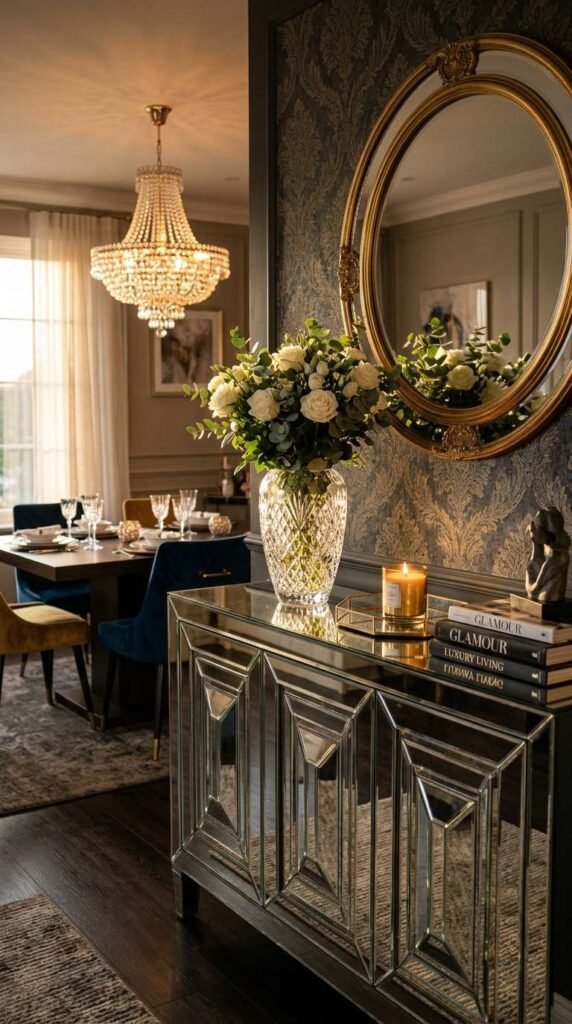
Mirrored furniture, a side table with a reflective top, a console with mirrored panel doors, brings the same light-bouncing benefit as a wall mirror but at a different, lower height in the room. This approach offers a subtler entry point among dining room mirror ideas for anyone not quite ready to commit to a large wall piece, since the reflection happens closer to eye level for anyone seated at the table rather than dominating the wall above.
I’ve noticed that mirrored furniture tends to show fingerprints and dust more readily than a wall-mounted mirror, simply because it sits at a height people interact with more directly. Wiping the surface with a glass-safe cleaner every week or so keeps it looking its best. Pairing one mirrored piece with otherwise solid, matte furniture nearby keeps the shine from feeling overwhelming, letting it read as a deliberate accent rather than the room’s dominant material.
11. Mirror Behind a Chandelier
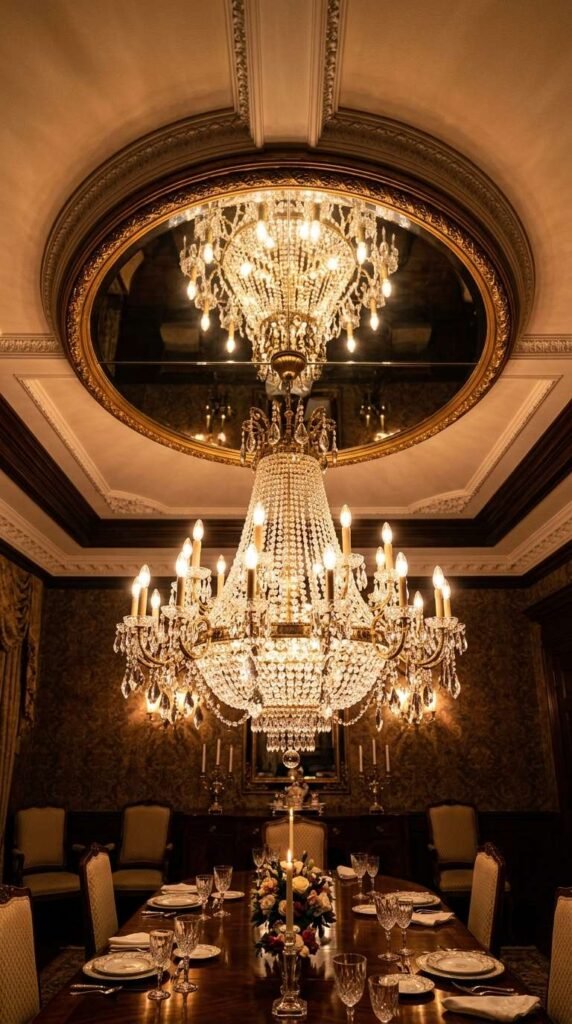
- Doubles the sparkle of the fixture above the table
- Adds depth to the wall the chandelier is mounted near
- Works well in rooms where the chandelier sits close to a wall
- Suits both crystal and more modern fixture styles
- Reflects candlelight for added warmth in the evening
When a chandelier hangs close enough to one wall, positioning a mirror directly behind or beside it doubles the fixture’s sparkle, since the reflective surface catches and bounces back whatever light the chandelier itself is already throwing off. This pairing works as one of the more atmospheric dining room mirror ideas for evening entertaining, since the combined effect of crystal and reflection creates considerably more shimmer than either element alone.
This setup suits dining rooms where the table sits fairly close to one wall rather than in the exact center of the room. I’ve found that a simple, unobtrusive frame works best here, since the goal is amplifying the chandelier’s own light rather than competing with it visually. Candlelight on the table below also reflects beautifully off this kind of mirror placement, adding another subtle layer of warmth during a shared meal.
12. Antique Mirror with Patina
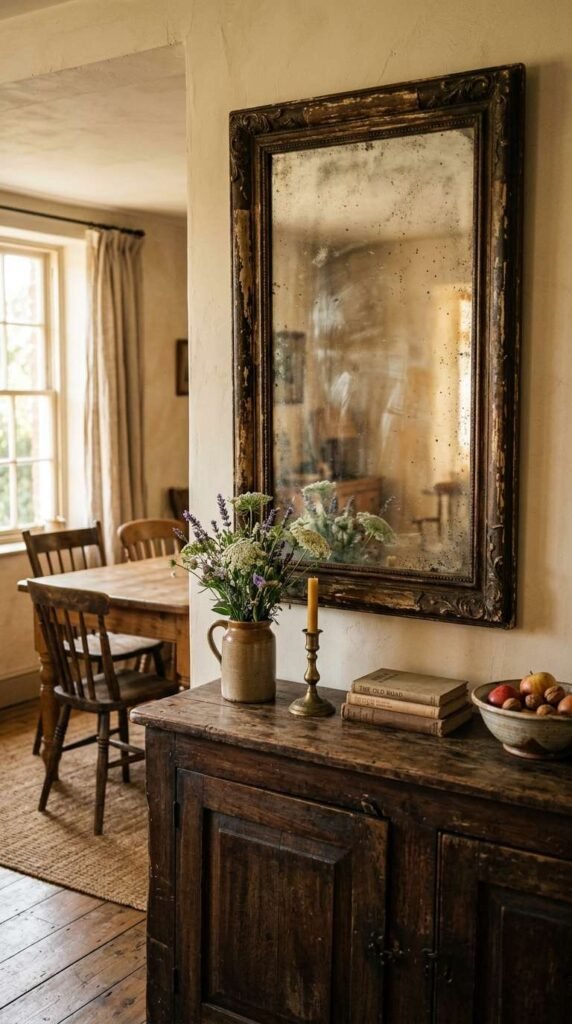
- Adds a soft, smoky reflection instead of a bright, clear one
- Hides fingerprints and smudges better than new glass
- Brings genuine age and character to the wall
- Suits glam, traditional, and eclectic dining rooms
- Pairs beautifully with candlelight and warm bulbs
The slightly clouded, mottled finish on an antique or mercury glass mirror produces a reflection that feels softer and more forgiving than a crisp, modern surface. Rather than showing every fingerprint and dust speck the way new glass does, this aged coating actually hides minor smudges, making it a genuinely practical choice among dining room mirror ideas for a room used daily. The soft, antique quality pairs especially well with candlelight, since the warm flicker interacts with the mottled surface in a way flat, bright glass simply doesn’t replicate.
Authentic antique pieces can run expensive, but plenty of reproduction versions achieve a similar look for considerably less. I’ve noticed this style photographs particularly well under warm lighting, so pairing it with a nearby sconce or dimmed overhead fixture brings out the depth of the finish far more than harsh daylight alone would.
13. Black-Framed Modern Mirror
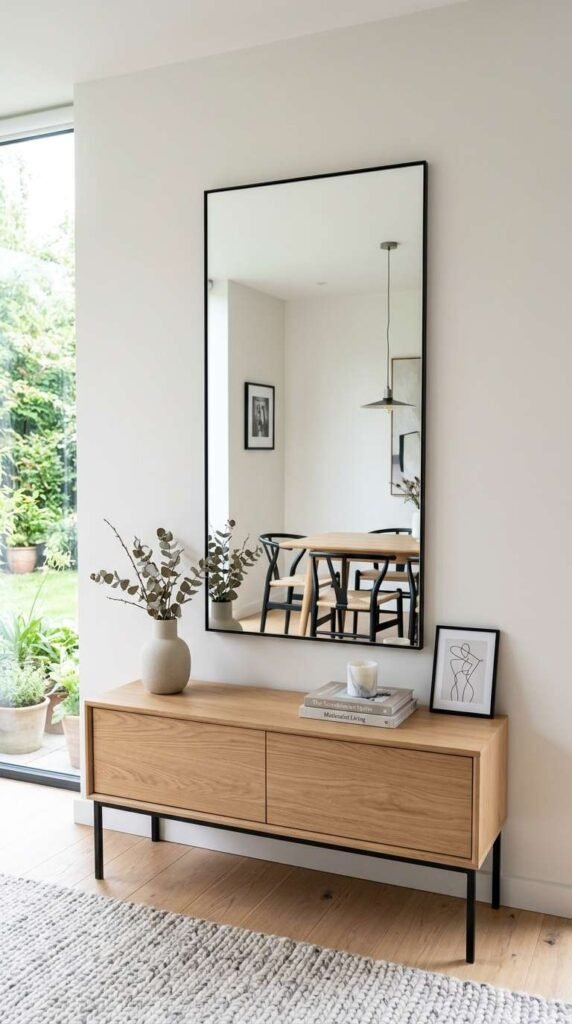
- Adds graphic contrast against light walls
- Suits minimalist and industrial-leaning dining rooms
- Pairs naturally with black hardware or lighting nearby
- Works well as a single piece or in a repeated set
- Keeps the overall look clean and architectural
A slim black frame brings a crisp, graphic quality to a mirror that reads as considerably more architectural than a traditional gold or wood finish would. Against pale walls, the dark outline creates sharp contrast, making this one of the more striking dining room mirror ideas for minimalist or industrial-leaning spaces. Round, square, or rectangular shapes all work within this frame style, letting the finish itself carry most of the visual impact rather than relying on an elaborate shape.
Repeating the same black tone in nearby light fixtures or chair hardware ties the mirror into the room’s broader material story rather than leaving it as an isolated element. I’ve found that this frame style tends to photograph particularly well in rooms with plenty of natural light, since the contrast reads clearly without appearing too heavy or dominant against a bright backdrop.
14. Mirror Gallery Wall
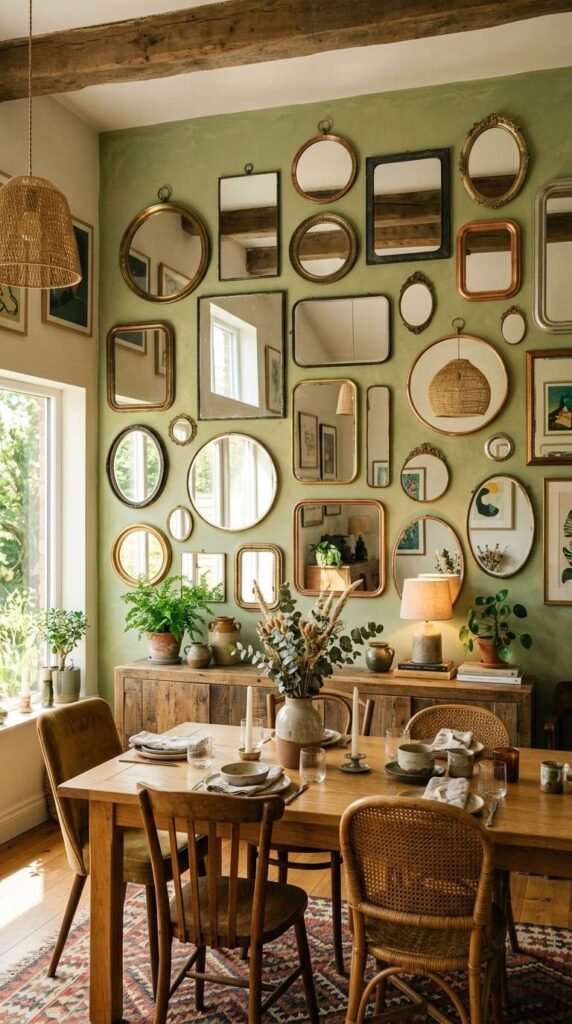
- Mixes multiple mirror styles into one cohesive display
- Adds texture and variety beyond a single matching set
- Fills a large wall gradually over time
- Suits eclectic and collected-looking dining rooms
- Builds naturally from vintage and thrifted finds
Unlike a cluster of matching round or geometric mirrors, a true gallery wall mixes several different mirror styles, round, oval, ornate, and simple, into one layered, collected display. This approach to dining room mirror ideas suits anyone drawn to a more eclectic look, since the variety itself becomes the main visual interest rather than relying on a single repeated shape. The wall grows naturally over time as new pieces get added, much like a traditional art gallery wall would.
I’ve noticed that keeping a loose color thread, all gold frames, or all pieces with some aged patina, helps an otherwise varied collection feel intentional rather than randomly assembled. Planning the rough layout on the floor first, before any actual hanging begins, saves considerable time and unnecessary wall damage once the arrangement starts taking shape.
15. Mirrored Tray Centerpiece
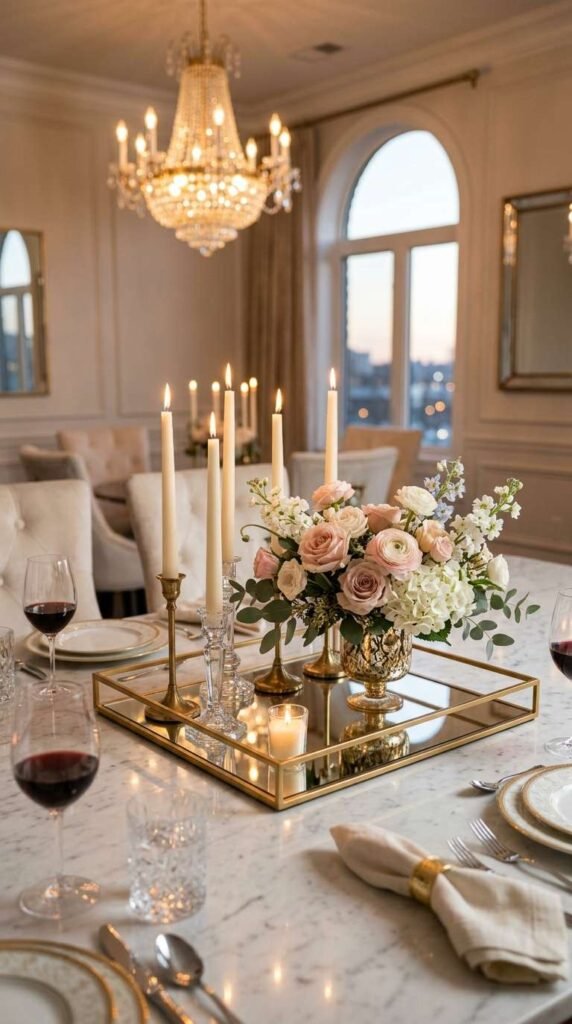
- Adds reflection and shine at table level
- Doubles whatever centerpiece sits on top of it
- Works beautifully with candles or a floral arrangement
- Suits both formal and casual table settings
- An affordable way to bring mirror detail to the table itself
A mirrored tray placed in the center of the dining table reflects candles, flowers, or any other centerpiece resting on top of it, multiplying the display’s visual impact without requiring any wall-mounted addition at all. This idea brings dining room mirror ideas down to table level, adding sparkle exactly where guests spend most of their time looking during a shared meal.
I’ve found that a simple round or oval tray in a thin metal frame suits most table settings without overwhelming whatever centerpiece gets placed on top. Grouping a few candles or a low floral arrangement directly on the tray creates a doubled, glowing effect once the sun goes down or candles get lit, adding genuine atmosphere to the table without needing anything hung on the walls at all.
16. Mirror Opposite a Window
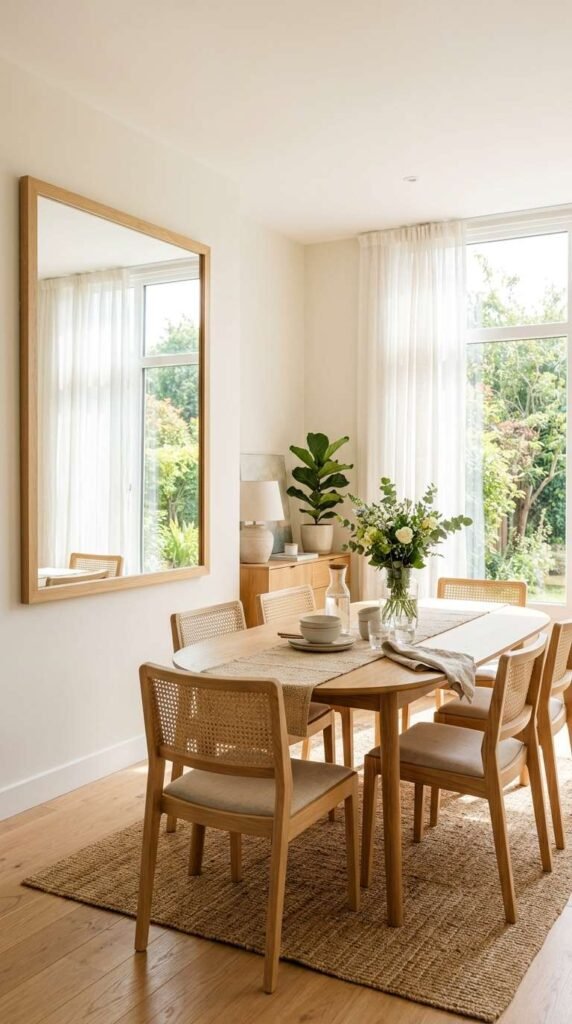
- Maximizes the amount of natural light bounced into the room
- Makes the window itself feel larger and more prominent
- Works with nearly any frame style or shape
- One of the most effective placements for brightening a space
- Costs nothing extra beyond the mirror itself
Positioning a mirror directly across from a window remains one of the single most effective placements among all dining room mirror ideas, since this spot maximizes how much natural daylight gets bounced back into the room rather than stopping at the first few feet near the glass. The trick works because the brain reads reflected daylight as genuine additional light, making even a modest-sized room feel noticeably brighter throughout the day.
I’ve noticed that this placement also makes the window itself feel more prominent and larger than its actual dimensions, since the reflection essentially doubles the sense of openness on that side of the room. Nearly any frame style works here, since the placement itself, rather than the mirror’s specific design, is what delivers the real brightening effect throughout the space.
17. Scalloped or Fluted Edge Mirror
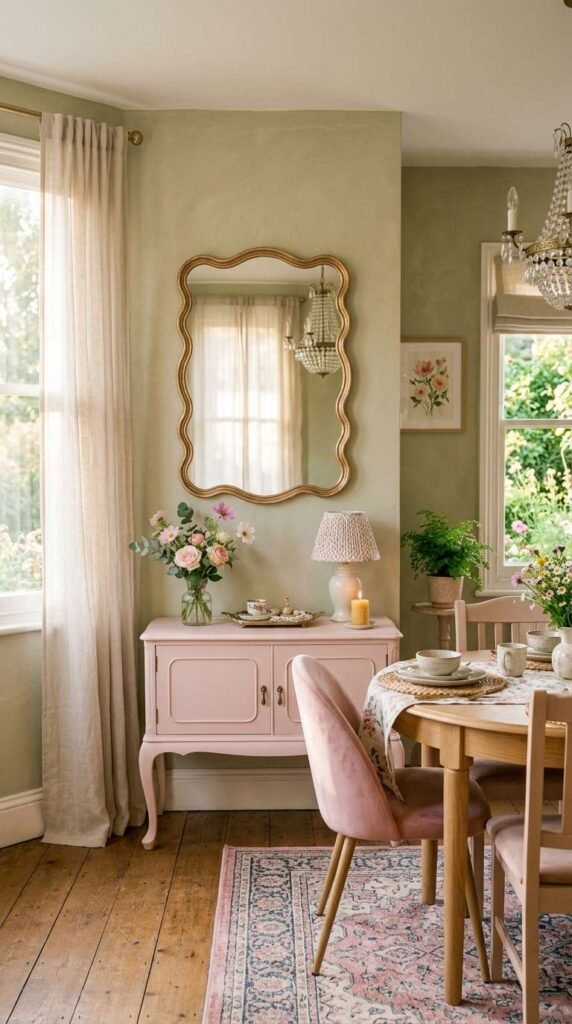
- Adds a soft, wave-like border instead of a straight frame
- Suits coastal, cottage, and romantic dining room styles
- Creates visual texture without needing a bold color
- Works as a smaller accent or an oversized statement
- Pairs naturally with rattan and linen textures nearby
A scalloped or fluted edge trades the sharp lines of a standard frame for a rippled, textured border that reads as noticeably softer on the wall. This detail suits dining room mirror ideas leaning toward a coastal or cottage feel particularly well, though a scalloped mirror in a deeper, saturated frame color can also work in a more romantic, traditional space without feeling out of place. Because the edge itself provides visual texture, the mirror doesn’t need an elaborate frame finish to feel interesting.
Pairing it with natural materials nearby, like a rattan chair or a linen runner, makes the mirror’s soft edge feel like part of a consistent material story. I’ve noticed that a cream or white scalloped frame tends to disappear slightly against a pale wall, so a pastel or wood-toned frame usually shows off the shape more clearly once hung.
18. Mirror Panels as a Wallpaper Alternative
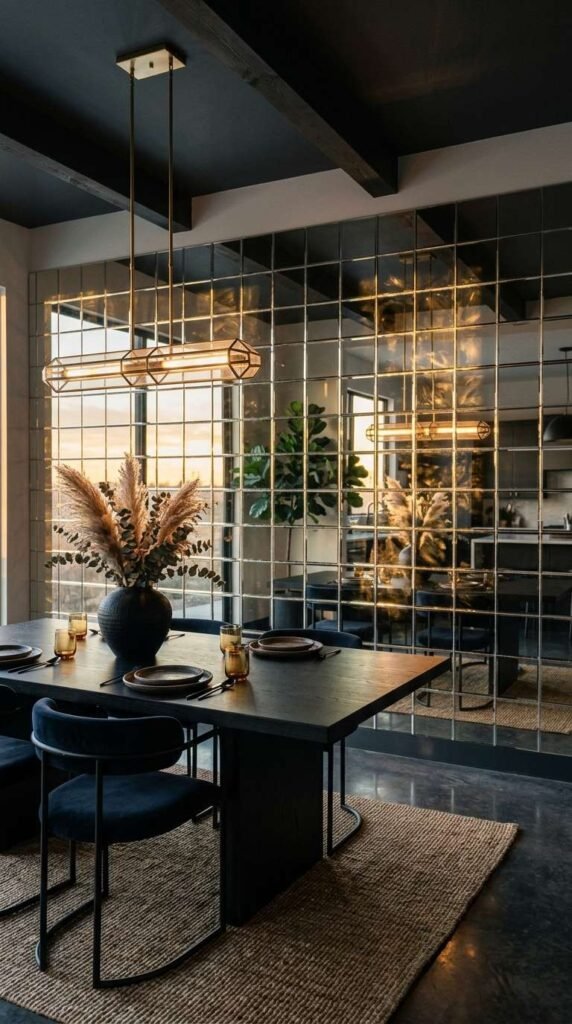
- Covers a section of wall with reflective texture instead of pattern
- Adds depth and dimension without any actual pattern
- Suits modern and glam dining rooms especially well
- Works well as a partial accent rather than a full wall
- Creates a sense of expanded space on a smaller budget
Rather than committing to wallpaper, a section of mirrored panels covering part of a wall adds depth and reflection in a way flat pattern never could. This approach to dining room mirror ideas works particularly well as a partial accent, say, behind a sideboard or along one half of a feature wall, delivering much of the drama of a full mirrored room without the same material cost or installation complexity.
Antiqued or smoked panel finishes tend to feel less stark than perfectly clear glass, softening the overall effect so the wall reads as intentional rather than like an actual mirror installation gone slightly overboard. I’ve seen this approach used well behind open shelving too, where the mirrored backing makes whatever sits on the shelves appear doubled and fuller than it would against a plain painted wall.
19. Mirror with a Built-In Shelf
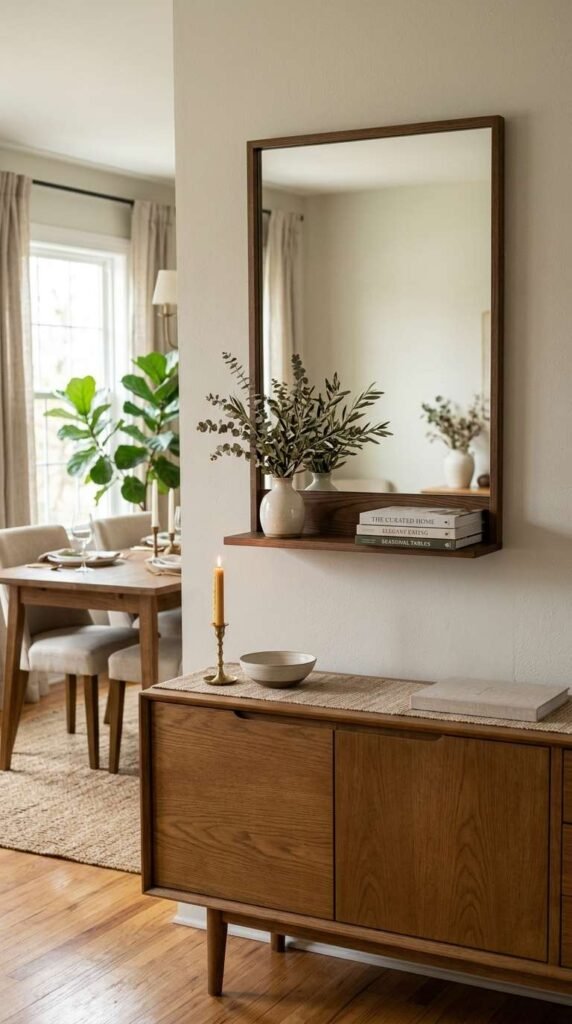
- Combines reflection and function in one piece
- Provides a small surface for candles or decor
- Works well in narrower dining rooms with limited wall space
- Suits both traditional and modern furniture styles
- Reduces the need for a separate console below it
A mirror with a small attached shelf, or a shallow ledge built into the bottom of the frame, provides both reflection and a display surface in one piece. This combination works especially well in narrower dining rooms where there simply isn’t room for a full console beneath a wall mirror. A few candles, a small vase, or a couple of framed photos on the built-in ledge get the same doubling effect a full console-and-mirror pairing would provide, in a fraction of the physical footprint.
Weight distribution matters more with this style, since the shelf adds load beyond the mirror alone, so checking the mounting hardware rating carefully before hanging anything heavier than a few candles on the ledge is worth the extra few minutes. I’ve seen this piece used well in a dining room too tight for a full sideboard, where it provided just enough surface for seasonal decor without requiring any additional floor-standing furniture.
20. Convex Mirror Accent
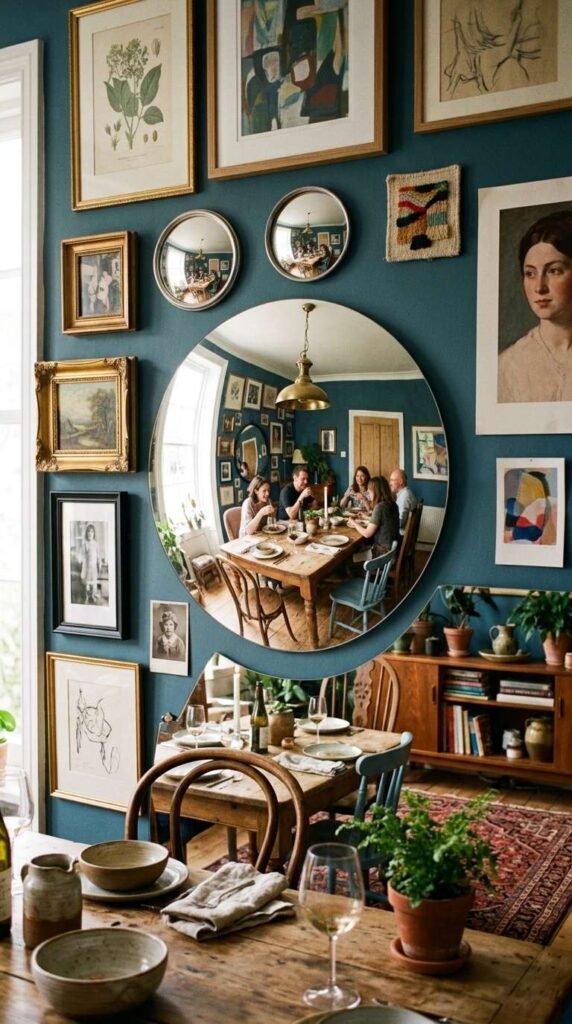
- Adds a curved, fisheye-style reflection for visual interest
- Works as a quirky, eclectic focal point
- Suits vintage, nautical, and eclectic dining rooms
- Smaller scale than most other statement mirror styles
- A distinctive choice among more common flat mirror options
A convex mirror, with its gently curved glass and distorted, fisheye-style reflection, offers something genuinely different among dining room mirror ideas. Rather than a flat, accurate reflection, the curved surface bends the room into a small, rounded view, adding a quirky, almost nautical or vintage character that suits eclectic spaces particularly well. These mirrors tend to run smaller in scale than most other statement pieces on this list, making them a good fit for a narrow wall or an accent spot rather than a primary focal point.
I’ve noticed that convex mirrors work particularly well paired with simple, uncomplicated surrounding decor, since the mirror’s own unusual reflection already provides plenty of visual interest on its own. A thin black or brass frame tends to suit this style better than anything overly ornate, letting the curved glass itself remain the clear point of focus.
21. Mirror Behind Open Shelving
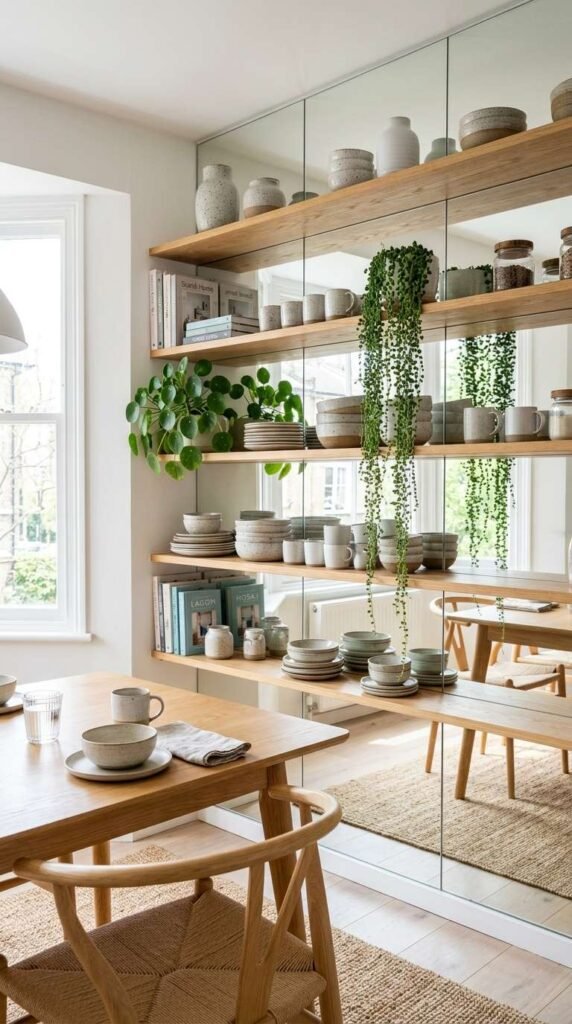
- Doubles whatever objects sit on the shelves
- Adds reflected light at a lower, more practical height
- Turns functional storage into a styled feature
- Works well for displaying glassware or small decor
- Simple to install with standard shelf brackets
A mirror mounted directly behind open shelving turns ordinary storage into something considerably more interesting. Glassware, small vases, or a stack of plates set on the shelf all appear doubled in the reflection, giving even a sparse arrangement a fuller, more finished look. Among dining room mirror ideas, this pairing bounces light into a lower, more immediate part of the room, which matters in spaces where table-level lighting often needs more help than the ceiling does.
Cutting the mirror to match the shelf’s width and depth precisely keeps the piece looking finished rather than like an afterthought extending past the shelf’s edges. I’ve seen this idea used well on a narrow ledge shelf holding just three or four objects, since the reflection multiplies a small display into something that reads as considerably more styled than it would against a plain wall.
22. Mirrored Backsplash Behind a Bar Cart
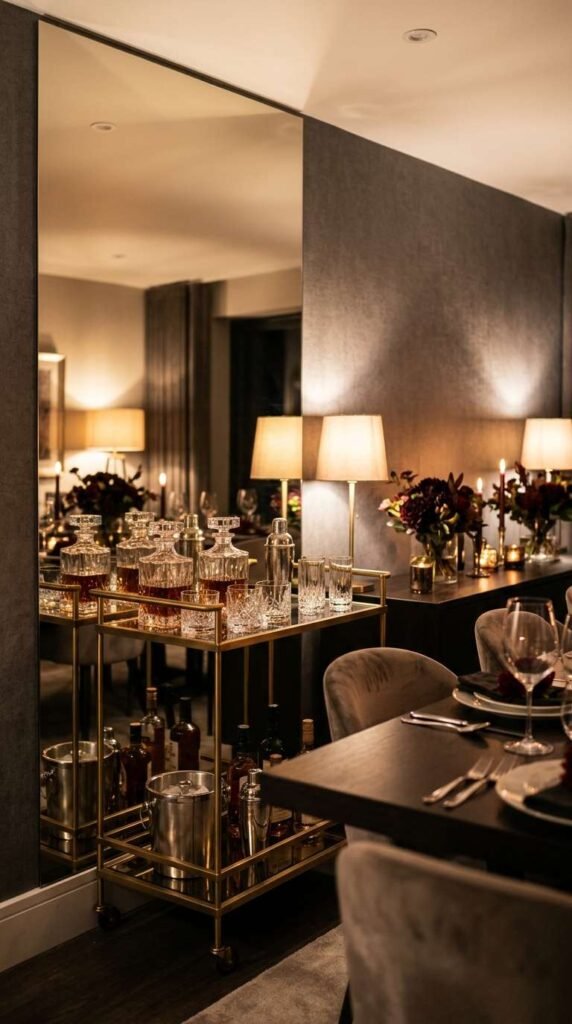
- Adds shine and reflection to a small entertaining nook
- Makes glassware and bottles appear doubled and fuller
- Works well in a corner or narrow stretch of wall
- Suits glam and transitional dining room styles
- A smaller, contained way to add mirror detail
A small mirrored backsplash positioned behind a bar cart adds shine exactly where it’s most noticeable during entertaining, reflecting glassware, bottles, and any decorative accents arranged on the cart’s shelves. This contained approach to dining room mirror ideas works particularly well in a corner or narrow stretch of wall, delivering a glam, boutique-like touch without requiring a large mirror installation elsewhere in the room.
I’ve found that a simple rectangular mirror cut to match the cart’s width looks more intentional than an oversized piece extending well beyond the furniture’s edges. Styling the cart with just a few well-chosen bottles and glasses, rather than crowding every shelf, lets the mirrored backing actually do its job of multiplying and brightening the display rather than getting lost behind too many competing objects.
23. Mirror with LED Backlighting
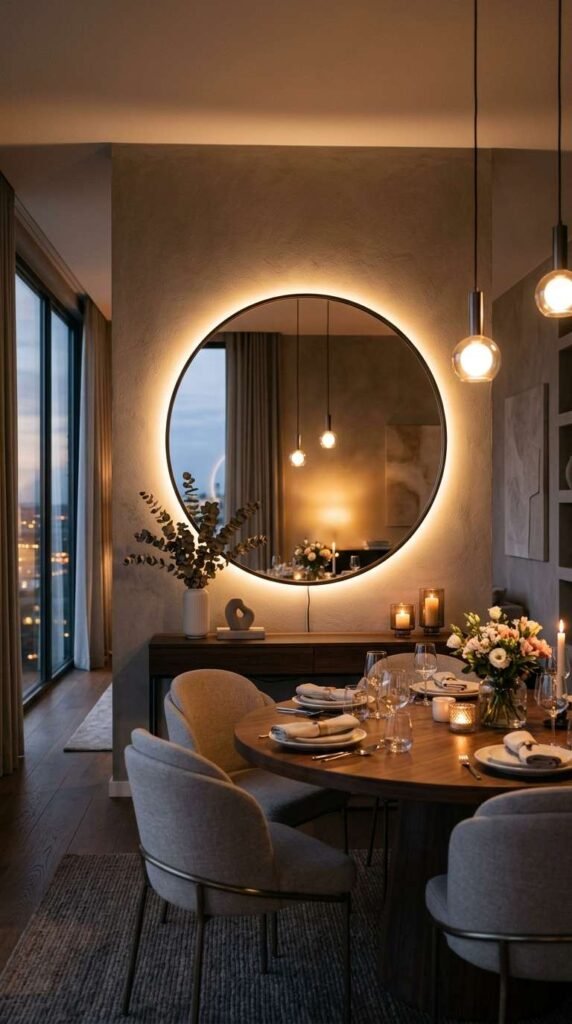
- Adds a soft, glowing halo effect around the frame
- Creates genuine ambiance beyond simple reflection
- Suits modern and glam dining room styles especially well
- Works well as a dimmable accent for evening meals
- A more technical but genuinely striking addition
A mirror fitted with LED strip lighting around its back edge creates a soft, glowing halo effect that goes beyond simple reflection into genuine ambient lighting. This more technical approach to dining room mirror ideas suits modern or glam spaces particularly well, since the backlit glow adds a boutique hotel quality that a standard, unlit mirror simply can’t replicate on its own.
Installation typically requires either a pre-made backlit mirror or a bit of DIY wiring work fitting an LED strip around a standard frame’s back edge. I’ve noticed that warm white LEDs, rather than cool blue-toned ones, suit a dining room’s generally warmer, more intimate lighting scheme far better. Pairing this feature with a dimmer switch allows the glow to shift from a subtle accent during daily use to a more dramatic, moodier statement for evening dinners and gatherings.
FAQs
1. Where is the best place to hang a mirror in a dining room?
Across from or adjacent to a window or main light source works best, since this position reflects natural light deeper into the room. Avoid facing a mirror toward a blank wall, since it will only reflect empty space rather than adding brightness.
2. What size mirror works best above a dining room sideboard?
A mirror roughly two-thirds the width of the sideboard beneath it tends to look the most proportional. Leaving four to six inches of space between the mirror’s bottom edge and the furniture top keeps the pairing feeling connected.
3. Can I use multiple mirrors in one dining room?
Yes, a cluster of mirrors or a full gallery wall can work beautifully, especially on a larger wall that a single piece might not fill well. Just keep spacing even and consider grouping styles that share a common thread, like frame finish or shape.
4. What mirror shape is best for a modern dining room?
Round, oval, and geometric shapes with slim black or brushed metal frames tend to suit modern dining rooms best. These styles avoid the heavier, more ornate detailing found in traditional carved wood or gold frames.
5. How do I make a small dining room feel bigger with a mirror?
An oversized mirror positioned across from a window does more for a small room than several smaller mirrors scattered across the wall. One large reflective surface creates a bigger sense of openness than a divided, fragmented arrangement.
6. What is a sunburst mirror and where should I hang it?
A sunburst mirror features metal rays radiating outward from a central glass circle, mimicking the shape of the sun. It works best as a single statement piece above a sideboard or on a wall with enough open space to let the shape stand out fully.
7. Can I pair a mirror with other wall decor?
Yes, mirrors pair well with framed art, botanical prints, or woven wall hangings as part of a larger gallery arrangement. Keep the mirror as the largest or most central piece so it still reads as the visual anchor among the grouping.
8. What is a good budget-friendly mirror idea?
A leaning floor mirror or a thrifted vintage frame both deliver real impact without a large investment. Secondhand shops and online marketplaces often carry beautiful mirrors at a fraction of retail cost, especially with a bit of patience while searching.
9. How do I add vintage charm with a mirror?
Look for antique or mercury glass mirrors with a slightly aged, mottled finish, or choose a gilded frame with visible carved detail. These softer, imperfect finishes carry genuine character that a brand-new, perfectly clear mirror can’t replicate.
10. What is a backlit mirror and is it worth adding?
A backlit mirror has LED lighting installed around its frame’s back edge, creating a soft glowing halo effect in addition to normal reflection. It’s a worthwhile addition for anyone wanting extra ambiance and a more modern, boutique-style feel in the dining room.
Conclusion
A dining room wall left bare wastes one of the easiest, most affordable ways to add light and personality to the space. These dining room mirror ideas, from a single oversized arched piece to a fully mirrored accent wall, show how much one reflective surface can change the way a room feels and functions. I’ve seen how swapping a plain blank wall for even a modest mirror above a sideboard noticeably brightens a room that previously felt flat and underlit. Save this list on Pinterest, pick one idea that fits your wall and your budget, and pass it along to anyone else ready to bring a little more light and dimension into their own dining room.