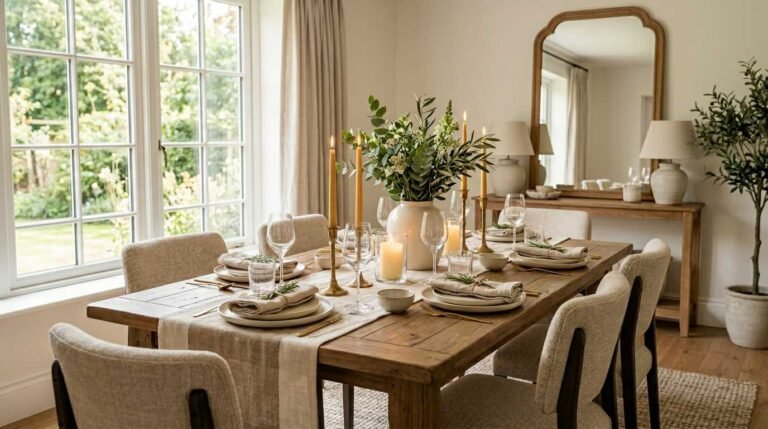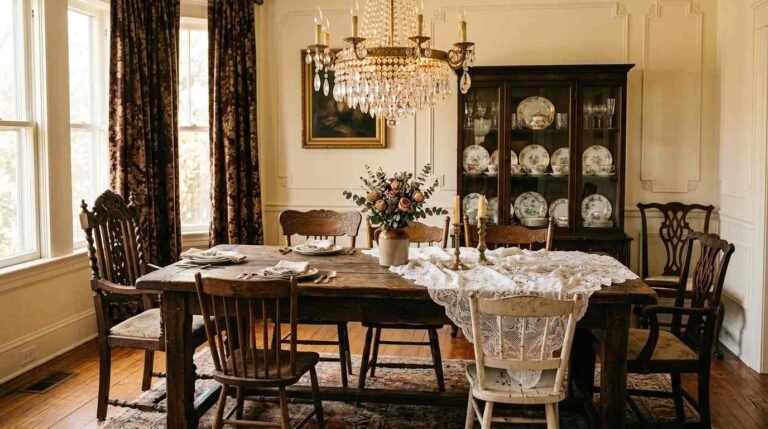
A farmhouse dining room starts at the table. The wood should look used, the metal a little worn, and the cloth soft from washing. That is the whole look, and it is also why so many people copy it. These farmhouse dining room decor ideas centre on the table itself, with reclaimed wood, red and black plaid, mason jars and galvanised metal doing most of the work. Pick the pieces that fit the table you already own, and add the rest one at a time.
Keep the palette narrow so the room reads as calm, not crowded. White walls, pale pine or oak, black iron and one check pattern are enough. Leave 12 inches of clear table at each place setting, and keep the centrepiece under 12 inches high, so people can talk across the table. Every idea below gives a size, a material or a step you can check before you buy or build it.
Farmhouse Dining Room Decor Ideas for a Rustic Table
Farmhouse style is a mix of hard and soft. A thick plank table needs a woven runner. Galvanised metal needs linen beside it to stop it looking cold. Plaid needs plain stoneware beside it to stop it looking loud. Work in threes where you can, one wood, one metal, one cloth, and repeat the same black or rust tone in the light, the chairs and the shelf brackets so the room holds together.
1. Reclaimed Wood Farmhouse Table
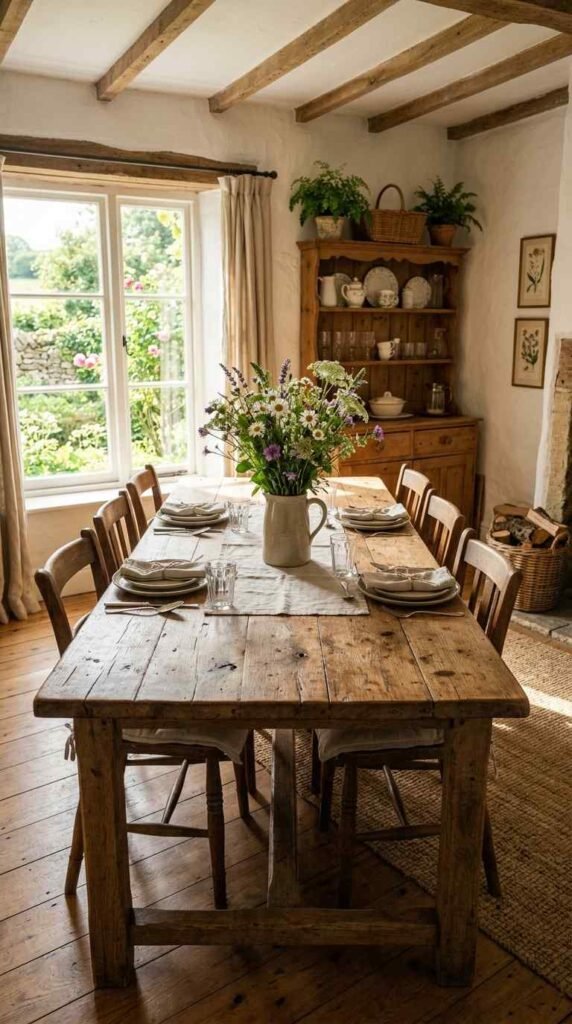
- Look for a plank top, 72 inches long and 36 inches wide, made from reclaimed pine or oak, 1.5 inches thick, with the saw marks left visible.
- Check that the legs are bolted through the apron, not just screwed, and that the table does not rock on a flat floor.
- Seal the top with two coats of matte hardwax oil, so spilled water beads on the surface instead of soaking into the wood.
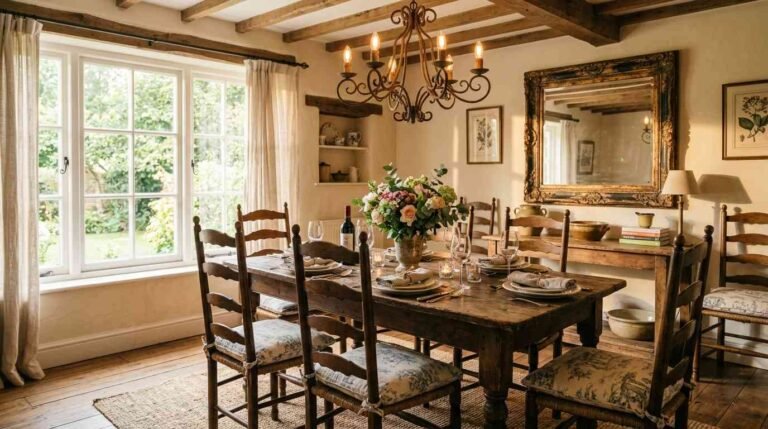
A reclaimed table sets the tone for everything else in the room. The knots, nail holes and colour changes in old pine give the table a history that a new flat top cannot copy. Set it in the middle of the room with 36 inches clear behind each chair, so people can pull out their chairs without hitting the wall.
Live with the table bare for a week before you add a runner, so you can see which side of the wood you like best. The paler side often suits summer, the darker side suits winter. A hand-rubbed oil finish can be patched in spots, which suits a table that gets daily use from a family.
2. Ladder-Back Dining Chairs
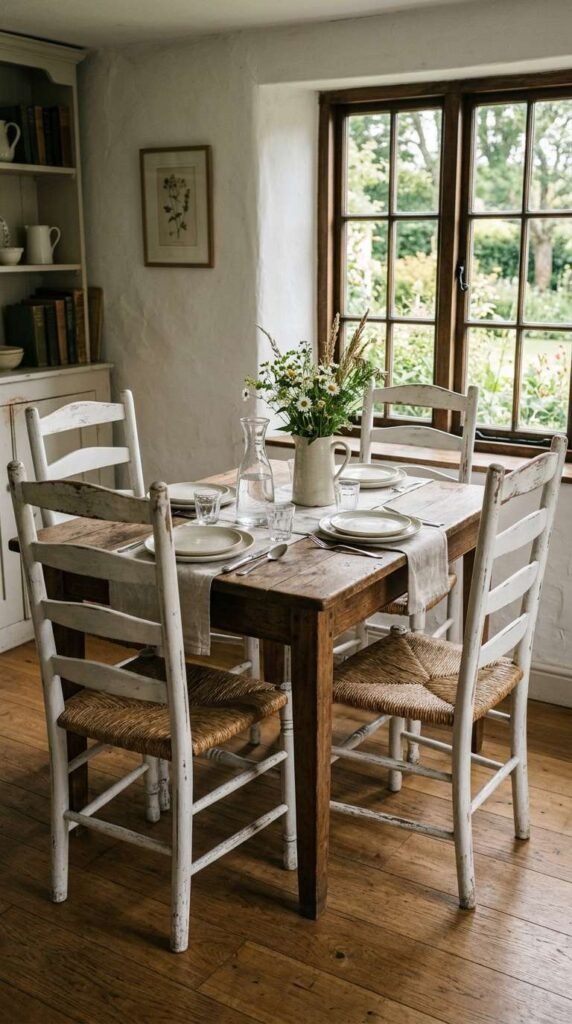
- Choose chairs with three slats, a woven rush or wood seat, and a back 38 inches high from the floor to the top slat.
- Test the seat before you buy six: sit for five minutes, and check that the front rail does not press into the back of your knees.
- Mix a painted cream set with two plain wood chairs at the ends, so the table ends feel a little heavier.
Ladder-back chairs are light to move, easy to store, and built to last. The open slats let light through the room, which keeps a small dining room from feeling solid and closed. A woven rush seat softens the wood, and it can be replaced by a local chair maker if it wears out.
Fix a loose rung with wood glue and a clamp overnight, and tighten the screws under the seat once a year. Add a thin seat pad, 15 inches square and 1 inch thick, tied with cotton tape, if you want more comfort without hiding the rush seat.
3. Shiplap Accent Wall
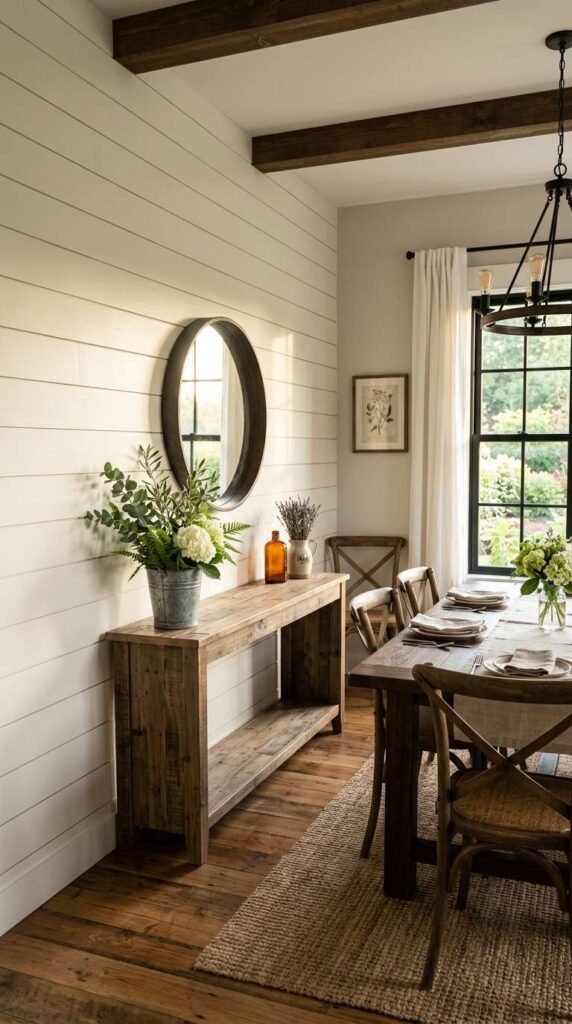
- Fit horizontal shiplap boards, 6 inches wide, on the wall behind the table, from the baseboard to a picture rail 84 inches high.
- Leave a 0.125 inch gap between boards, paint them in a soft white such as alabaster, and use a matte finish so the shadows read.
- Hang one framed print or a small wreath on the boards, centred 60 inches from the floor, so it sits above the table, not beside it.
Shiplap gives the wall behind the table a texture that plain plaster lacks, and it makes the table look finished even when the table itself is bare. Horizontal boards make a narrow room feel wider, while vertical boards make a low ceiling feel taller, so choose the direction to suit your room.
Start at the bottom and work up, checking each board with a 24 inch level. Paint the boards before you fit them, and touch up the nail holes with a small brush afterwards. One wall is enough, because four shiplap walls can make a room feel like a shed.
4. Galvanized Metal Accents
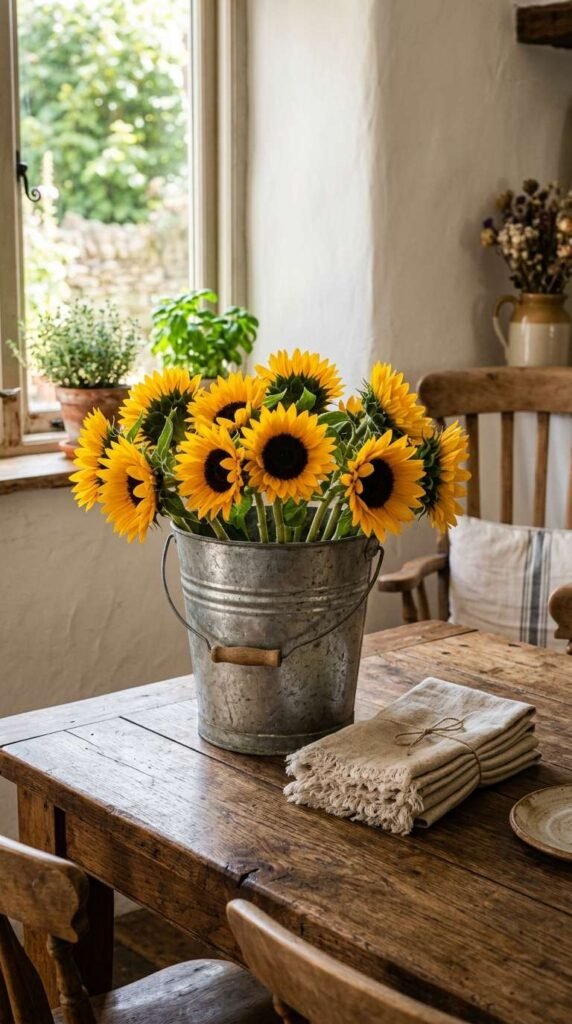
- Repeat galvanised metal in three places: a 12 inch tray, two 4 inch planters, and one 10 inch pitcher.
- Choose a dull zinc finish with a mottled pattern, not a shiny mirror finish, so it looks aged rather than new.
- Line metal planters with a plastic pot and a saucer, so water never sits against the zinc or drips onto the table.
Galvanised metal is the farmhouse counterweight to soft linen and warm wood. A zinc tray in the middle of the table holds candles, salt and a small plant, and stops them sliding when you wipe the table. The grey tone works with both white and green walls, and it does not show fingerprints the way chrome does.
Wipe galvanised pieces with a damp cloth and dry them at once, so water spots do not form. Do not use vinegar or harsh cleaners on zinc, because they strip the coating. If a piece rusts at a seam, rub it with fine steel wool and leave it, as the marks are part of the look.
5. Mason Jar Centerpiece
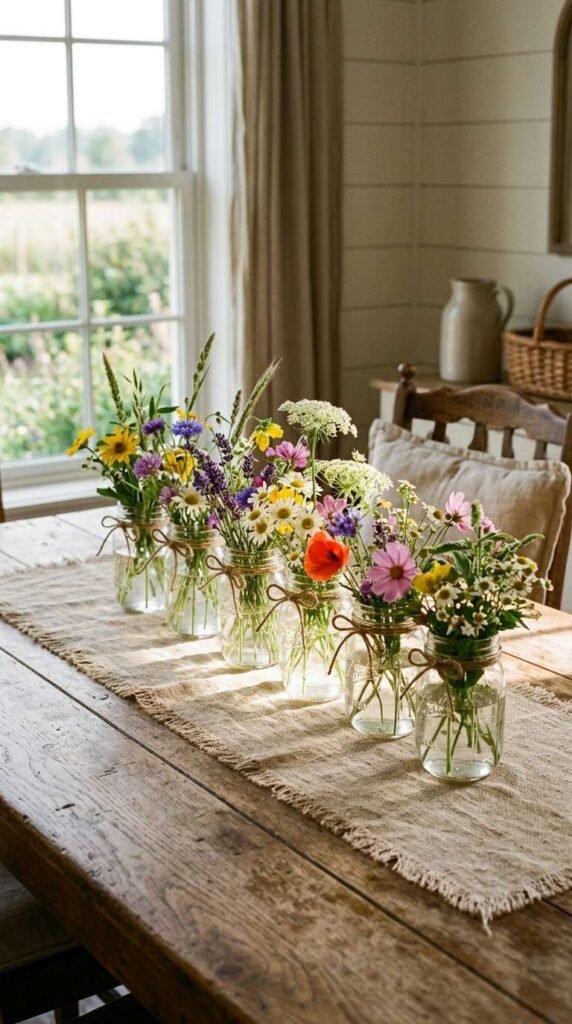
- Set three 16 ounce mason jars in a row, 6 inches apart, on a 24 inch wood board, 1 inch thick.
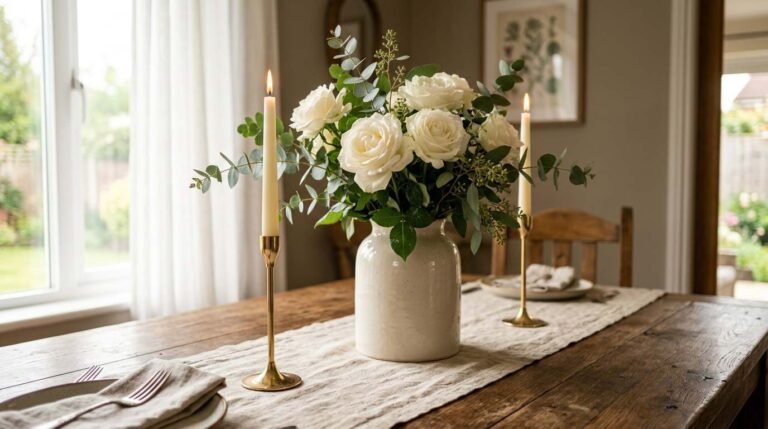
- Fill one jar with water and five stems of eucalyptus, one with dried wheat, and leave the third empty with a tea light inside.
- Tie a 0.5 inch strip of burlap around each jar neck, and knot it at the front with a short tail of 3 inches.
Mason jars are cheap, plain and easy to change, which is why they last in a farmhouse room. The row of three reads as one centrepiece, and the board lets you lift the whole thing off the table in one move when you need space for a large dish. Change the stems with the season, and the jars stay the same.
Use regular mouth jars for stems, because wide mouth jars tip more easily on a tray. Change the water every three days, and trim 0.5 inch off each stem at an angle when you refill. The tea light jar gives a low glow in the evening without any wiring.
6. Woven Rattan Pendant Light
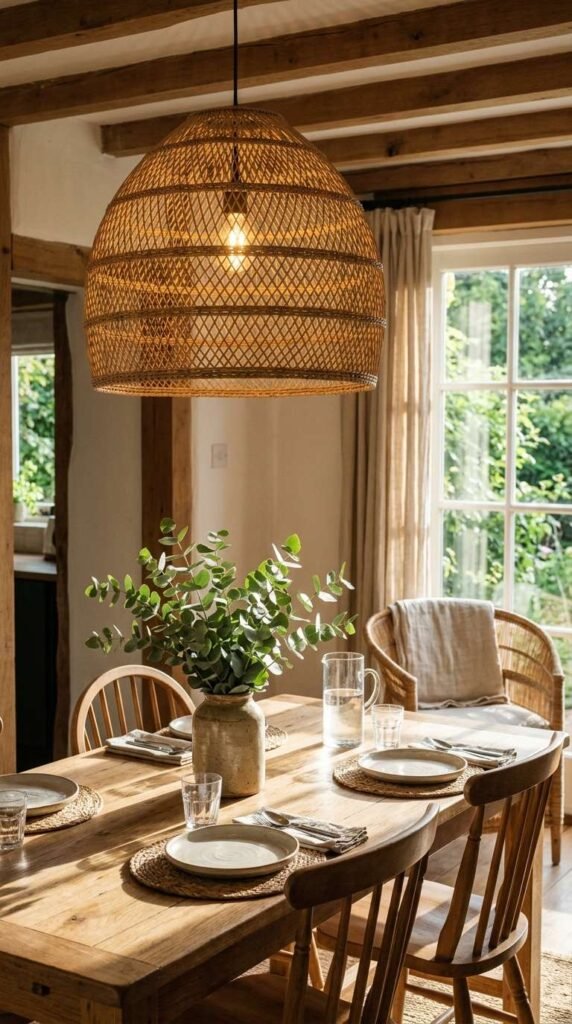
- Hang a rattan shade, 18 inches wide and 12 inches tall, so the bottom of the shade sits 30 to 34 inches above the tabletop.
- Fit a warm white bulb, 2700 Kelvin and 800 lumens, with a dimmer switch on the wall, so you can lower the light at supper.
- For a table longer than 72 inches, hang two shades, 36 inches apart, centred over the table, not over the room.
A rattan pendant throws a soft, patterned light across the table, and the shade itself adds a warm, woven texture above the wood. It is light enough to hang from a standard ceiling hook, and it casts a shadow that changes as the bulb is dimmed. Keep the chain or cord short and straight, so the shade hangs level.
Dust rattan with a soft brush once a month, and keep it away from steam from a kettle or a hot pot. If a strand works loose, tuck it back in and fix it with a small dab of clear glue on the inside of the shade.
7. Vintage Farmhouse Sign
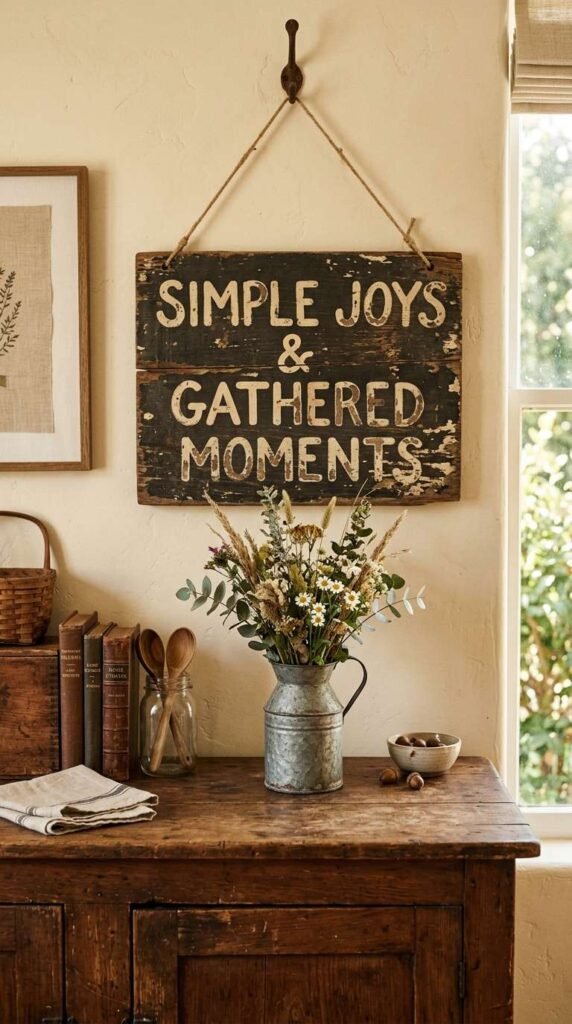
- Hang one wood sign, 24 inches wide and 12 inches high, on the wall above the sideboard or buffet, centred on the table.
- Choose painted lettering in cream on a dark wood board, with letters 2 inches tall, so the words read from the far end of the room.
- Fix it with two picture hooks, 16 inches apart, and a small felt pad behind each bottom corner so it does not mark the wall.
One sign is enough. It gives the room a focal point above the table, and the painted wood ties in with the tabletop. A short phrase in a plain serif font suits a farmhouse room better than a long quote in script, because it can be read at a glance. The sideboard below the sign is also the place for a lamp, a stack of plates and a small plant, and you can find more dining room buffet decor ideas you will truly adore to finish that surface.
Hang the sign 12 inches above the sideboard top, and 60 inches from the floor to its centre, so it sits at eye level when you are standing. Dust the board with a dry cloth, and keep it out of direct sun, because painted wood fades in strong light.
8. Open Shelving Display
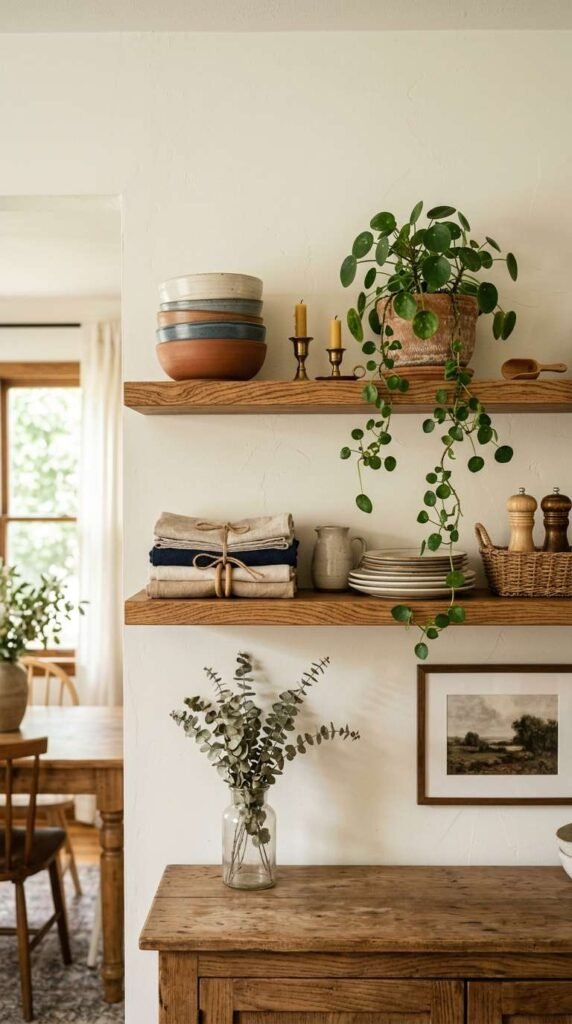
- Fit two pine shelves, each 36 inches long and 10 inches deep, on the wall beside the table, 18 inches apart vertically.
- Use black iron L brackets, 8 inches deep, fixed into wall studs with 2.5 inch screws, so each shelf holds 20 pounds.
- Display four plates, two jars and one small plant per shelf, leaving a third of each shelf empty.
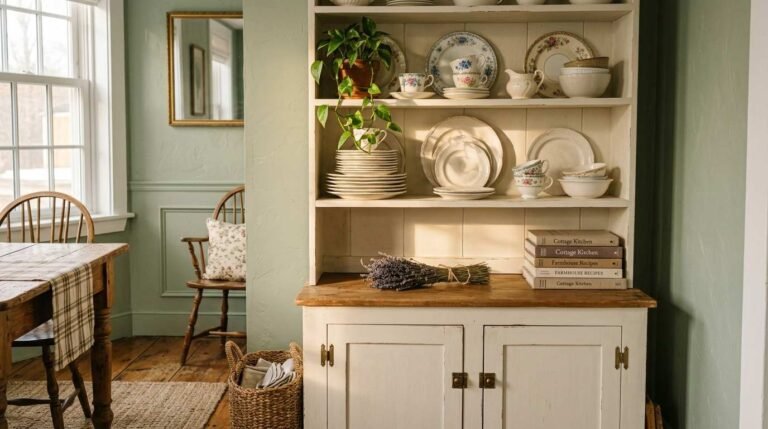
Open shelves work in a farmhouse dining room because the pieces on them are the same pieces you use at the table. White plates, stoneware mugs and glass jars look good on a pine shelf, and you can reach them without opening a cupboard. Keep the shelves neat, and the wall feels styled; stack them full, and it feels like a storeroom.
Group items in odd numbers, and put the tallest piece at one end of the shelf. Wipe the shelf tops weekly, because open shelves collect dust from cooking. Store the pieces you use less often on the higher shelf, and the daily plates on the lower one.
9. Cross-Back Dining Chairs
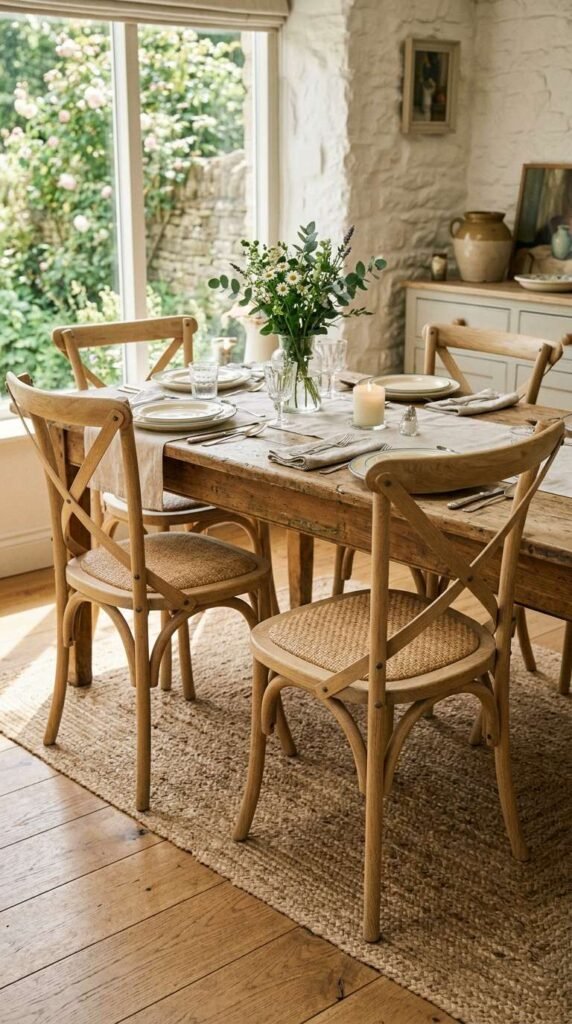
- Choose cross-back chairs in washed oak or painted cream, with a seat 18 inches high and 16 inches wide.
- Check the cross joint: it should be glued and pinned, with no wobble when you press the top of the chair back.
- Use chairs with a flat wood seat, and add a linen seat pad, 16 inches square, tied on with two cotton tapes.
Cross-back chairs are the classic farmhouse chair, and they look right with both a plank table and a painted table. The X shape on the back is strong, and it keeps the chair light in the room, because you can see through it. They also stack well against a wall when you need extra floor space.
Keep spare chairs in a dry room, not a damp garage, so the joints do not loosen. Tighten any bolt under the seat with a hex key once a year. A washed oak finish shows scratches less than a painted finish, which helps in a house with children.
10. Dining Room Buffet Decor Pairing
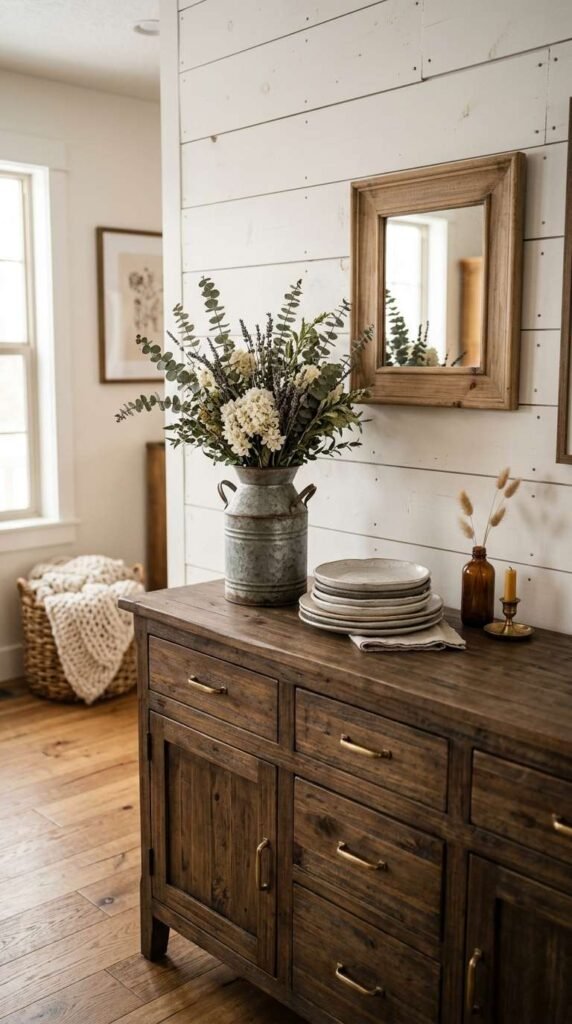
- Place the buffet, 48 inches long and 18 inches deep, against the wall 36 inches from the end of the dining table.
- Set a lamp, 20 inches tall with a linen shade, at the left end, and a stack of three cookbooks at the right end.
- Put a low bowl of green apples, 10 inches wide, in the middle, so the buffet has height at the ends and a low centre.
A buffet is the farmhouse workhorse beside the table. It holds extra plates, serves as a drinks station, and gives you a surface to style. The lamp at one end and the books at the other frame the middle, and the low bowl of fruit keeps the centre calm. Keep the top clear of clutter, and the buffet reads as part of the dining room, not as extra storage.
Serve food from the buffet for a large meal, and keep serving spoons in a stoneware jug on top so guests can help themselves. Wipe the top after each meal, and store table linen in the top drawer, folded in thirds, so it is easy to reach.
11. Neutral Linen Curtains
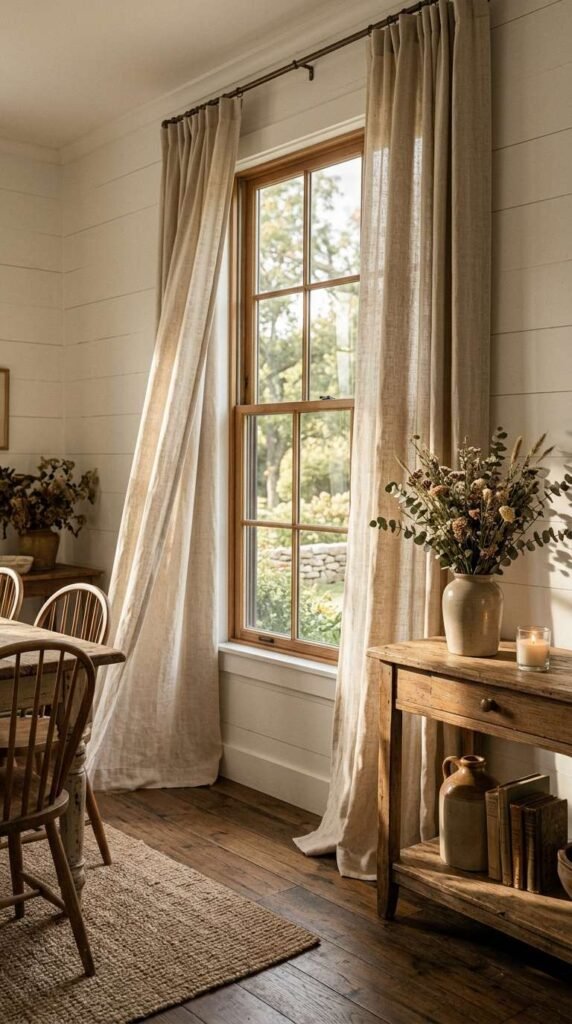
- Hang linen curtains in natural or oatmeal, with panels 54 inches wide, on a black iron rod fixed 4 inches above the window frame.
- Make the panels long enough to touch the floor, with a 1 inch break, and use 8 to 10 rings per panel so they slide easily.
- Leave the curtains drawn to the sides of the window during the day, not closed, so the table gets full daylight.
Linen curtains soften a farmhouse dining room without adding a pattern. The fabric filters light, drops in soft folds, and sways a little when a door opens, which makes the room feel lived in. A natural oatmeal shade works with white, pine and black, and it does not compete with a plaid runner on the table.
Wash linen curtains on a gentle cycle and hang them damp on the rod, because they straighten as they dry. Iron only the hems, and let the rest of the fabric keep its slight wrinkles, which are part of the look.
12. Wire Basket Storage
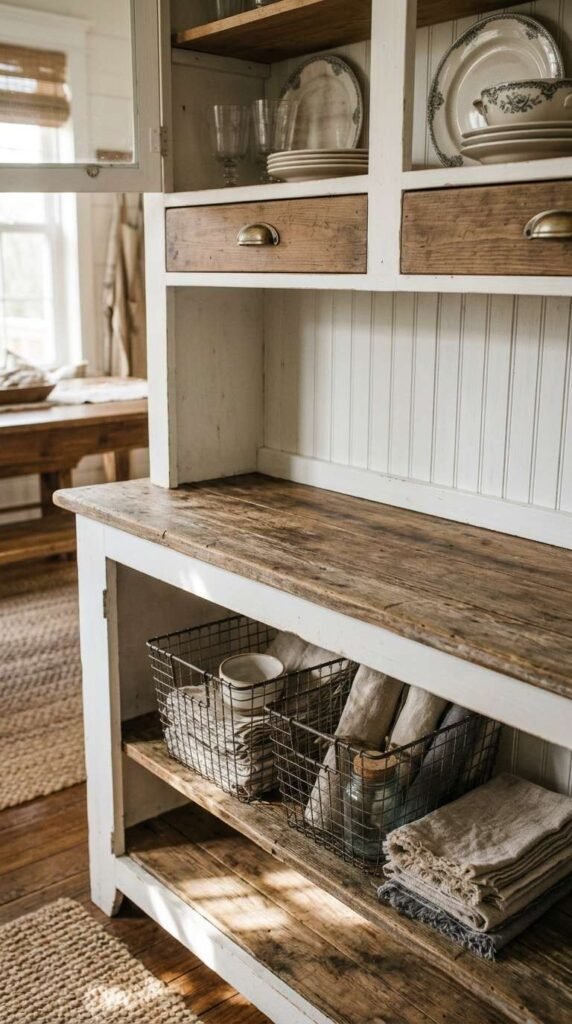
- Use two wire baskets, each 14 inches long, 10 inches wide and 8 inches tall, on the buffet or on a shelf beside the table.
- Line each basket with a folded tea towel, so small items do not fall through the wires, and label each one with a small paper tag.
- Keep one basket for napkins and one for placemats, folded in thirds, so you can set the table without opening a drawer.
Wire baskets give a farmhouse room honest storage that you can see into. They hold cloth, candles and fruit, and they stack when they are empty. On a buffet shelf, two baskets at the same height look tidy, and the black wire matches iron brackets and light fittings in the room.
Wipe wire baskets with a dry cloth, and dry them at once if they get wet, so rust does not start at the joints. Replace a torn tea towel liner with a fresh one, and keep the tags short, one word each, so the baskets are easy for children to use.
13. Distressed Wood Bench
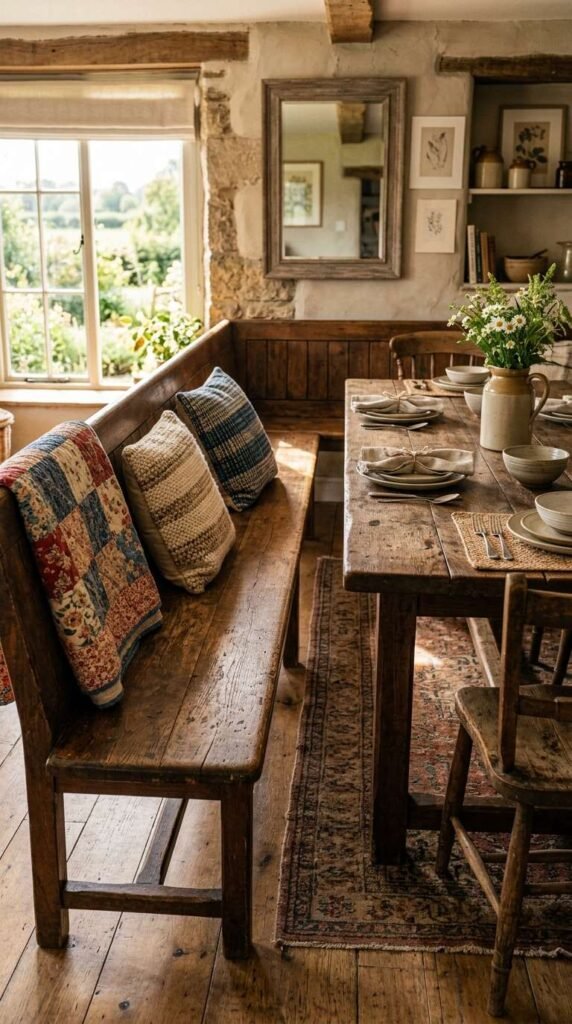
- Place a bench, 60 inches long, 12 inches wide and 18 inches high, along one side of a 72 inch table, leaving 6 inches clear at each end.
- Choose wood with a distressed white paint finish, sanded back on the edges, so the pine shows through in thin lines.
- Add a folded plaid throw, 50 inches by 30 inches, on the bench seat, so the hard wood feels softer to sit on.
A bench changes how a dining table works. Children can squeeze in beside each other, and the bench slides under the table when it is not in use, which frees floor space. The distressed paint makes it look old even when it is new, and the marks it picks up over time only add to that look.
Check that the bench legs are set in 6 inches from each end, so it does not tip when someone sits on the edge. Clean it with a damp cloth and a mild soap, and touch up chipped paint with a small brush and the same colour, thinly applied.
14. Cozy Plaid Table Runner
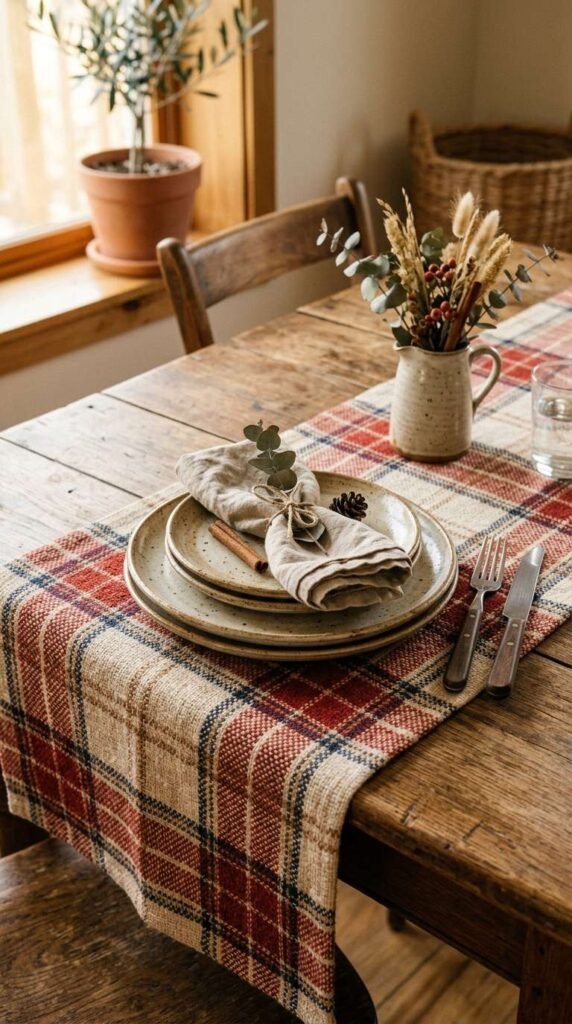
- Choose a cotton plaid runner, 14 inches wide, in red, black and cream, that hangs 8 inches over each end of the table.
- Press it, then lay it straight down the centre, smoothing it from the middle out to the ends so the check stays even.
- Set a wood board or a galvanised tray on the runner to hold the centrepiece, so candles sit steady on the cloth.
Plaid is the farmhouse pattern. A red and black check on a pale wood table is bold enough to carry the room on its own, and it needs little else beside it. Plain white plates and clear glasses let the runner do the talking, and a small green plant at the centre softens the straight lines of the check.
Wash a plaid runner in cold water, and hang it to dry, so the red does not run into the cream. Fold it in half for a narrow table, or use two runners side by side on a wide table, leaving a 2 inch gap of wood between them.
15. Black Metal Light Fixture
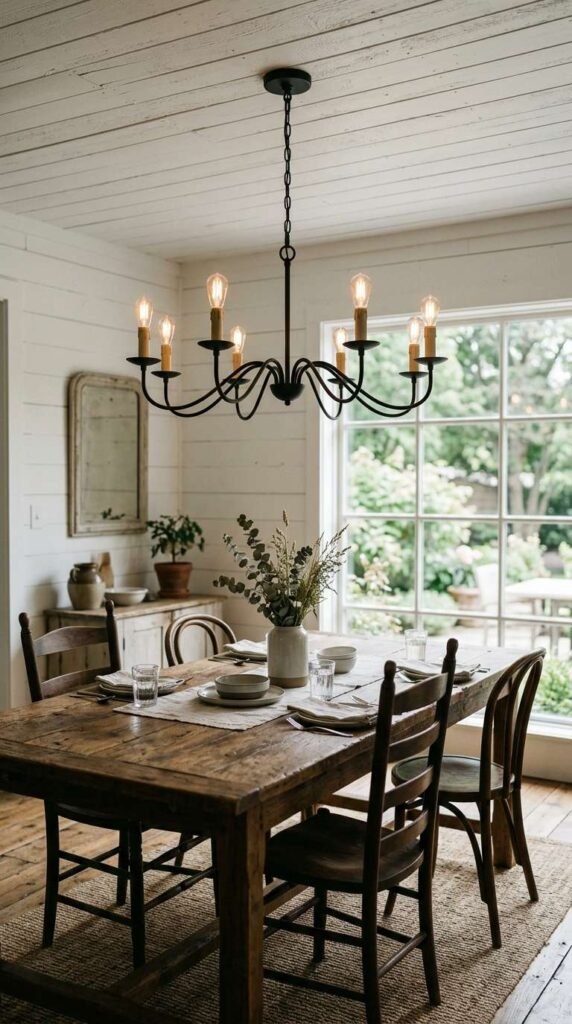
- Fit a black metal dome or cage fixture, 20 inches wide, centred over the table, with the bottom 32 inches above the tabletop.
- Use an Edison style bulb, 60 watts or its LED equivalent, at 2700 Kelvin, so the light is warm and the filament shows.
- Clean the fixture with a dry cloth once a month, and check that the shade is fixed tight, because a loose shade rattles.
Black metal is the hard edge that stops a farmhouse room from looking too soft. A dark fixture above a pale wood table gives the room a clear focal point, and the warm bulb inside keeps the light from feeling cold. It pairs well with black shelf brackets, black chair frames and a black iron curtain rod.
Fit the light on a dimmer, so you can lower it for supper and raise it for homework. If your ceiling is low, choose a flush mount, not a hanging fixture, so no one bumps their head when they stand up from the table.
16. Farmhouse Window Trim
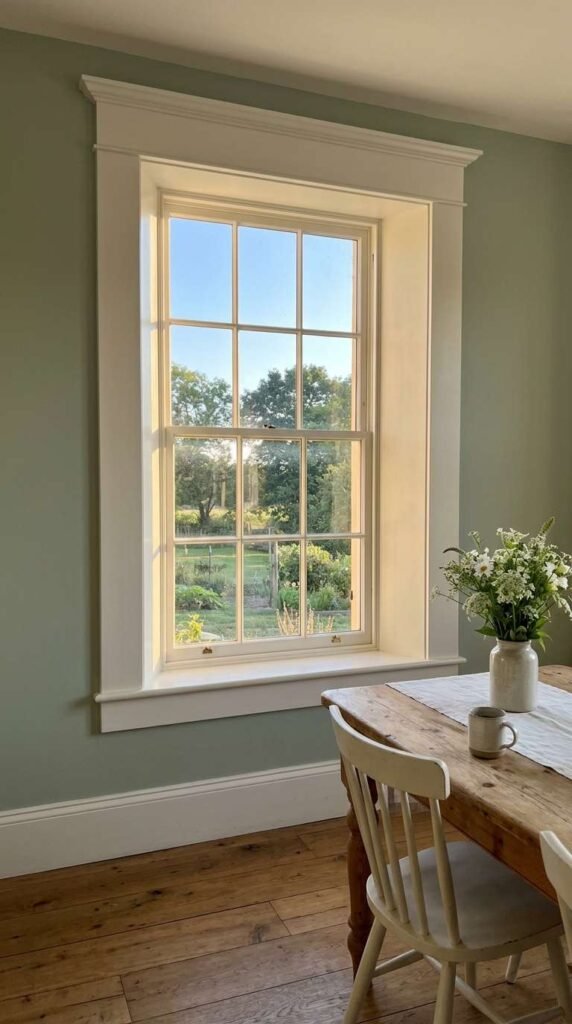
- Fit wide trim, 3.5 inches across, around the dining room window, in painted white pine, with a small sill that sticks out 1.5 inches.
- Paint the trim the same white as the skirting boards, in a satin finish, so it wipes clean.
- Set a small potted herb, in a 4 inch terracotta pot, on the sill, and keep the window clean so the light falls on the table.
Wide trim frames a window the way a frame holds a picture. It makes a standard window look made, and it gives the dining room a finished edge, even when the curtains are open. The deep sill is also a useful spot for a herb pot or a small candle, right beside the table.
Measure the window twice before you cut the trim, and fit the top piece first, then the sides, so the joints are tight. Fill any gaps with paintable caulk, and paint the caulk once it has dried for a clean line.
17. Dried Wheat and Wildflower Bouquet
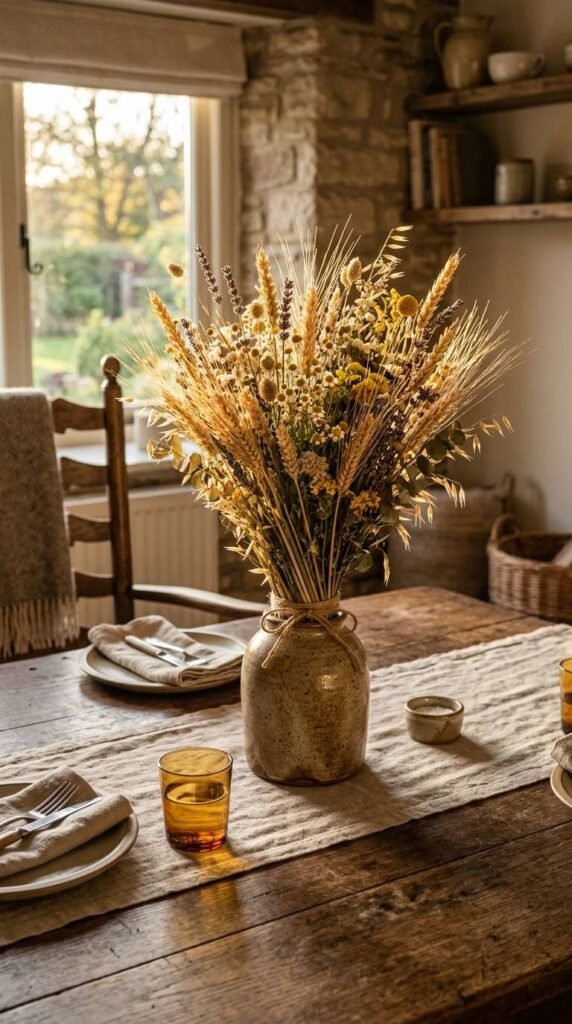
- Cut 15 stems of dried wheat, 18 inches long, and 10 stems of dried wildflowers, 14 inches long, and mix them in a stoneware pitcher.
- Use a pitcher, 8 inches tall and 5 inches wide, set in the middle of a 24 inch wood board on the table.
- Spread the stems out in a fan, with the tallest wheat at the back and the wildflowers at the front, so the bouquet looks full from every chair.
Dried wheat and wildflowers are the farmhouse bouquet that needs no water. The gold wheat gives height, the small wildflowers give colour, and the stoneware pitcher gives weight, so the bouquet does not tip when someone reaches across the table. It lasts all season, and it costs little to put together.
Shake the stems outside first, so loose seeds do not fall on the table. Trim any stem that is too long with sharp scissors, and store the bouquet in a tall box between seasons, so the stems do not bend.
18. Antique Dough Bowl Centerpiece
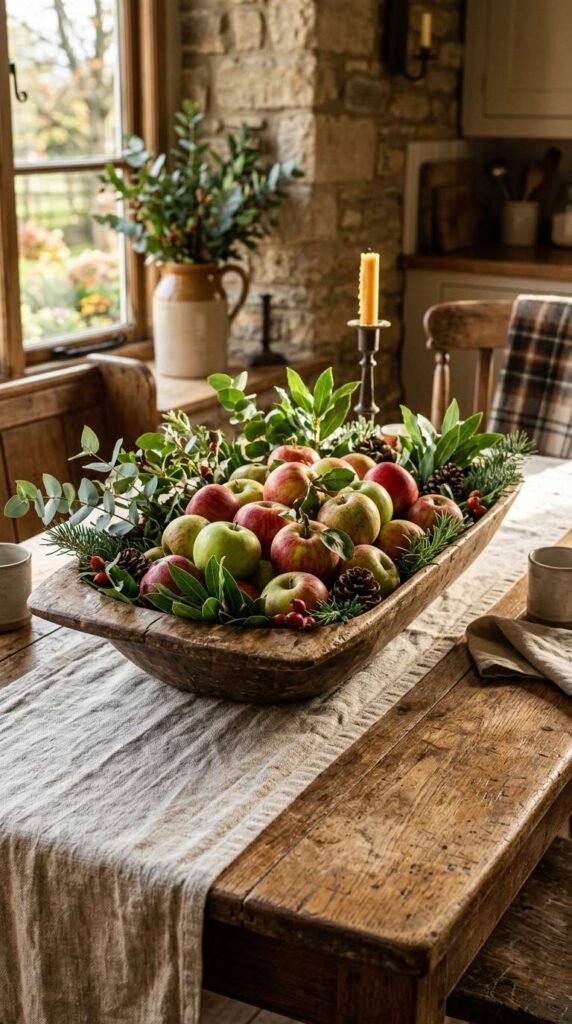
- Choose a carved wood dough bowl, 20 inches long, 8 inches wide and 4 inches deep, with a worn, smooth inside surface.
- Fill it with a line of greenery, such as eucalyptus sprigs, and add three pillar candles, 3 inches wide, in cream.
- Place the bowl in the centre of the table, on a folded linen cloth, so the wood does not scratch the tabletop.
A dough bowl is an old farmhouse tool turned centrepiece. It is long and low, which is the perfect shape for a dining table, because it leaves space for plates at each end and never blocks the view. The wood is warm to the touch, and the greenery inside it stays tidy in the bowl shape.
Check that the bowl is free of cracks before you set candles in it, and use a glass plate under each candle. Change the greenery every two weeks, and oil the bowl twice a year with food safe mineral oil if you also use it for serving bread.
19. Barn Door Accent
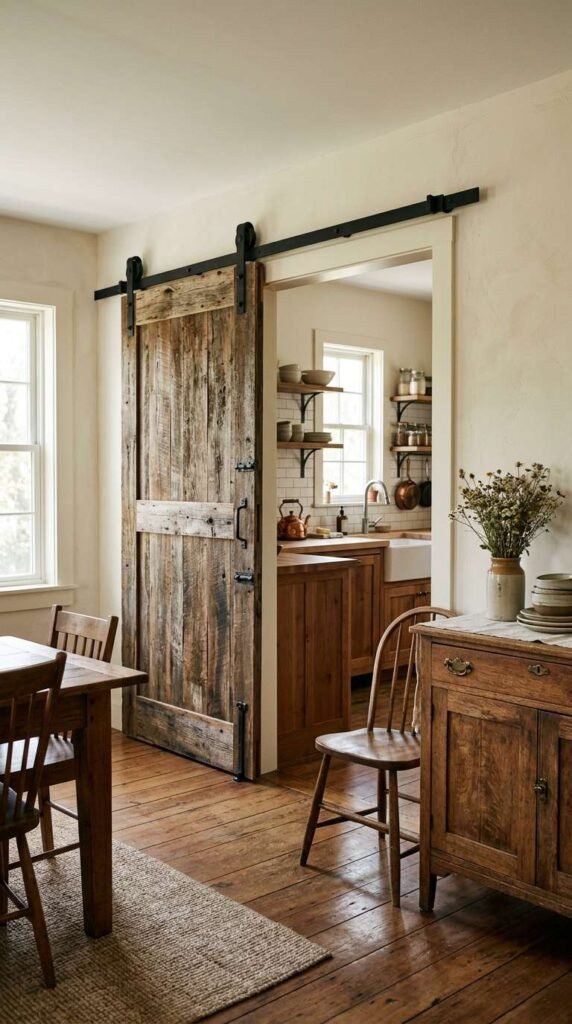
- Fit a sliding barn door, 36 inches wide and 84 inches tall, on a black iron rail fixed 6 inches above the door frame, on the wall beside the table.
- Use a pine door with a Z brace on the front, painted in a soft white or a pale grey, to match the table chairs.
- Leave 36 inches of clear wall beside the doorway, so the door can slide fully open without covering the table.
A barn door adds the biggest farmhouse statement in a dining room, and it saves floor space because it slides instead of swinging. The rail and rollers are part of the look, so choose black iron and keep them visible. When the door is open, it sits flat against the wall, and the dining room feels larger.
Check that the wall can take the rail, fixing it into studs with 3 inch screws, because a solid pine door is heavy. Oil the rollers twice a year, and fit a small floor guide, so the door does not swing out at the bottom.
20. Stoneware Pitcher Display
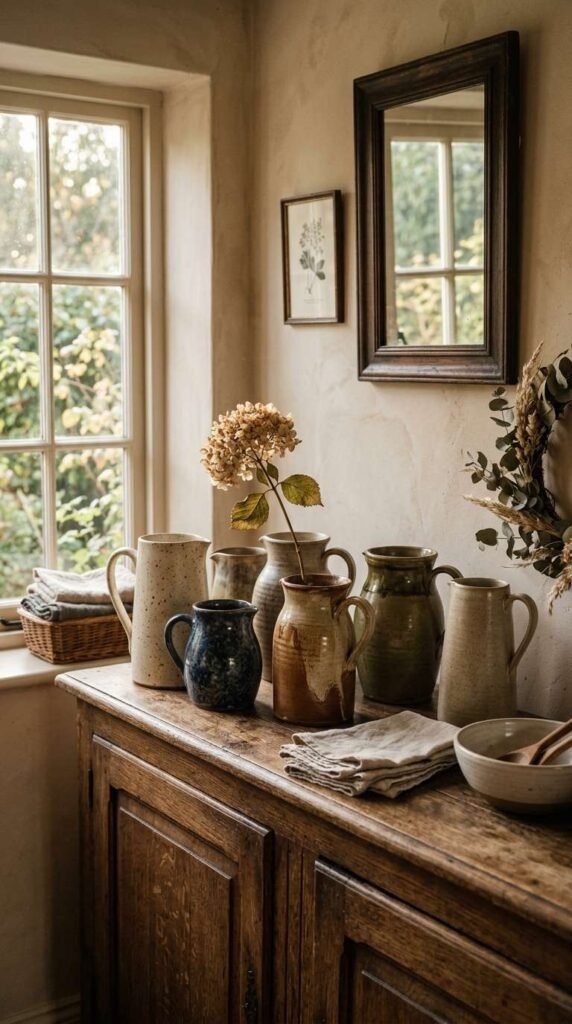
- Set a stoneware pitcher, 10 inches tall and 6 inches wide, at the centre of the table, with five stems of dried lavender inside.
- Use a pitcher in cream or sage, with a matte glaze and a small spout, so it looks handmade, not factory made.
- Add a second smaller pitcher, 7 inches tall, on the buffet, filled with water for the meal, so the pair matches without being identical.
A stoneware pitcher is both a jug and a vase, which makes it one of the most useful farmhouse pieces on a table. Fill it with water for a meal, or with dried stems when it is not in use, and it never looks out of place. The weight of the stoneware keeps it steady, and the matte glaze picks up the light softly.
Wash a stoneware pitcher by hand, and dry it upside down on a rack, so water does not sit inside. If the glaze crazes with age, keep using it for dry stems, and use a glass jug for drinks instead.
21. Chunky Wood Beam Ceiling
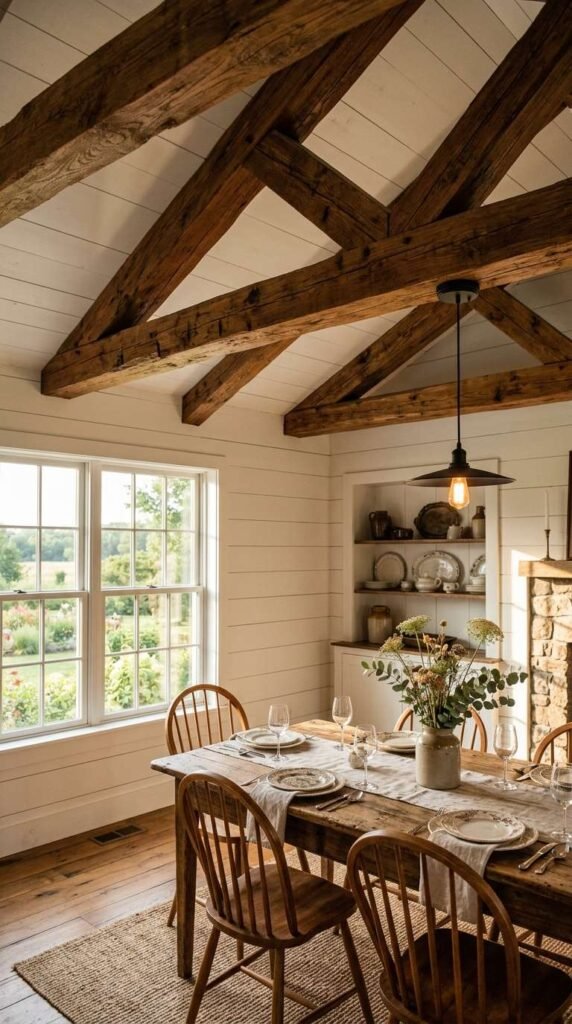
- Fit beams, 6 inches wide and 8 inches deep, across the ceiling above the table, spaced 36 inches apart, in dark stained pine.
- Check the ceiling height first: beams work best in a room with a ceiling 96 inches high or more, so no one feels crowded under them.
- Mount each beam with two 4 inch lag bolts into ceiling joists, and fit a pendant light between two beams, not through one.
Wood beams give a dining room the feel of an old farmhouse, and they frame the table from above. The dark stain contrasts with a white ceiling, and the beams make a large room feel smaller and warmer. They also give you a place to hang a light, a swag of greenery or a drying rack for herbs, right above the table.
Use hollow box beams if your joists cannot take the weight of solid timber, because they look the same from below. Dust the tops with a long handled duster, and check the bolts once a year for any movement.
22. Vintage Scale or Clock Accent
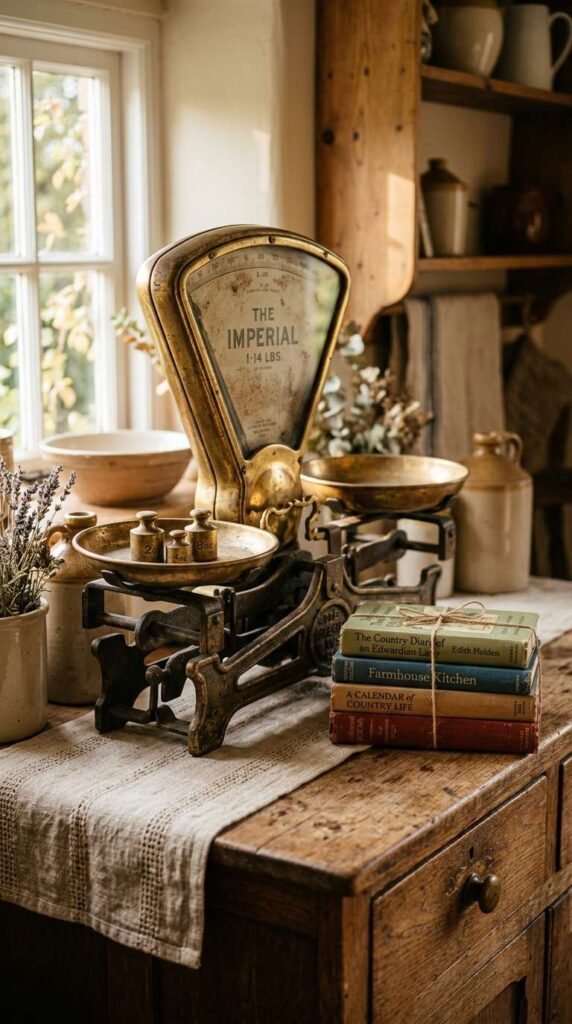
- Place a vintage kitchen scale, 10 inches wide and 12 inches tall, or a wall clock, 18 inches across, on the buffet or on the wall behind the table.
- Choose a piece in cast iron with a cream dial, and check that the clock keeps time or the scale still balances before you buy it.
- Keep the piece at eye level, 60 inches from the floor, and do not crowd it with smaller items around it.
A vintage scale or a large clock adds the farmhouse history that new decor cannot copy. The cast iron patina, the aged numbers and the weight of the piece give the buffet or the wall a focal point. A clock is also practical in a dining room, because everyone can see the time from the table.
Clean cast iron with a dry cloth, and oil it lightly once a year to keep rust away. If a clock does not run, use a new movement kit inside the old case, so the face stays old while the time stays right.
23. Cozy Neutral Paint Palette
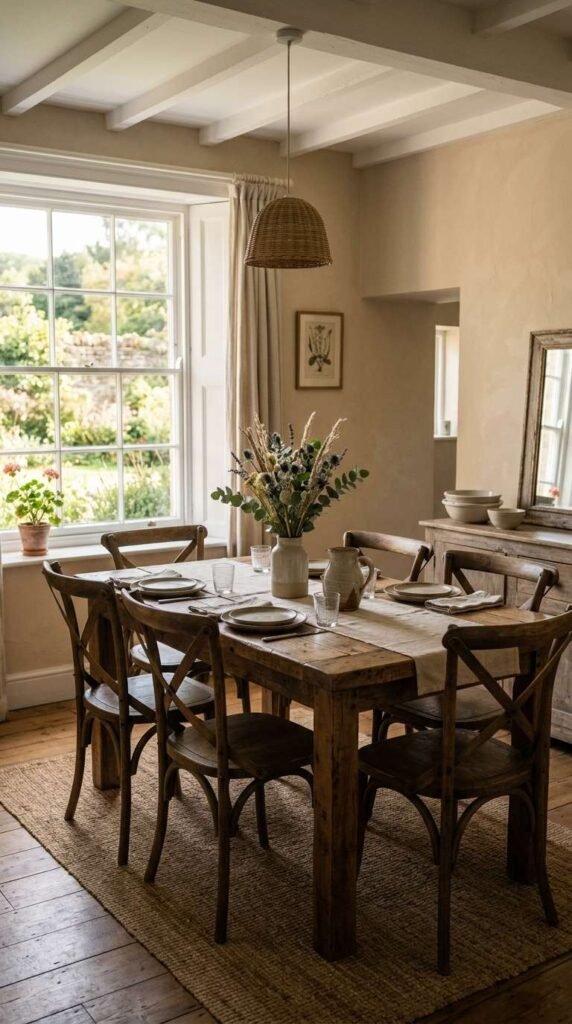
- Paint the dining room walls in a warm white, such as alabaster, and one wall in a pale sage or greige, using a matte finish on the walls.
- Paint the table chairs in the same warm white, but use a satin finish on them, so they wipe clean after meals.
- Test a colour with a 12 inch painted square on the wall, and look at it in morning, noon and evening light before you commit.
A neutral palette is what lets the farmhouse pieces work. Warm white walls make reclaimed wood, plaid and galvanised metal stand out, while a pale sage or greige wall adds a little colour without making the room feel dark. The same white on the chairs ties the table set together, even if the chairs were bought at different times.
Paint the ceiling white first, then the walls, and use two coats on each, letting the first coat dry fully overnight. Keep a small pot of each colour for touch ups, and label the lids with the room name and the date you painted it.
Farmhouse Dining Room Decor Ideas: Frequently Asked Questions
What is farmhouse dining room decor?
Farmhouse dining room decor uses natural wood, linen, metal and simple, lived in pieces. Reclaimed pine tables, ladder back chairs, mason jars, plaid runners and galvanised metal are the core pieces, in white, cream, black and wood tones.
How can I decorate my farmhouse dining room table?
Start with a plaid or linen runner, add a low centrepiece such as a dough bowl, mason jars or a wood board with candles, and keep the centre under 12 inches high. Finish with plain stoneware plates and linen napkins, so the table stays usable.
What colours go with farmhouse dining room decor?
Warm white, cream, sage, greige, black and natural pine work best, with rust or red plaid as an accent. Keep one accent colour, repeat it in two or three places, and keep the rest neutral.
How do I make a small farmhouse dining room feel larger?
Use a bench on one side, ladder back or cross back chairs that you can see through, a light wall colour, and a mirror or light curtains. Keep the table edges clear, and choose one statement piece instead of several small ones.
What can I use as a farmhouse dining room centrepiece?
A dough bowl with greenery and candles, three mason jars on a wood board, a stoneware pitcher with dried stems, or a galvanised tray with a plant and candles all work. Each lifts off in one piece when you need the table.
Are farmhouse dining rooms still popular?
Yes, because the style uses plain materials and pieces that last. A wood table, iron light and linen cloth suit many homes, and the neutral base makes it easy to change the runner, flowers or plates with the season.
How do I decorate a farmhouse dining room on a budget?
Start with what you have: a plain wood table, jars from the kitchen, a plaid cloth, and dried wheat or stems from the garden. Add one bought piece at a time, such as a rattan light or a dough bowl, and paint existing chairs rather than replacing them.
Pick three ideas from this list and try them this weekend. A plaid runner, mason jars on a wood board and a stoneware pitcher with dried wheat will change your table in an afternoon, for very little cost. Save this guide on Pinterest, and add the next pieces as you find them, so the room grows slowly and looks lived in, not bought in one day.