Your front door is the first thing guests see and the last thing they remember, so front porch christmas decor deserves more than a wreath tossed on a nail. A porch dressed for December feels warm before anyone steps inside, and it photographs beautifully from the street. The trick is sizing everything to the door, because a wreath that is too small looks lost and planters that are too short disappear beside the frame. This list walks through the whole entry, from the wreath and garland to the lanterns, trees and doormat, with real measurements, prices and safety tips for every idea. Pick one piece to start, add another next weekend, and the whole front of your home will feel like Christmas.
Statement Door Wreath
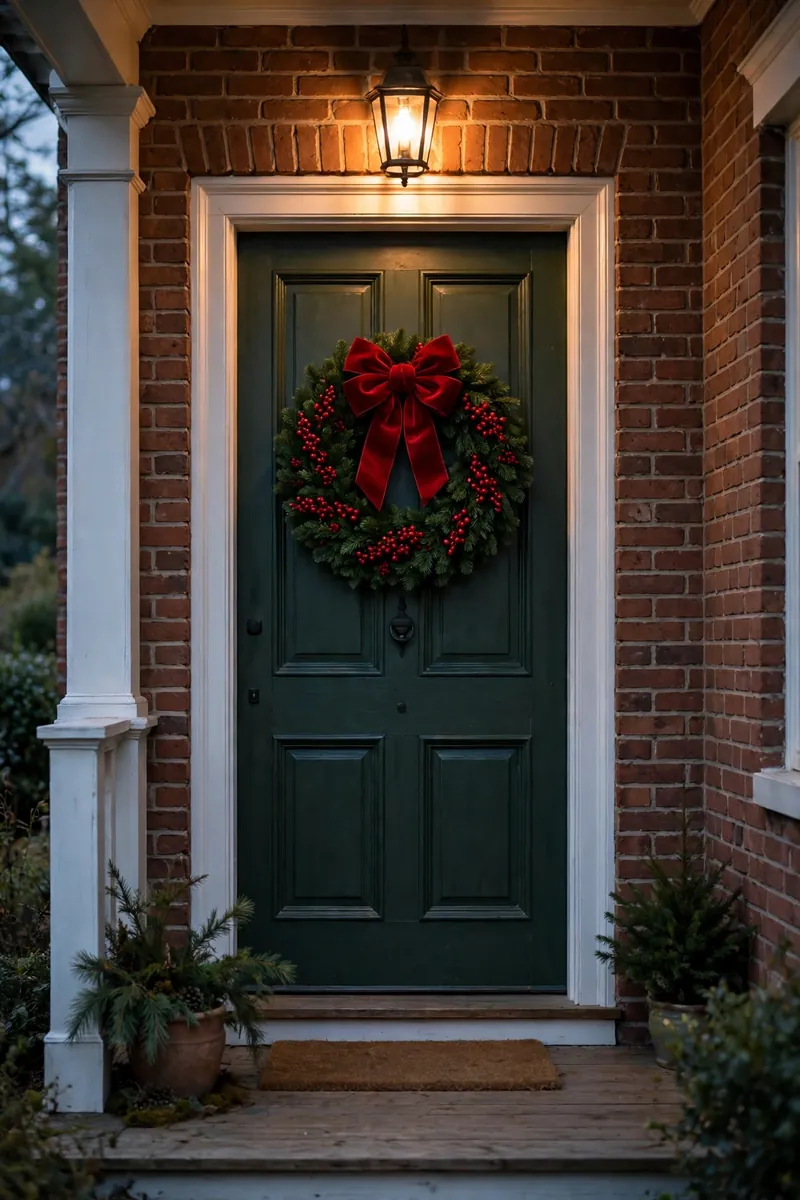
- Choose a wreath about two-thirds as wide as the door, 22 to 24 inches on a standard 36 inch door
- Hang it so the center sits 58 to 64 inches from the floor
- Pick outdoor rated greenery so rain and wind do not ruin it
- Add one wide ribbon bow, not ten small decorations
A wreath that is too small disappears on a front door, and one that is too big crowds the frame, so size is the decision. For a standard 36 inch door, a wreath 22 to 24 inches across covers about two-thirds of the width and reads clearly from the street. Hang it so the center sits 58 to 64 inches from the floor, which is eye level for adults. A 28 inch fresh wreath from Costco costs about 25 dollars, while a 24 inch option at Target runs about 30 dollars, so the best size is the cheapest to find.
The before and after is striking, because a bare door reads as an afterthought while the same door with a full wreath looks ready for guests. Choose greenery rated for outdoor use, since indoor wreaths use adhesives and dyed ribbons that fall apart in rain and humidity. Fresh fir smells wonderful and lasts four to six weeks in cold weather, while faux greenery survives the season and stores for next year. Add one wide wired ribbon bow, at least four inches wide, and skip extra ornaments, because a clean wreath with one strong bow photographs better than a crowded one.
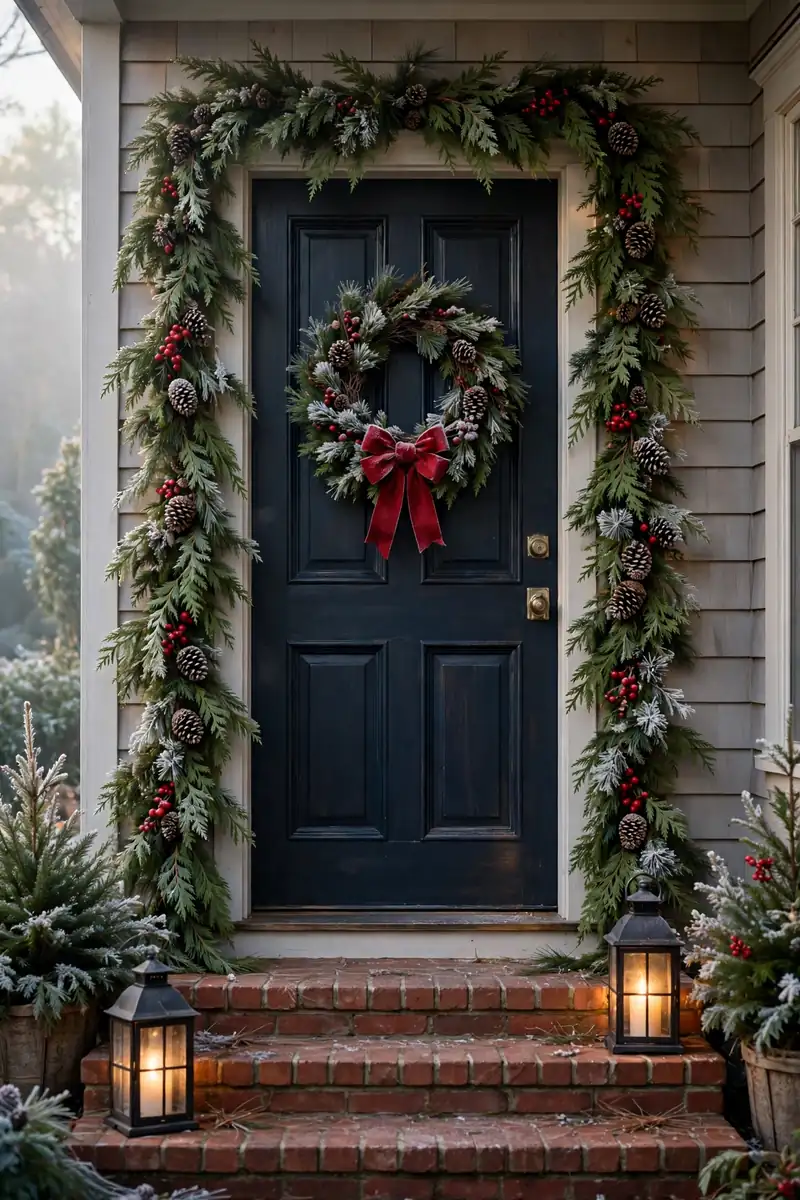
Garland Framed Door
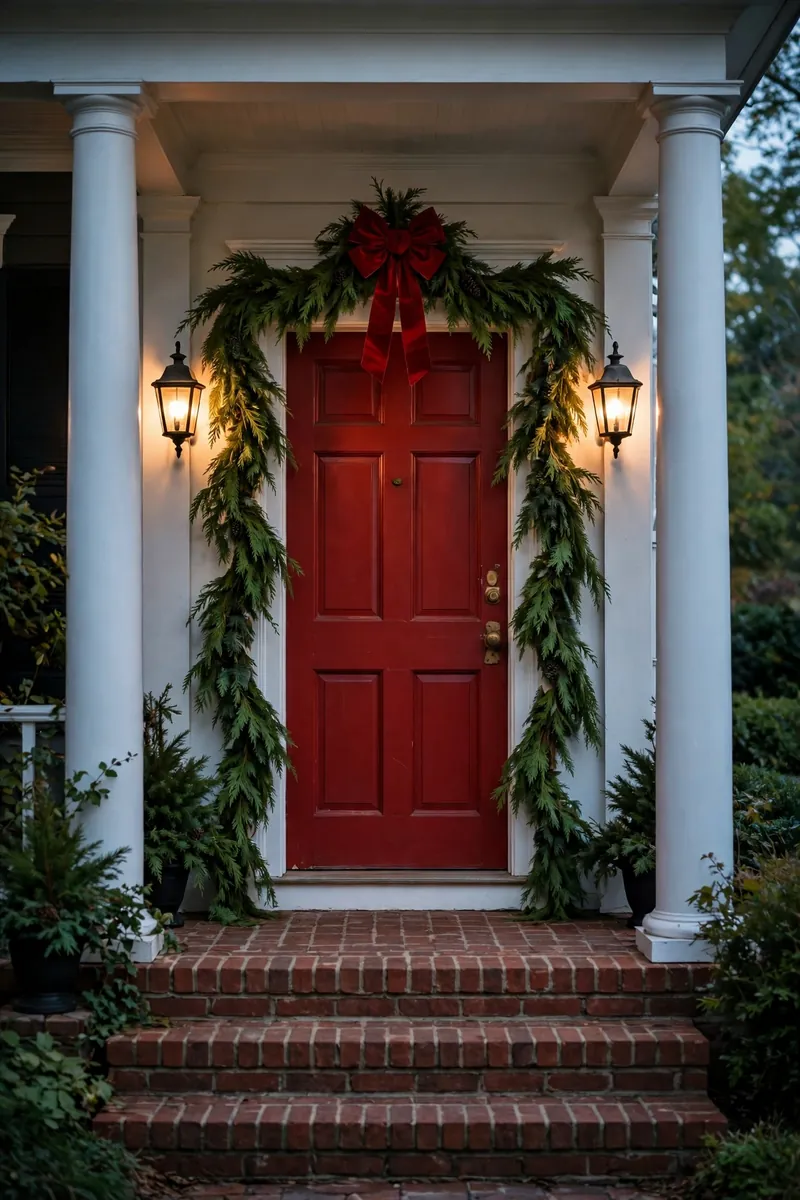
- Measure the door frame first: height twice plus width, about 17 feet for a standard door
- Join two 9 foot garlands at the top for full coverage
- Secure with clear outdoor hooks on painted trim or brick clips on brick
- Let the top dip slightly for a soft swag, 6 to 12 inches extra
Garland around the door frame makes an ordinary entrance look twice as important, and the math is simple. A standard 80 inch door needs the height twice plus the width, which works out to about 17 feet, and adding 6 to 12 inches gives the top a soft swag instead of a tight pull. Two 9 foot garlands joined at the top cover a 36 inch door, since one strand alone always falls short. Buy the longer length when you are between sizes, because extra garland tucks away behind the greenery and short garland cannot stretch.
Hang the garland before the wreath, because the frame sets the shape and the wreath sits inside it. On painted trim, clear outdoor rated adhesive hooks hold without holes, and on brick, clips that grip the mortar line work without drilling. Faux garland survives a whole season outside, while fresh cedar or pine looks fuller but browns faster in a sunny spot. Trader Joe’s sells a 15 foot fresh cedar garland for about 25 dollars in early December, which covers most of a door frame with a little left over for the railing.
Twin Lit Planters
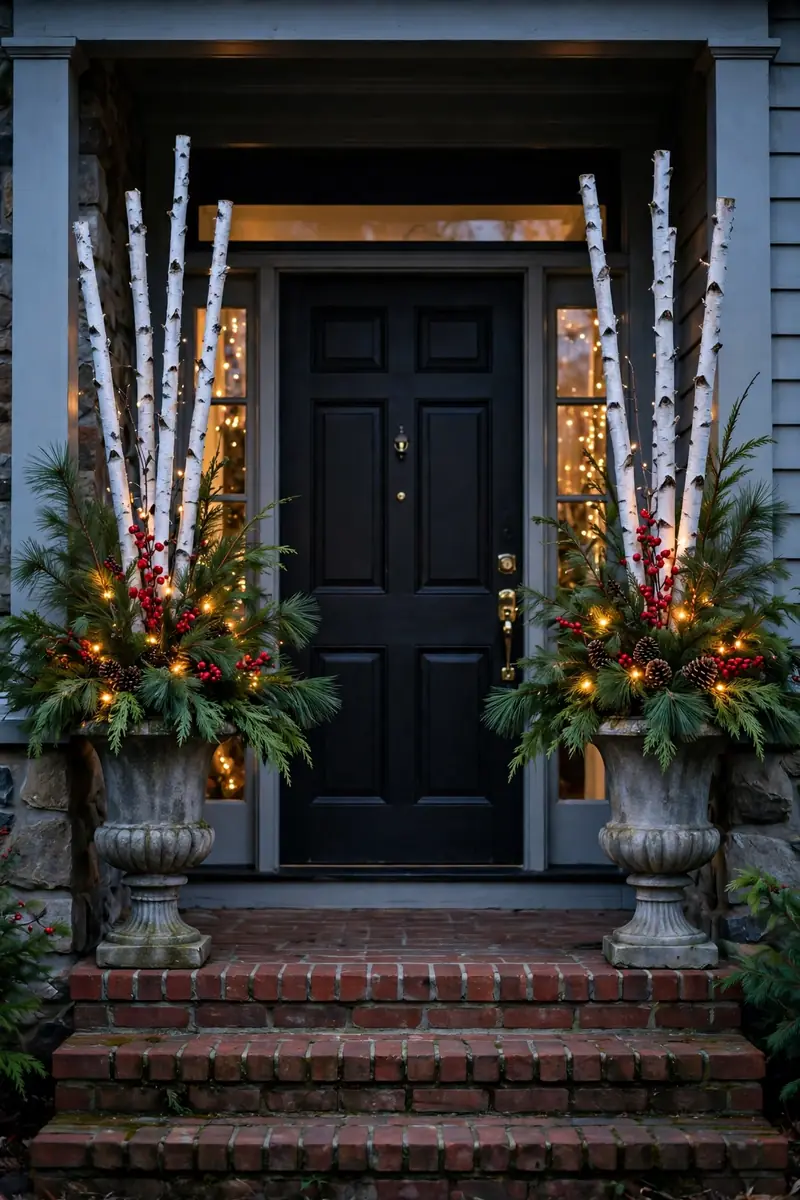
- Place one matching urn on each side of the door for balance
- Choose pots at least 24 inches high so they are not swallowed by the doorway
- Fill so pot plus greenery reaches 4 to 5 feet tall
- Tuck a battery fairy light strand inside the branches for a glow after dark
Two matching planters flanking the door do more for curb appeal than any single decoration, because symmetry makes an entrance feel finished. Pick urns or tall tapered pots at least 24 inches high, since anything shorter gets swallowed by the doorway, and fill them so the pot plus the greenery reaches 4 to 5 feet tall. A pair of stone look urns from HomeGoods costs about 50 dollars for the pair in the fall, and they survive winter without cracking. Stand one on each side of the door, step back to the street, and the entrance suddenly looks balanced.
Fill each planter in layers, tallest in the middle and trailing pieces at the edges, so the arrangement looks full from every angle. Stick two or three white birch poles in the center, surround them with cut evergreen branches, and tuck in red berry sprays and pinecones for color. Birch pole bundles of three cost about 15 dollars at Michaels, and an 8 dollar strand from Target tucked inside the branches makes the planters glow from within after dark. Use a heavy ceramic, metal or thick resin urn, since thin plastic can crack in a freeze.
Lantern Steps Trio
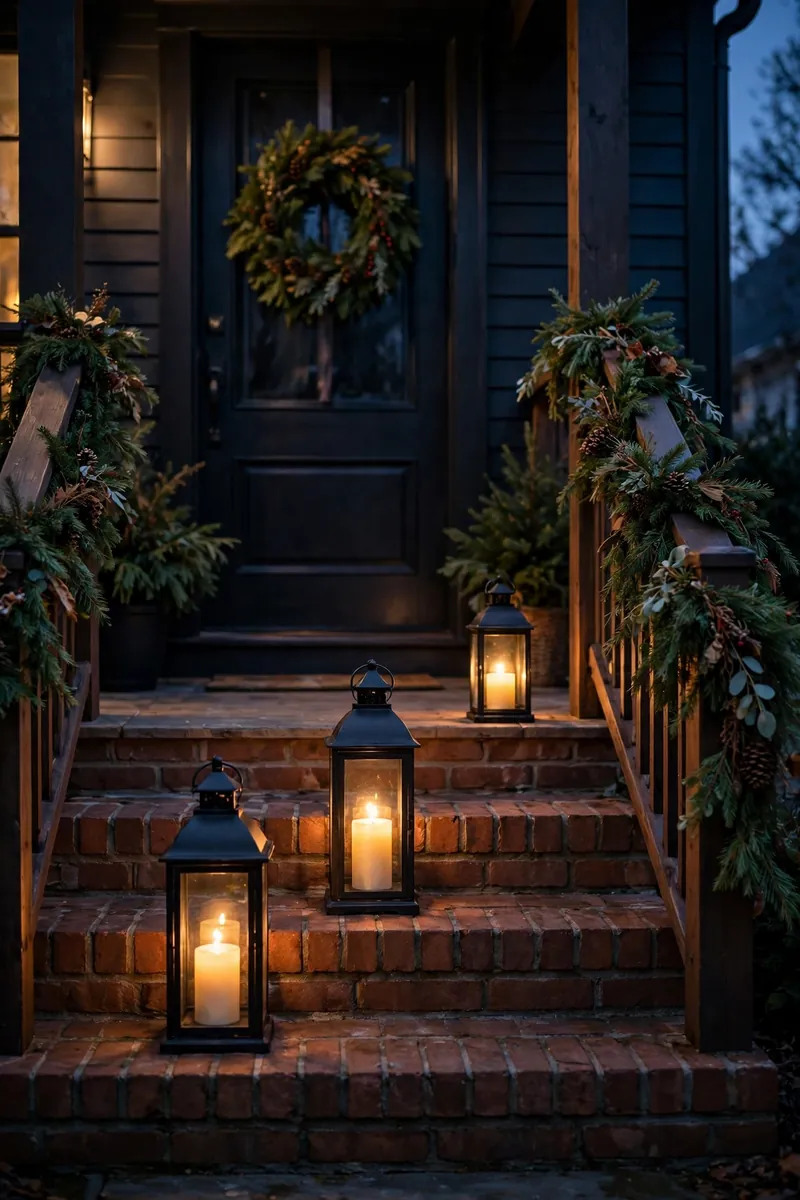
- Group lanterns in threes on the steps, one tall with one or two shorter ones
- Choose lanterns 12 to 18 inches tall so they read from the street
- Use flameless LED candles with a 6 hour timer, never real flames outside
- Set them to one side of the steps so the walkway stays clear
Lanterns on the steps are the warmest light on a porch, and the grouping makes them look intentional instead of random. Choose lanterns 12 to 18 inches tall, since that size reads from the street, and group them in threes, one tall with one or two shorter ones, because a matched row looks stiff. A three piece set in graduated 17, 19 and 22 inch heights costs 56 to 72 dollars, and most sets include flameless LED candles with a remote and a timer. Set the group to one side of the steps so the walkway stays clear.
The timer is the feature that matters most, because lanterns you have to switch on every night go dark by the second week. A 6 hour timer switches the candles on at dusk and off before bed, and the same set repeats the next evening without anyone touching it. Flameless candles never get hot, never blow out in the wind, and never drip wax on the steps, which is why they beat real candles outside every time. Place one lantern on the top step and two on the step below, and the light climbs the stairs like a welcome.
Layered Doormat
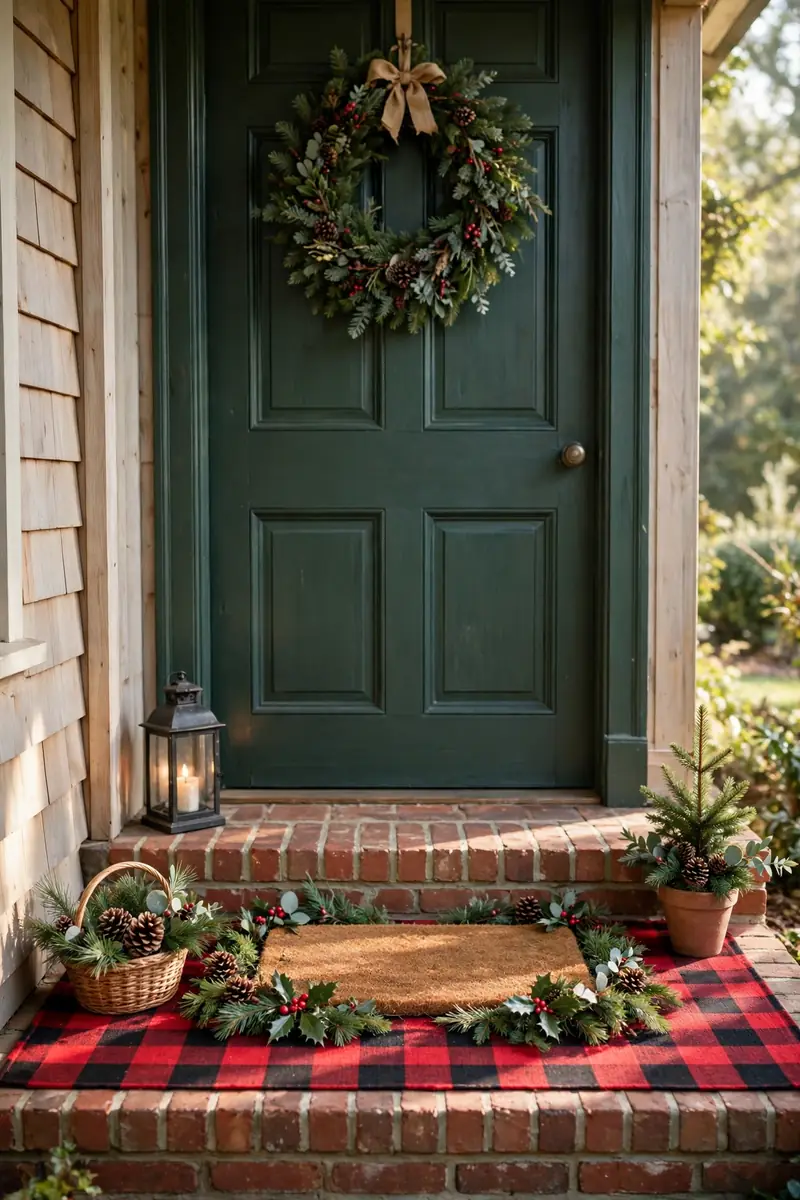
- Lay an 18 by 30 inch coir mat over a 24 by 36 inch plaid base rug
- The base rug leaves a 3 inch border on all sides
- Choose coir for covered porches, synthetic or rubber for uncovered ones
- Fix the top mat with double sided outdoor rug tape so it does not slide
A layered doormat is the cheapest way to style a porch, and the sizing is a simple formula. Lay a standard 18 by 30 inch coir mat over a 24 by 36 inch plaid base rug, which leaves a 3 inch border on all sides, and the two layers read as one piece. A buffalo plaid base rug in red and black is the classic pick, and the whole layered look costs 30 to 100 dollars. The base rug must be at least 6 inches wider and longer than the top mat, or the pattern hides underneath it.
Material matters more than pattern, because a mat that soaks up snow and ice turns into a hazard. Coir comes from coconut husks, scrapes mud and snow off boots well, and resists mildew, but it absorbs melting snow and can freeze solid overnight on an uncovered porch, which is dangerous. For a fully exposed entry, choose synthetic polypropylene or vulcanized rubber instead, which shed water and stay grippy and safe when wet. Fix the top mat to the base with double sided outdoor rug tape, and the layers stay put through every muddy boot in December.
Column Garland Spiral
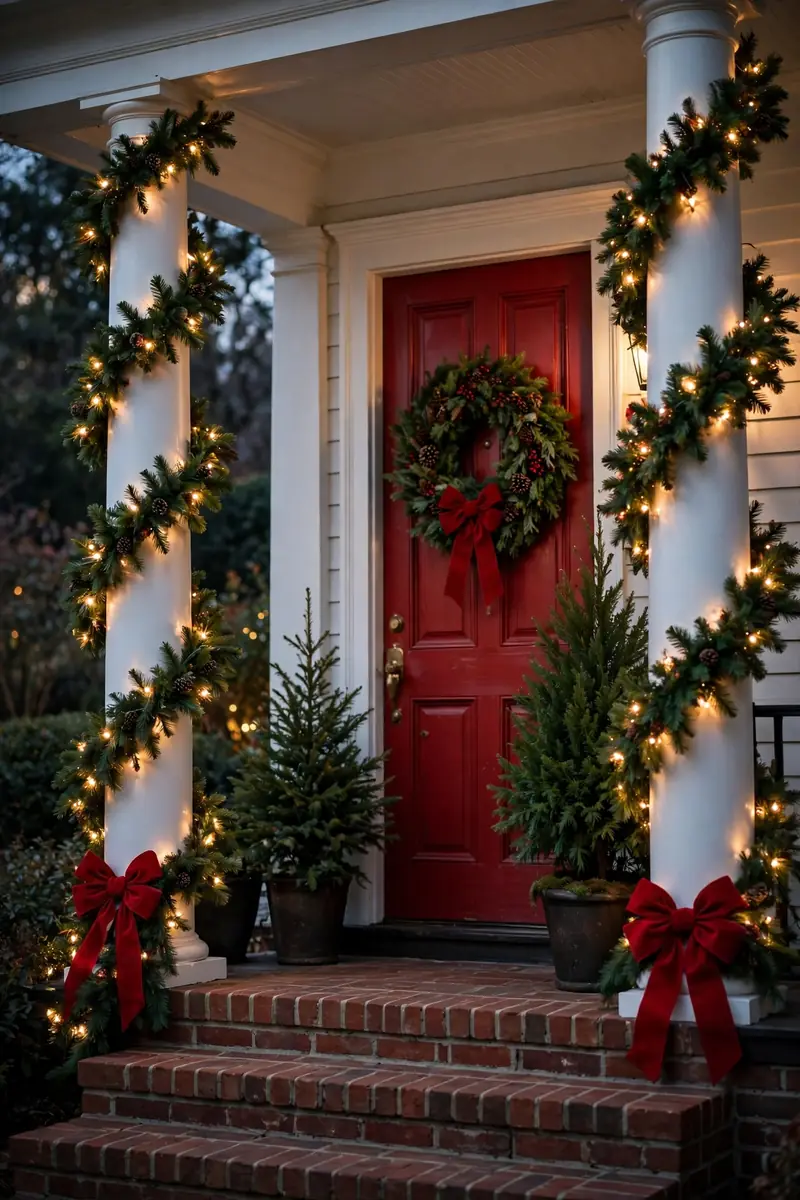
- Spiral garland around each porch column at a 45 degree angle
- Allow 14 to 16 feet of garland for one 8 foot column
- Secure with clear zip ties every 12 to 24 inches, hidden behind the greenery
- Wrap both columns the same way so the porch looks balanced
Garland spiraled around the porch columns is the single biggest transformation you can make to a front entry, because it turns plain posts into part of the display. An 8 foot column takes roughly 14 to 16 feet of garland to spiral generously, which is about 1.8 times the column height, so measure before you buy. Start at the base, secure the end with a clear zip tie, and wind upward at a steady 45 degree angle, keeping about 12 inches between each rotation. The spiral reads as deliberate from the street, while a loose wrap reads as an afterthought.
The ties are the part nobody sees and everybody needs, so use clear zip ties every 12 to 24 inches and tuck them behind the greenery. Weave warm white lights into the garland before you hang it, because threading lights through a wrapped column afterward is a miserable job. Wrap both columns the same way, starting at the same side and spiraling in the same direction, so the porch looks balanced instead of lopsided. When January comes, snip the ties, coil the garland, and the columns go back to plain in ten minutes.
Railing Garland Swag
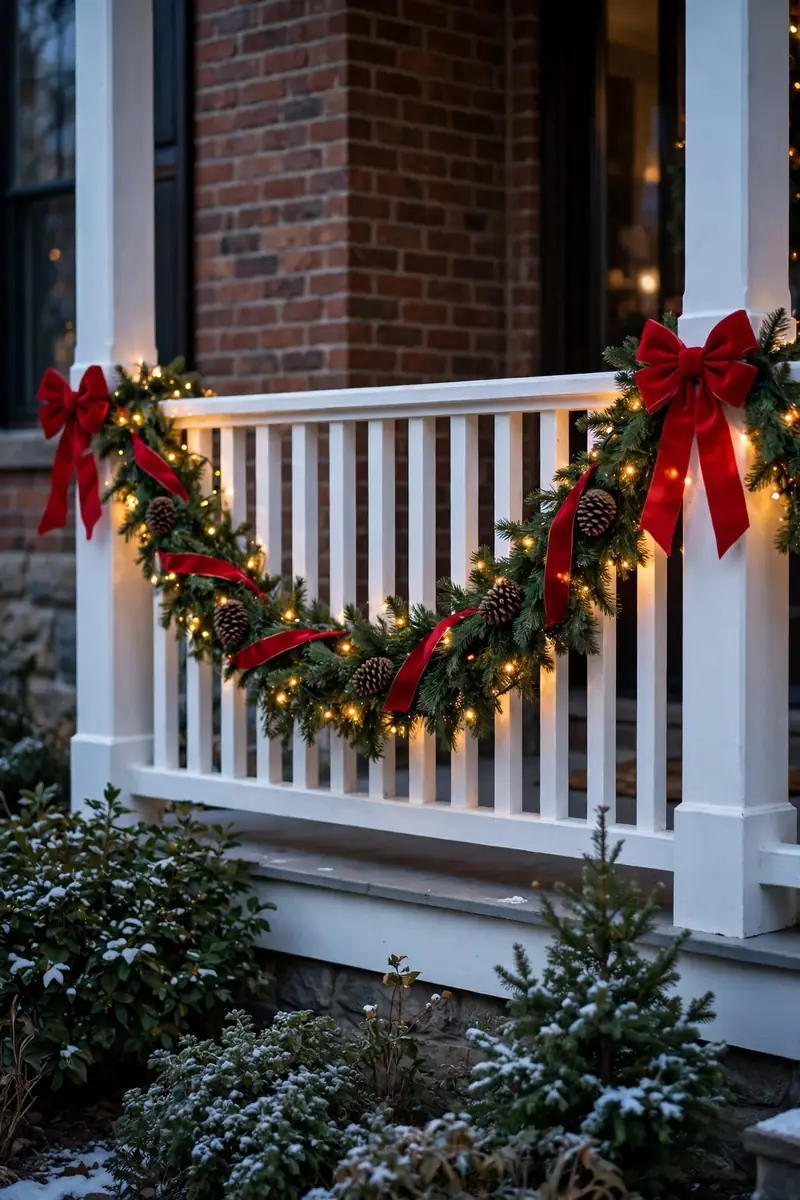
- Allow 1.5 times the railing length so the garland can swag
- Secure with clear zip ties every 18 inches, hidden behind the greenery
- Tuck pinecones every 24 inches and weave in battery micro lights
- Decorate only the top railing if the porch has two levels
A garland draped along the porch railing turns a plain handrail into a major design element, and the ratio is easy to remember. Allow 1.5 times the railing length, so an 8 foot rail needs about 12 feet of garland, and the extra length is what makes the soft swag between the posts. Pull the garland taut and it looks like a rope, but let it dip gently and it looks like a proper Christmas display. Secure it with clear zip ties every 18 inches, hidden behind the greenery, and the garland stays put through wind and snow.
The details are what make a railing garland look finished instead of thrown on. Tuck a cluster of pinecones every 24 inches, weave the same wired ribbon through it that you used on the wreath, and add a few battery operated micro LED lights so the railing glows after dark. If the porch has an upper and a lower railing, decorate only the top one, because doubling up reads cluttered on most porches. Fluff the branches after hanging so the garland looks full rather than flat, and step back to check the swags hang evenly.
Window Mini Wreaths
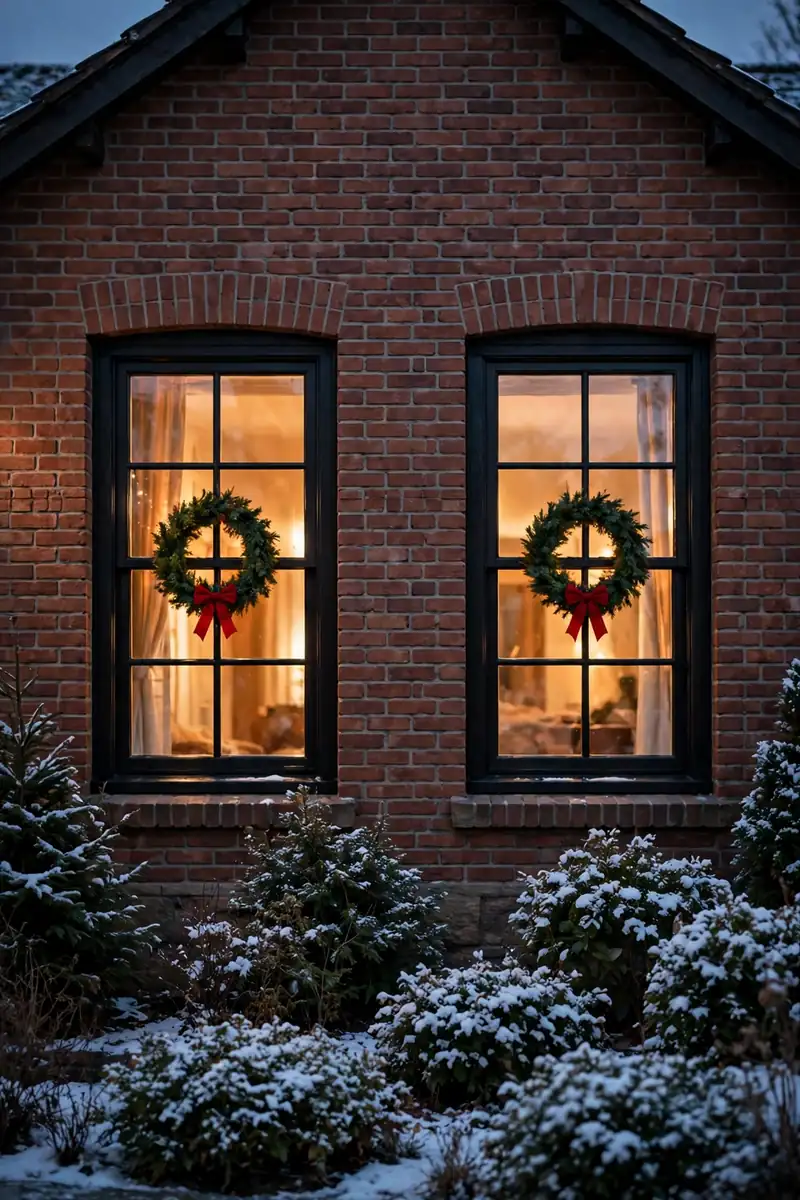
- Hang mini wreaths 12 to 16 inches across on the front windows
- Hang every wreath at exactly the same height
- Match the ribbon color on every window so the house reads as one design
- Use suction hooks or removable clips so the glass stays undamaged
Small wreaths on the front windows are the quiet detail that makes a whole house look decorated, not just the door. Wreaths 12 to 16 inches across suit most standard windows, and the rule is to hang every one at exactly the same height, because a row of wreaths at different heights looks like a mistake. Match the ribbon color on every window, red on each one or plaid on each one, so the house reads as one design from the street. Suction hooks hold them on the glass without a single hole in the frame.
The effect is bigger than the effort, because the windows are the largest surface on the front of the house and they usually sit bare. Two or three mini wreaths cost less than one large door wreath, and they tie the door display to the rest of the house. Keep the greenery the same on every window, and resist the urge to give each window a different theme, since matching wreaths look calm and mixed ones look busy. At night, the wreaths catch the light from inside the house and glow like framed pictures.
Porch Tree Pair
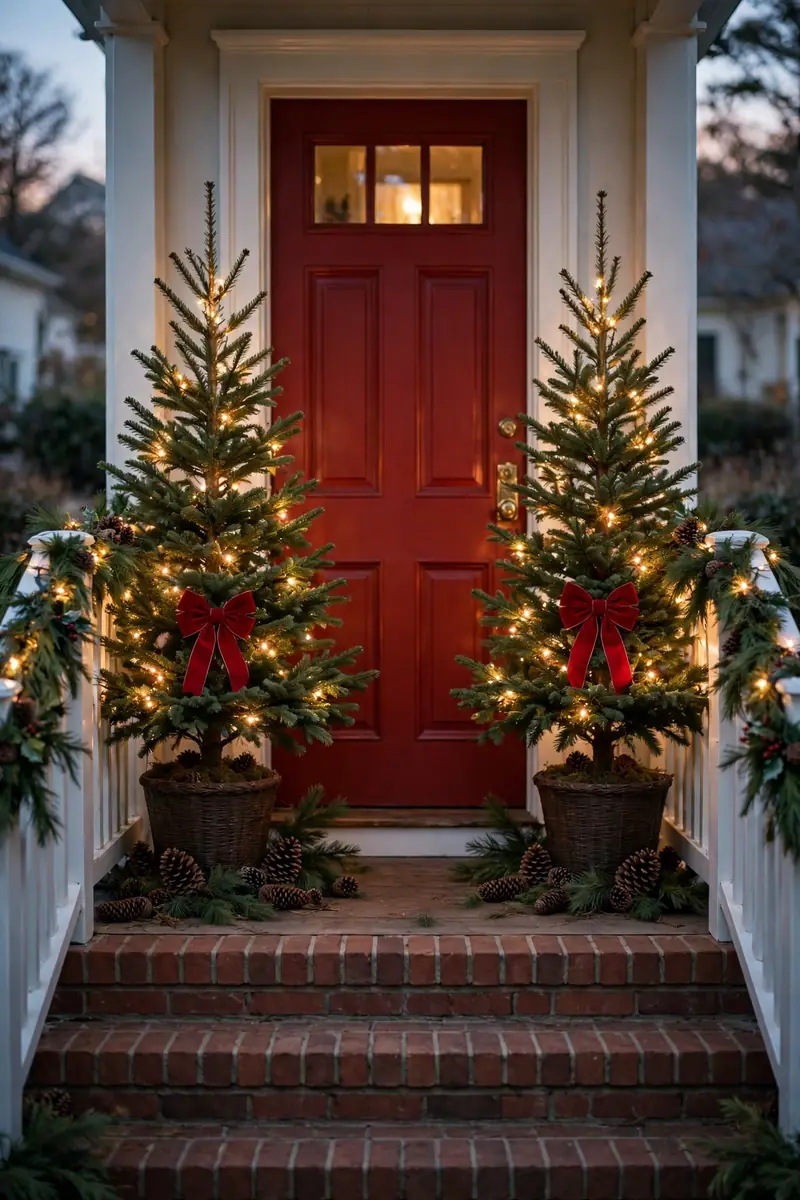
- Flank the door with two potted evergreen trees, 3 to 5 feet tall
- Choose pots 14 to 16 inches across so a 2 to 3 foot tree sits steady all winter
- Pick pre-lit trees with a timer so they glow without extra cords
- Add red berries or pinecones at the base for color
Two potted evergreen trees flanking the door are the most traditional porch look, and they work on porches of every size. A 4 foot pre-lit potted tree costs about 75 dollars, while a 5 foot pre-lit cedar runs about 99 dollars, and a pair instantly frames the entrance. Choose pots 14 to 16 inches across so a 2 to 3 foot tree sits steady all winter, and fill the pot with soil or gravel so a gust of wind cannot topple it. A 36 inch lighted berry porch tree costs about 72 dollars and already carries its own timer.
Pre-lit trees are worth the extra money outside, because stringing lights around a potted tree in the cold is nobody’s idea of fun. Look for a built in timer, so the trees switch on at dusk and off before bed without anyone touching them. Add red berries or pinecones at the base of each pot for color, and a red bow tied around the trunk finishes the pair. After Christmas, the trees move to a sheltered corner and keep growing, which makes them the one porch decoration that earns its keep all year.
Fresh Cut Bucket
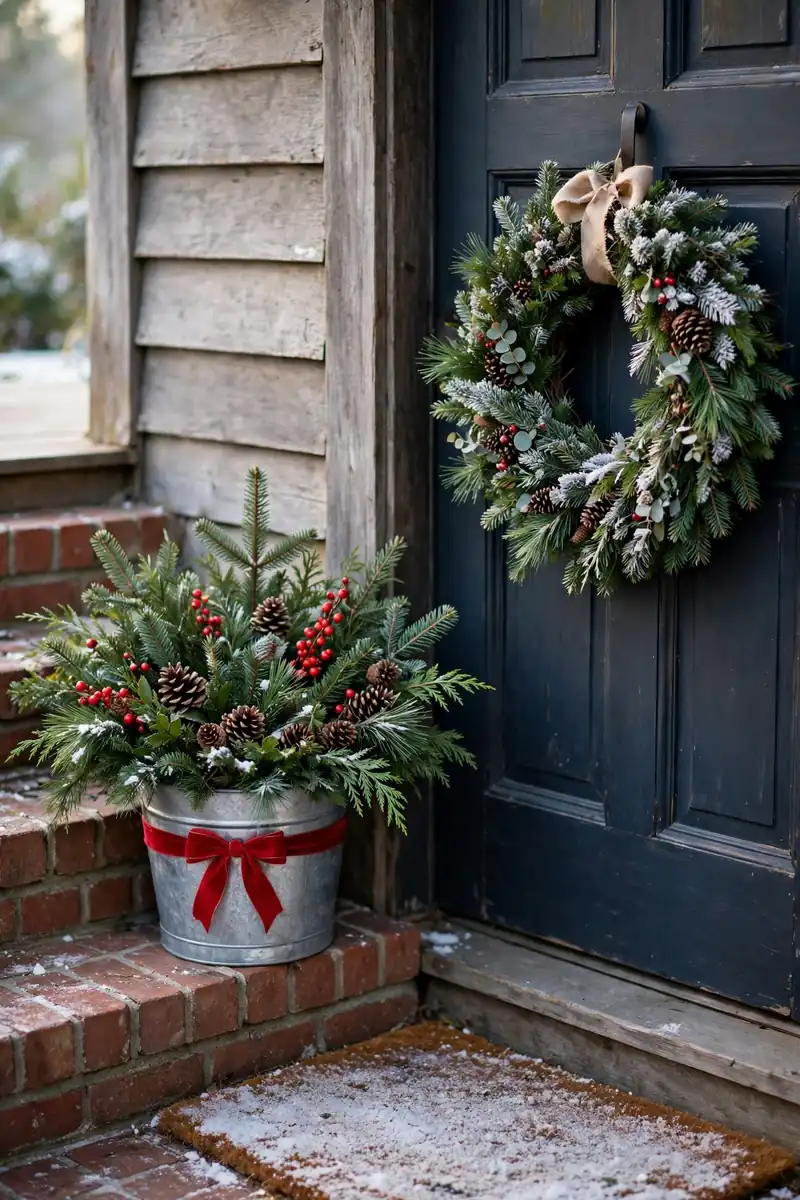
- Fill a galvanized bucket with fresh cut evergreen branches
- A bucket costs about 13 dollars at Target, less at a thrift store
- Trader Joe’s sells fresh cut greenery bundles for about 10 dollars
- Set the bucket beside the door where the scent greets guests
A galvanized bucket full of fresh cut evergreen branches looks like you just came in from the woods, and it costs almost nothing. A bucket runs about 13 dollars at Target, and thrift stores often have them for three dollars if you look, while Trader Joe’s sells bundles of fresh cut greenery for about 10 dollars. Cut the stems at an angle, pack them tight so they stand upright, and add a few pinecones and red berry sprays from the yard. The whole arrangement takes ten minutes and smells like December itself.
The scent is the reason this idea beats a store bought arrangement, because guests smell the pine before they see it. Set the bucket beside the door where the scent greets everyone who walks up, and keep it out of the windiest corner so the branches do not dry out in a day. Fresh greenery lasts four to six weeks in cold weather, so a bucket filled in early December still looks good on Christmas morning. When the season ends, the branches go in the compost and the bucket stores flat until next year.
Ribbon Tail Wreath

- Add a big bow with tails that hang a foot or more below the wreath
- Use wired ribbon at least 4 inches wide so the bow holds its shape
- Secure the bow with floral wire, not by tying it straight to the wreath
- Match the ribbon to the planters and garland for one color story
A plain wreath becomes the focal point of the whole porch when you add a big bow with tails that hang a foot or more below it. Use wired ribbon at least 4 inches wide, because narrow ribbon disappears on a large wreath and soft ribbon collapses in the rain. Secure the bow with a loop of floral wire rather than tying it directly to the wreath, so the shape can be adjusted and the tails hang straight. One strong bow in a single color beats three small bows competing for attention.
The ribbon is what ties the porch together, so match it to the planters, the garland and the doormat for one clear color story. Red velvet reads traditional, plaid reads farmhouse, and gold reads glamorous, but mixing all three together on one porch reads as noise. Cut the tails at an angle so they do not fray, and let them hang a foot or more below the wreath where the winter wind can move them. When the bow starts to look tired after a few wet weeks, swap just the ribbon and the wreath looks brand new.
Birch Pole Trio
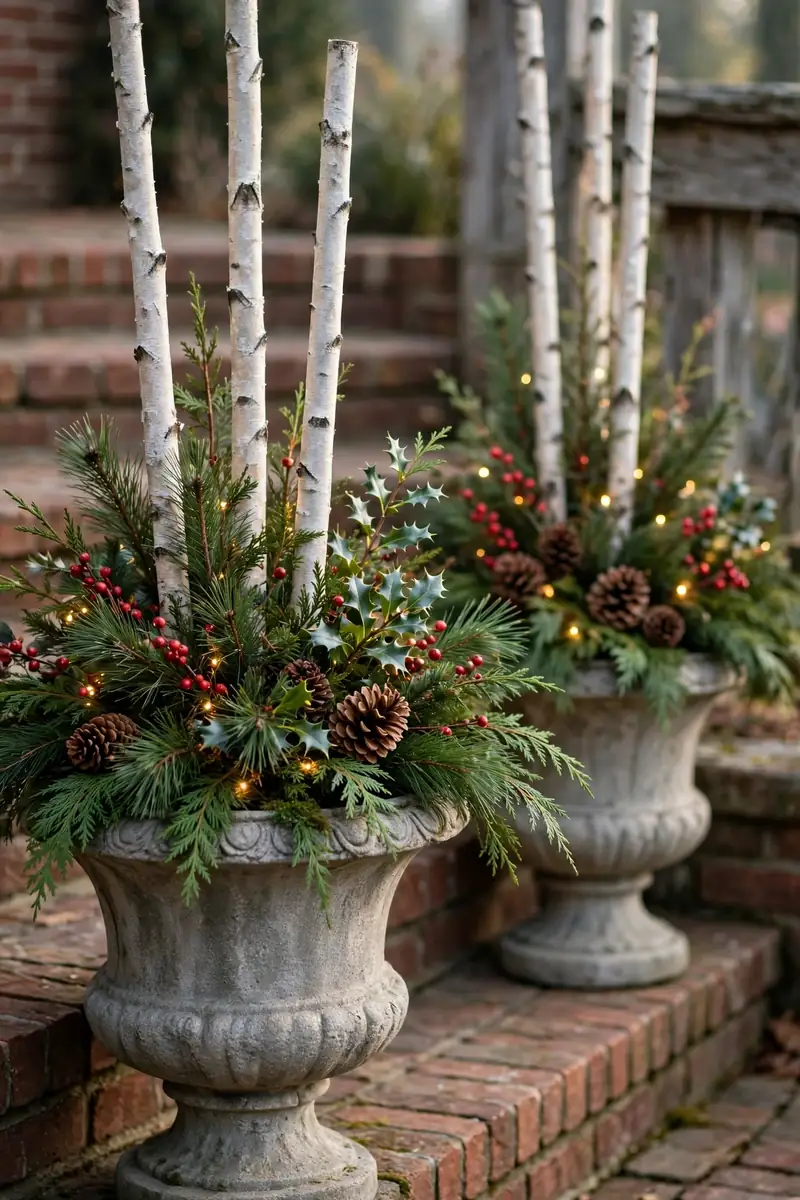
- Stand two or three white birch poles in the center of each planter
- Birch pole bundles of three cost about 15 dollars at Michaels
- Surround the poles with cut evergreen and tuck in berry sprays
- Keep the tallest pole in the middle for a natural look
White birch poles are the tall, pale exclamation mark that makes a porch planter look designed instead of stuffed. A bundle of three costs about 15 dollars at Michaels, and two or three poles in the center of each planter give the arrangement height without any extra weight. Cut the poles to different lengths, keep the tallest in the middle, and push them deep into the soil or floral foam so they stand straight through wind and snow. The pale bark glows against dark evergreen, which is why designers reach for birch first.
Surround the poles with cut evergreen branches, tuck in red berry sprays and pinecones, and the planter looks like a little winter forest. The poles are the skeleton and the greenery is the flesh, so do not hide the bark completely behind branches, because the white bark is the whole point. Birch poles last for years if you store them dry, and they work just as well in a plain pot with no greenery at all. One bundle fills two planters, which makes them the cheapest height you can buy for a porch.
Outdoor Safety Check
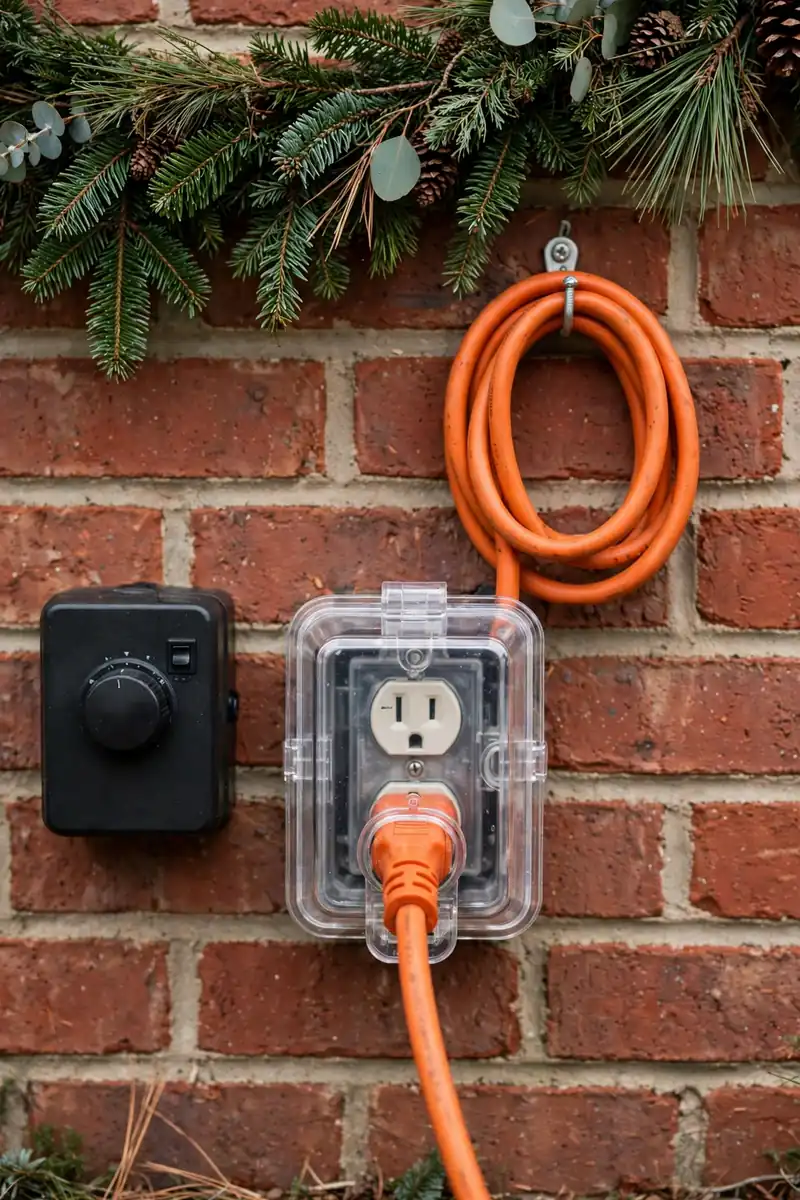
- Plug everything into a GFCI protected outdoor outlet, required by code
- Use only lights and cords labeled UL or ETL listed for outdoor use
- Choose extension cords 16 AWG for runs under 50 feet, 14 AWG for longer runs
- Elevate every plug connection at least 6 inches off the ground
Outdoor Christmas lights are only beautiful when they are safe, and the safety rules are not suggestions. Every outdoor connection must plug into a GFCI protected outlet, which the National Electrical Code requires on all outdoor receptacles, because it cuts the power the instant moisture causes a fault. Use only lights and cords labeled UL or ETL listed for outdoor use, and look for an IP44 rating or higher for moisture protection. Indoor cords have thinner insulation that cracks in the cold, and using one outside is one of the most common causes of holiday electrical fires.
The connections are the weak point, not the bulbs, so treat them with care. Elevate every plug junction at least 6 inches off the ground on a stake or hook, because plugs sitting in mulch, grass or snow collect moisture fast. Angle each connection downward so water drips off instead of pooling inside, and add a drip loop, a U shaped bend in the cord before each plug, so rain runs away from the connection. Never staple or nail a light string, never daisy chain extension cords together, and never run a cord through a window or a door.
Warm Glow Timer
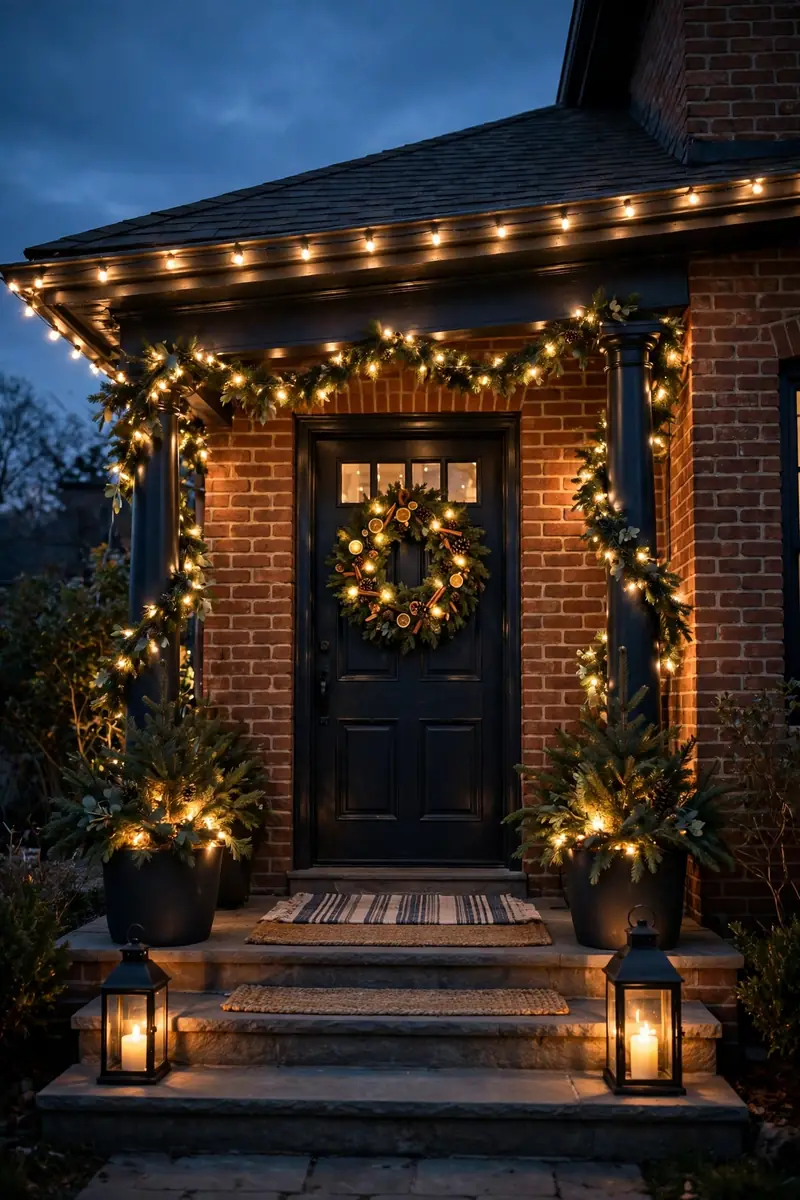
- Put the lights on a timer that turns them on at dusk and off before bed
- Use LED strings, which draw far less power than old incandescent bulbs
- Load any circuit to only 80 percent of its capacity for lights left on for hours
- One 15 amp circuit supports roughly 1,400 watts of lights
A timer is the cheapest upgrade a porch display can get, because lights that switch themselves on at dusk look magical and lights you forget to switch on look abandoned. Set every strand on a 6 hour timer, so the porch glows through the evening and goes dark before bed without anyone touching a switch. Outdoor timers and smart plugs cost a few dollars, plug into the GFCI outlet first, and then take every light string after them. The porch looks lit every single night, even when the house is empty.
LED strings are the reason a whole porch can glow on one circuit, because they draw far less power than old incandescent bulbs. The National Electrical Code says to load a circuit to only 80 percent of its rated capacity for anything running more than three hours, and one 15 amp circuit supports roughly 1,400 watts. Add up the watts on the tag of each light string before you plug in a new one, and never share an outlet between lights, inflatables and a space heater. Warm white LEDs give the porch a candlelit glow that cool white never matches.
Fresh Greenery Timing
- Hang fresh evergreen in early December, not November
- Fresh garland lasts 4 to 6 weeks in cold weather between 25 and 45 degrees
- Mist the greenery lightly once a week if the porch is sunny and dry
- Take lights down within 2 to 3 weeks after Christmas to avoid freeze thaw damage
Fresh evergreen is the best smelling decoration on a porch and the shortest lived, so timing is everything. Fresh garland lasts four to six weeks in cold outdoor weather, roughly between 25 and 45 degrees, which means a garland hung in early December still looks good on Christmas morning. Hang it in November and it browns before the big day, so wait until the first week of December even when the shops start selling it earlier. Fraser fir and noble fir hold their needles longest, while pine drops faster in a sunny spot.
A little care stretches fresh greenery by weeks, and neglect kills it in days, so a weekly check is worth it. Mist the garland lightly with water once a week if the porch is sunny and dry, and keep it out of the windiest corner where the cold air strips moisture from the needles fastest. After Christmas, take the lights down within 2 to 3 weeks, because repeated freeze thaw cycles damage the light strings and the greenery. Compost the branches, coil the lights neatly, and the porch is clean before January ends.
Small Porch Budget
- A small porch can look finished for about 75 to 150 dollars
- Reuse last year’s wreath with a fresh bow and forage pinecones and branches
- Spend the new money on lights and a timer, the two things that show at night
- A full layered entry runs about 200 to 400 dollars
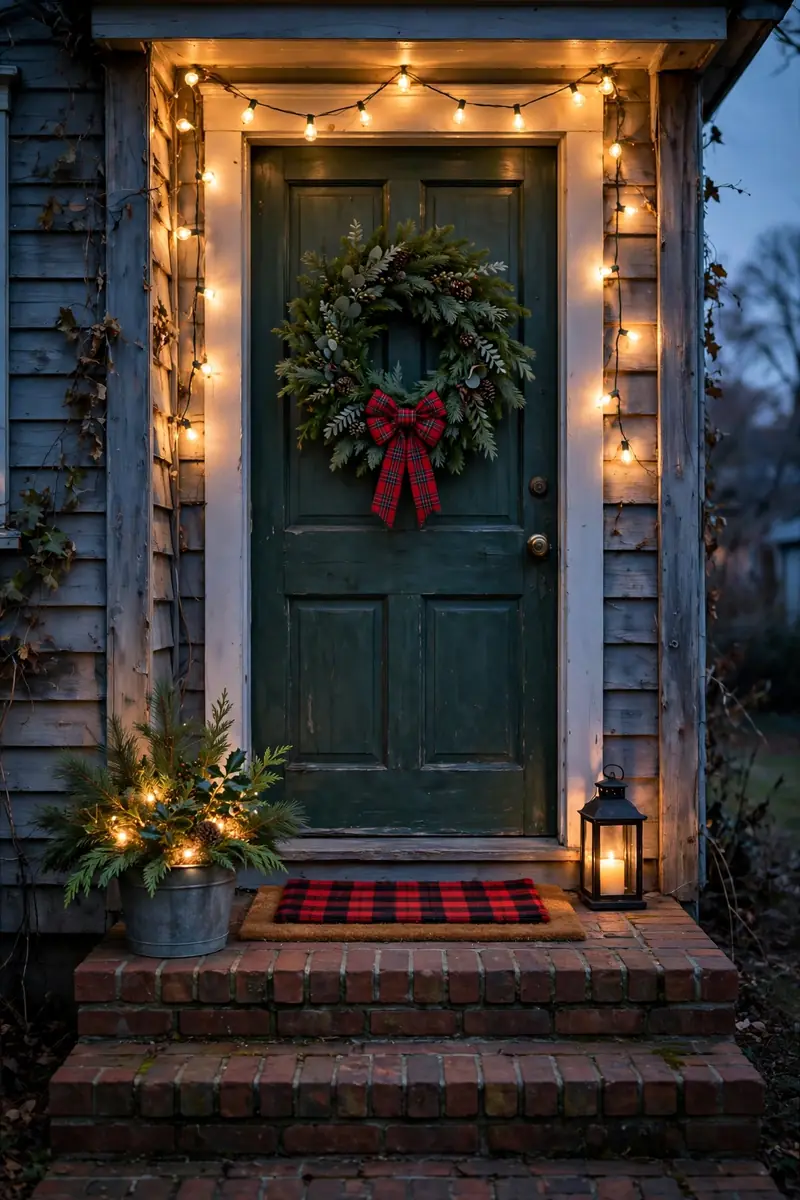
A small porch does not need a big budget to look finished, because three well chosen pieces beat ten cheap ones. A small porch can look dressed for 75 to 150 dollars, and the trick is spending where it shows after dark. Reuse last year’s wreath with a fresh bow, forage pinecones and branches from the yard, and buy only lights and a timer, which make the porch glow at night. A full layered entry with matching trees and premium garland runs about 200 to 400 dollars, but the small version photographs just as well.
Start with the door, because the wreath and one strand of lights are the whole display on a tiny stoop. Add a layered doormat next, since the rug and mat together cost 30 to 100 dollars and change the ground under the door. Skip the second planter if the porch is narrow, and put one good urn on the side where guests walk up. A 24 inch wreath costs 25 to 40 dollars on the budget route, and a pre-lit premium one runs 50 to 90 dollars, so the difference is mostly in the lights.
Double Door Pair
- Hang one wreath on each door, a few inches narrower than each door
- Or hang one large 30 to 36 inch wreath centered across both doors
- Match the ribbons exactly so the pair reads as one design
- Keep the planters identical on both sides for balance
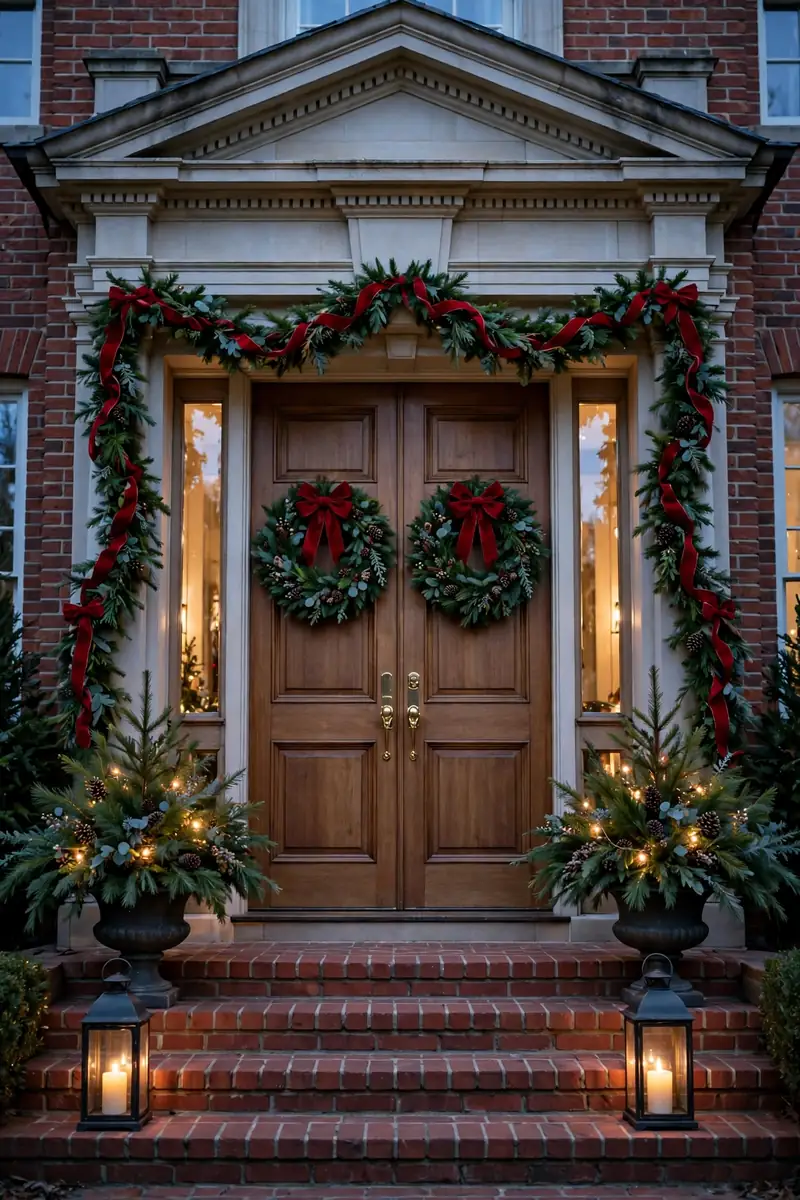
Double doors are a gift for Christmas decorating, because they give you twice the canvas and twice the chance to get it wrong, so plan first. Hang one wreath on each door, a few inches narrower than each door, and the pair reads as one single design from the street. Or hang a single large wreath 30 to 36 inches across, centered right on the seam between the doors, which looks grand on a wide entry. Either way, match the ribbons exactly, because two different bows on two doors look like two different houses entirely.
Balance matters more on double doors than on a single door, since the eye compares the two halves instantly. Keep the planters identical on both sides, the same height, the same pot, the same greenery, so nothing pulls the eye to one side. Garland framing the whole double opening needs about 20 feet, which is the height twice plus the width, and two 9 foot garlands joined at the top cover it with a little to spare. Step back to the street and check the symmetry before you call it done.
No Damage Hanger
- Hang the wreath on an over the door hanger, no holes needed
- Use a magnetic hook on a steel door, it holds without a mark
- Grip brick clips onto the mortar line, never drill into brick
- Clear outdoor adhesive hooks hold garland on painted trim
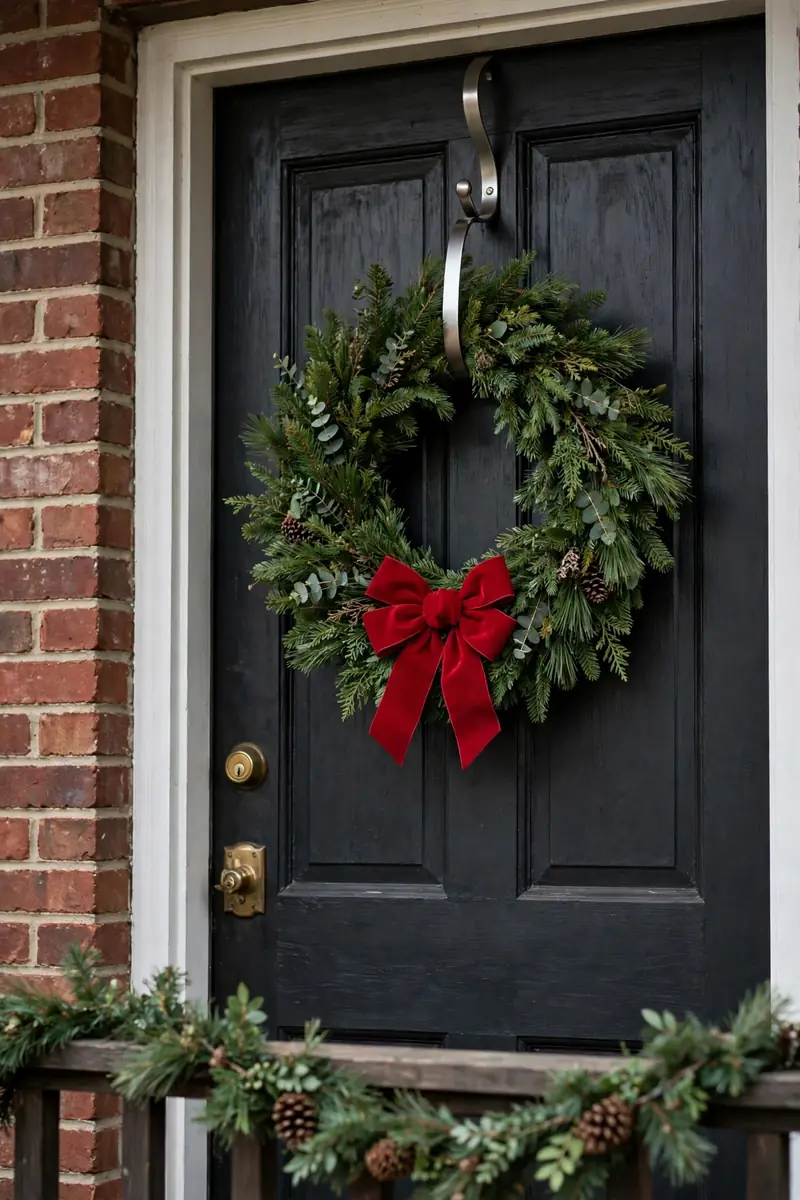
Your wreath should never cost you your deposit or your door, and the right hanger makes holes unnecessary. An over the door hanger slips over the top of the door and holds a wreath up to 30 inches without a single nail, and it comes off in January with no trace. A magnetic hook grips a steel door firmly and peels off clean, while brick clips grip the mortar line without drilling into the brick itself. Clear outdoor rated adhesive hooks hold garland on painted trim and pull off without peeling the paint.
The mistake is reaching for a nail first, because a hole in a steel door rusts and a hole in brick lets water in. Test the hanger with the wreath on it before you walk away, since a wreath that falls at midnight ends up in the bushes by morning. On a glass storm door, a suction hook holds a light wreath, and on a wooden door, a small removable hook on the trim does the same job. When the season ends, every hanger on this list comes off clean and stores flat for next year.
Conclusion
Start with the door, because one wreath sized right and one strand of lights will change the whole front of your home tonight. Add the planters when the budget allows, hang the garland next weekend, and let the porch grow into December one piece at a time. That is the heart of front porch christmas decor, a welcome that starts at the street and ends at the door. Save this post, pick the idea that fits your porch and your budget, and share it with a neighbor whose door still looks like November. Christmas starts at the front door.
FAQ
What size wreath should I hang on my front door?
A wreath about two-thirds as wide as the door looks right. For a standard 36 inch door, choose 22 to 24 inches across, and hang it so the center sits 58 to 64 inches from the floor. On double doors, hang one wreath on each door, a few inches narrower than each door.
How do I keep outdoor Christmas lights safe in rain and snow?
Use only lights and cords labeled UL or ETL listed for outdoor use, plug everything into a GFCI protected outlet, and elevate every plug connection at least 6 inches off the ground. Angle connections downward so water drips off, and never use an indoor extension cord outside.
How long does fresh evergreen garland last outside?
Fresh garland lasts four to six weeks in cold weather between 25 and 45 degrees. Hang it in early December so it still looks good on Christmas morning, mist it lightly once a week if the porch is sunny, and take it down within a few weeks after the holiday.
What should I put in porch planters in winter?
Fill them with cut evergreen branches, pinecones, red berries and sturdy twigs, anchored in soil or floral foam. Fresh spruce tips, cedar, fir and pine hold up for weeks in freezing weather. Use a heavy ceramic, metal or thick resin urn, since thin plastic can crack in a freeze.