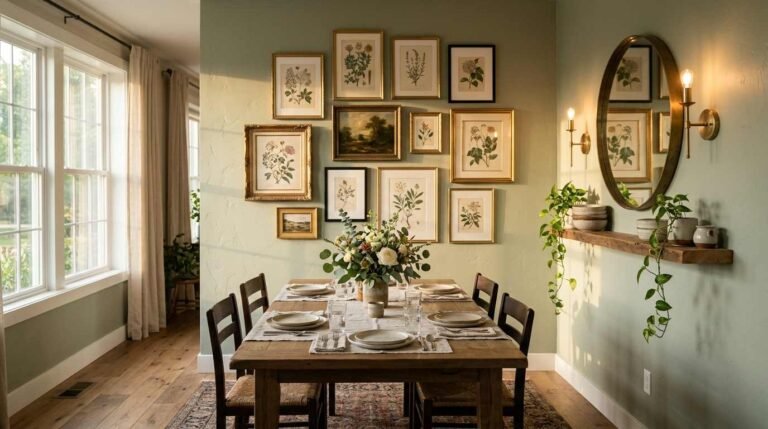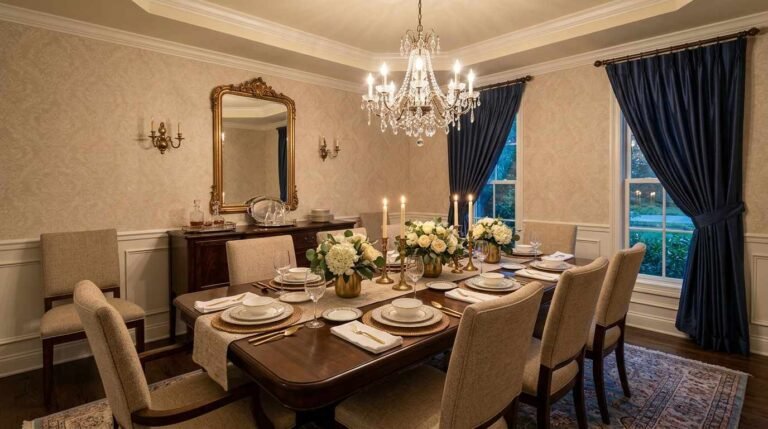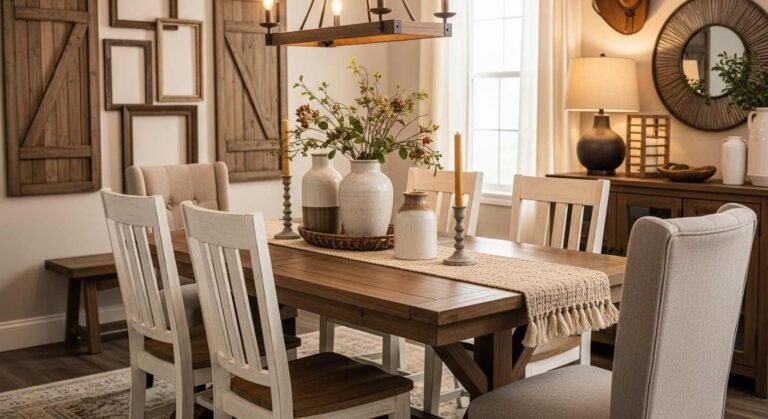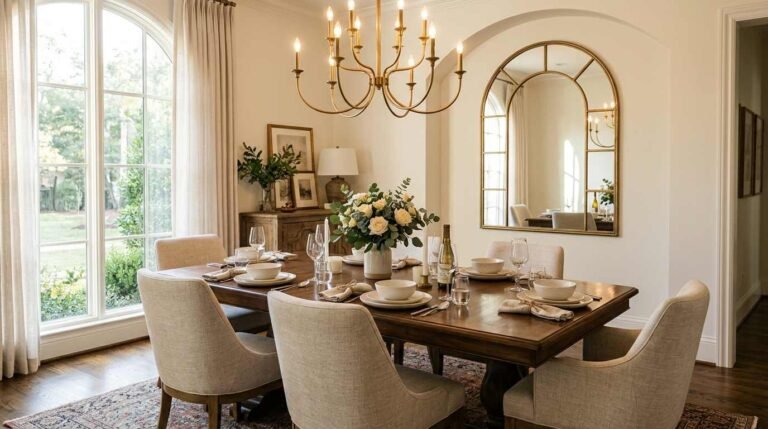
A blank wall behind the dining table wastes the cheapest art in the house. Mirror wall decor ideas for a stunning dining room work because the mirror is the art: the shape, the frame, and the glass do the decorating before a single picture is hung. This guide looks at 24 mirrors as statement pieces, from a single oversized round to a full paneled wall, and gives you the sizes, frame materials, and hanging heights to make each one look deliberate. Save the ones you love to Pinterest and compare the frame finishes before you buy.
How to Read Mirror Wall Decor Ideas as Art
Start with the shape, not the size. A circle softens a room of rectangles, a tall arch adds height, and a cluster adds movement. Then choose the frame: the frame is the part you actually see from the table, so its material, width, and colour set the tone. A 1 inch black steel frame reads modern, a 2 inch carved wood frame reads traditional, and a rattan weave reads relaxed. Match the frame to one other material already in the room, such as the wood of the table or the metal of the pendant, and the mirror will look like it belongs there.
Next, check the glass. Clear glass gives a sharp reflection and suits modern rooms. Smoked, antiqued, or mercury glass gives a softer one and suits older or warmer rooms. Hold the mirror near the table before you hang it: if the reflection shows the table setting and the window, the glass works; if it shows the ceiling fan, move the mirror or change the tilt.
1. Oversized Round Mirror
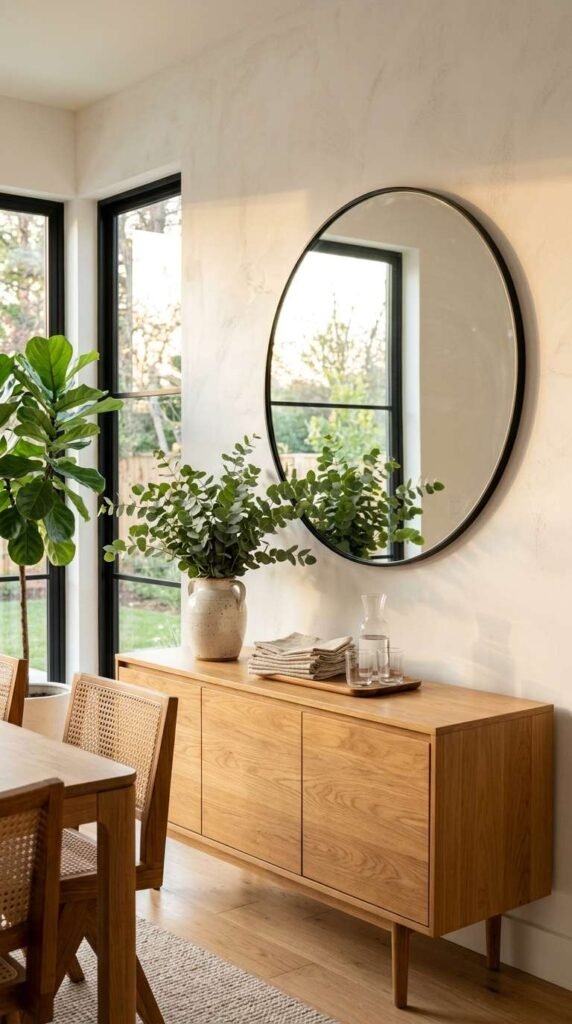
A single round mirror 36 to 42 inches across can carry a whole wall. The circle breaks the rectangles of the table, the chairs, and the sideboard, and the curved edge catches light from every direction instead of one. Hang it alone with at least 12 inches of bare wall on each side so the shape stays the star.
A 36 inch round suits a table 60 inches long; a 42 inch round suits a longer table or a wider wall. The frame decides the style: slim brass 1/2 inch wide reads light and modern, while a 2 inch walnut frame reads warm and traditional. Center the mirror 58 inches from the floor and check the reflection from a seated chair.
Frame and finish: 36 to 42 inches across, 1/2 to 2 inch frame width. Brass or matte black for a modern room, walnut or oak for a warm one. Fixing: two anchors rated for 25 to 35 pounds, or a French cleat for the heavier sizes.
2. Vintage Gold Ornate Mirror
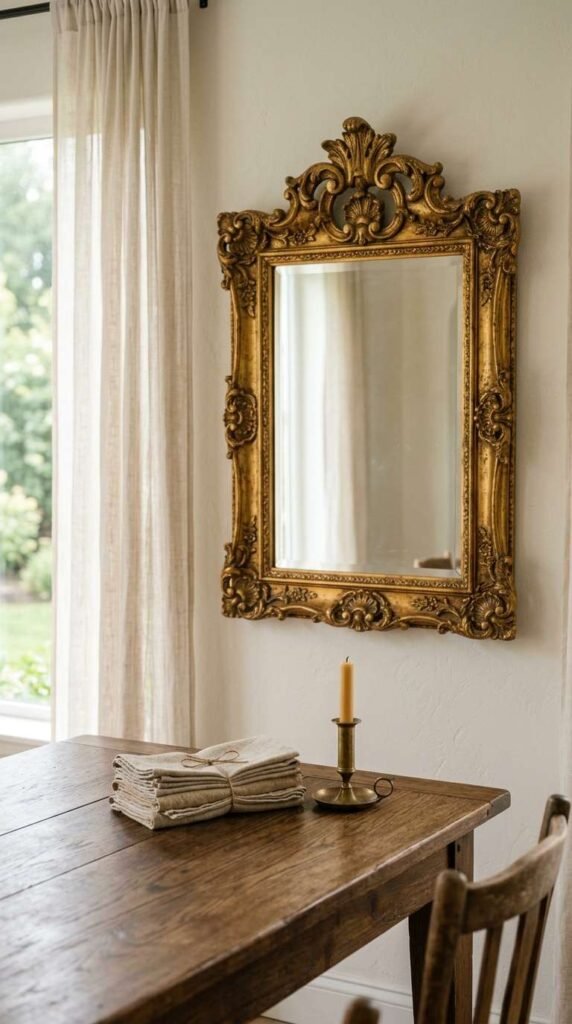
An ornate gold mirror is art before it is glass. Carved wood frames 30 to 40 inches wide, with scrolls and leaves 1 to 2 inches deep, throw shadows that change through the day. Place it over a dark wood sideboard or against a deep green or navy wall, where the gold has something to stand against.
Buy it where you can inspect it. Check the back for damp, press the backing board, and look for foxing, the cloudy gray freckles that mean the silvering is failing. Light foxing near the edges is fine and reads as age; heavy foxing across the center will spoil the reflection. Hang it from a wire rated for 40 pounds, fixed to a stud.
What to look for: solid carved wood, not plastic. Gold leaf or gilded paint, not bright spray gold. Fixing: one wall hook in a stud, wire rated for 40 pounds. Height: center 58 inches from the floor.
3. Mirror Cluster Gallery Wall
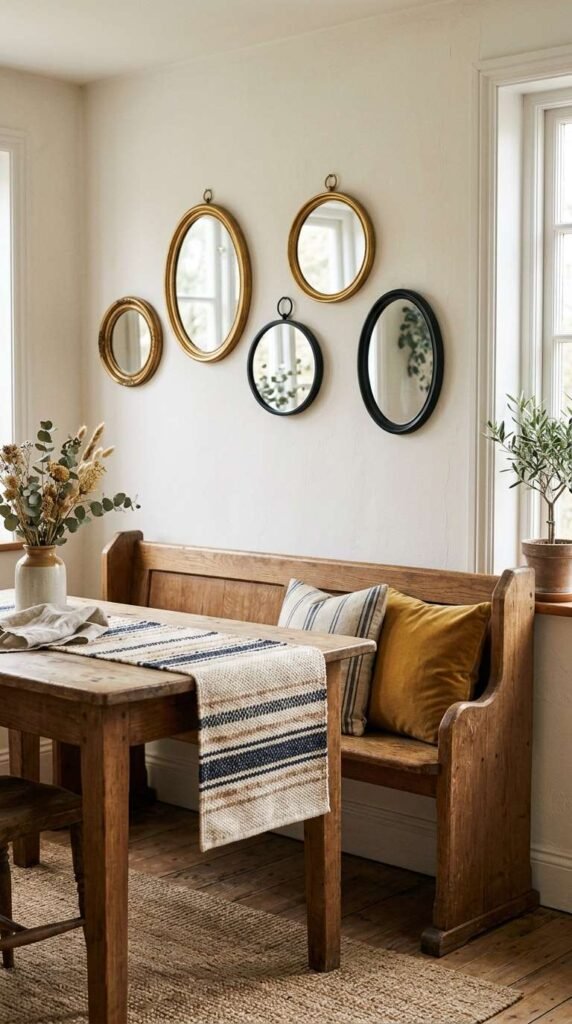
A cluster turns five to seven small mirrors into one piece of art. Mix round, oval, and rectangular shapes between 10 and 20 inches, and keep one frame finish across the whole group, such as all brass or all black, so the mix looks gathered rather than random. The group should span 48 to 60 inches wide on the wall.
Lay the pieces on the floor inside a taped rectangle before you drill anything. Start with the largest piece just left of center, 58 inches from the floor, and work outward with 2 to 3 inch gaps. Photograph the floor layout so you can rebuild it on the wall piece by piece.
Grouping plan: five to seven pieces, 10 to 20 inches each, one shared frame finish. Span: 48 to 60 inches wide. Gaps: 2 to 3 inches. Fixing: one hook per piece, rated for 10 pounds each.
4. Leaning Floor Mirror
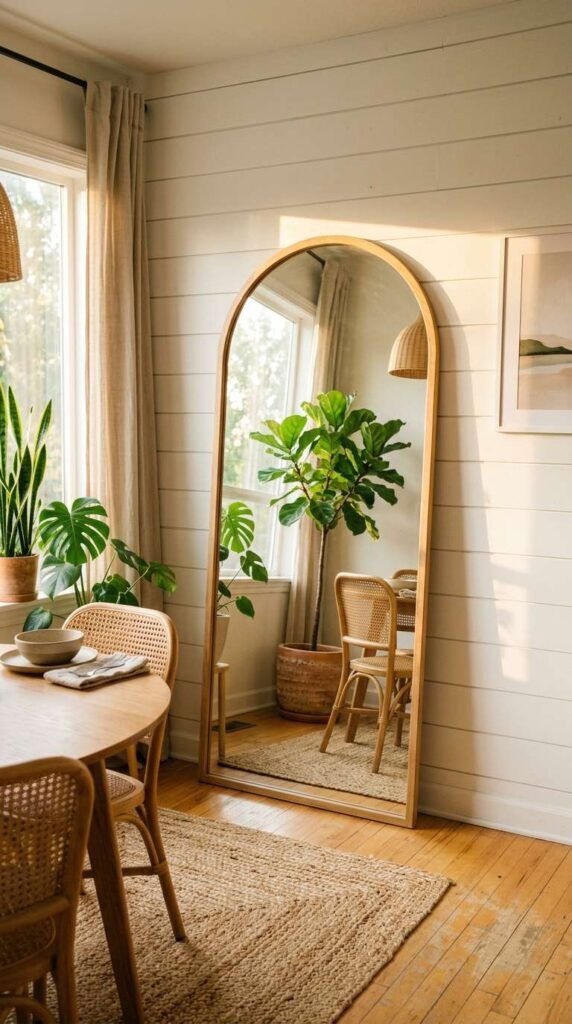
A leaning mirror is the easiest statement piece to try, because it needs no holes in the wall. Pick one 65 to 72 inches tall and 24 to 30 inches wide, with a frame that reads from across the room: black steel for a modern look, pale oak for a soft one. Lean it in the corner beside the sideboard, with the base about 5 inches from the skirting board and the top 4 to 6 inches from the wall.
The tilt matters. Lean it too far forward and it reflects the ceiling; too upright and it shows only the floor. Add an anti tip strap screwed into a stud behind the top edge, even in a room without children, because a chair can bump a leaning mirror. Keep a 36 inch clear floor strip in front of it so nobody walks into the glass.
Lean it right: 65 to 72 inches tall, base 5 inches from the wall, top 4 to 6 inches from the wall. Strap: one anti tip strap into a stud. Clearance: 36 inches of floor in front.
5. Sunburst Mirror Accent
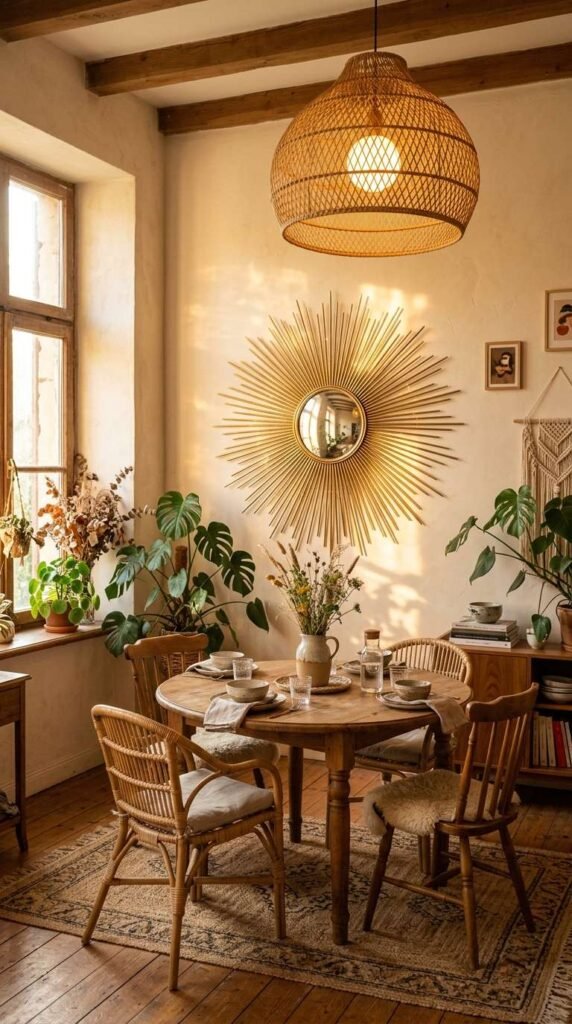
A sunburst is sculpture first and mirror second. Metal rays spread 30 to 36 inches across, with a round glass center 12 to 16 inches wide, and the points cast small spokes of light on the wall. Hang it alone above a low sideboard so the rays have clear wall around them, at least 6 inches on each side.
Long, widely spaced rays read mid century; short, dense rays read softer and suit a smaller room. Brass rays warm a gray wall, black rays sharpen a white one. The center glass is small, so this mirror is about shape, not reflection: check the rays, not the view, when you choose it.
Ray count: 30 to 36 inches across, center glass 12 to 16 inches. Height: center 60 inches from the floor. Fixing: one heavy anchor rated for 30 pounds. Pair with: a plain wall, a low sideboard 48 to 60 inches wide.
6. Arched Mirror Panel
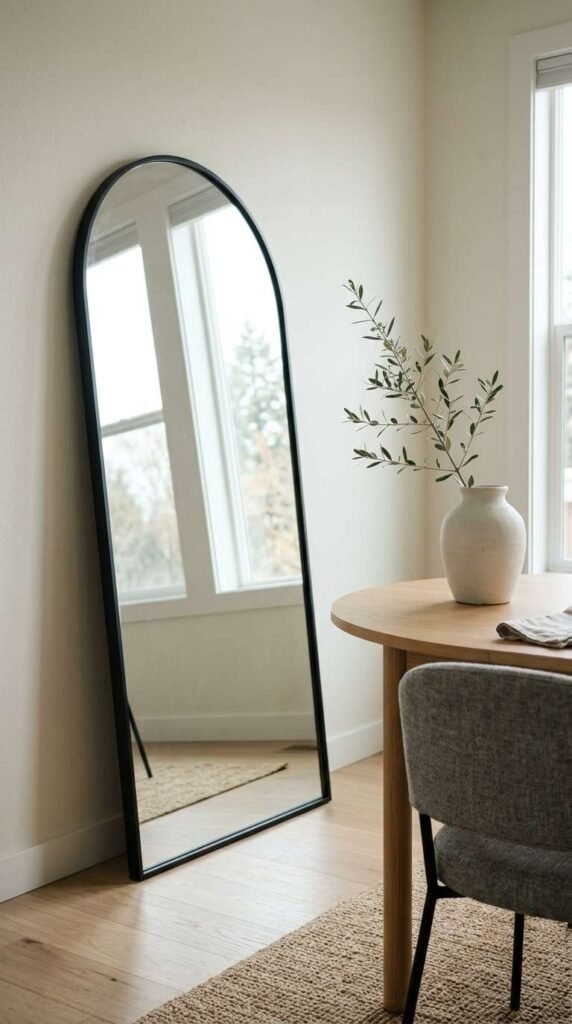
An arch borrows its shape from doorways, so it adds height without adding height to the room. A panel 24 to 30 inches wide and 48 to 60 inches tall suits the narrow wall beside a door or at the end of the table. The curved top breaks the straight lines of the room the way a round mirror does, but the straight sides suit a taller wall.
A frameless arch, where the glass itself curves, reads sleek and modern. A thin brass or black frame 1 inch wide keeps the same line but adds definition. Hang it so the bottom edge sits 8 to 12 inches above the sideboard or console, and center the glass 58 inches from the floor.
Shape note: 24 to 30 inches wide, 48 to 60 inches tall. Frame: none, or 1 inch brass or black metal. Height: center 58 inches from the floor. Works with: plaster walls, wood paneling, pale paint.
7. Mirrored Console Backdrop
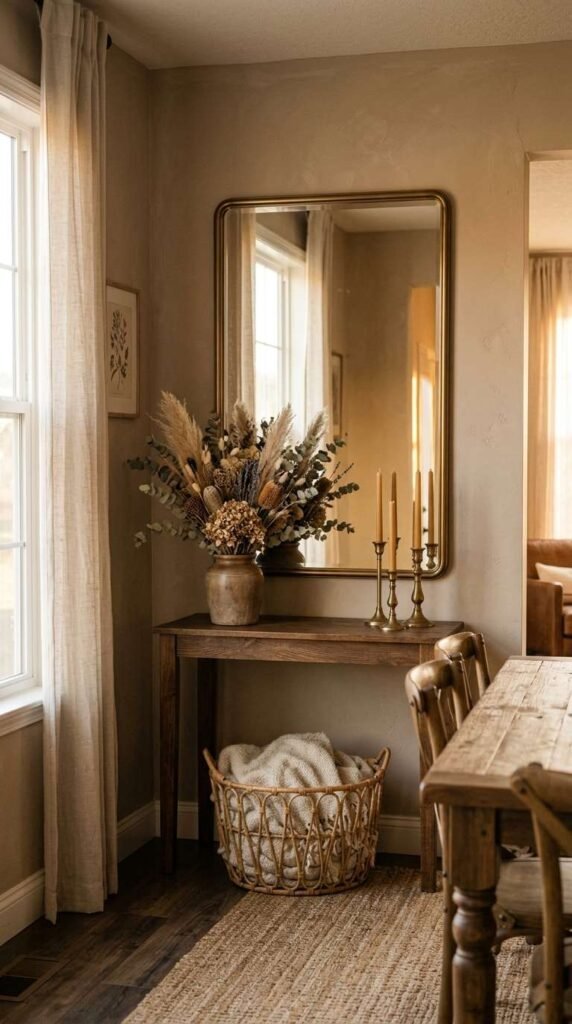
A mirror hung as a backdrop turns a console into a vignette. Size the glass to about two thirds of the console width, so a 48 inch wooden console takes a 32 inch mirror, and leave 4 to 6 inches between the mirror’s bottom edge and the console top. The glass then doubles the vase, the candlesticks, and the bowl on the console.
Keep the console display to three objects: one tall, one low, one wide. A vase 12 inches tall, a pair of candlesticks 8 inches tall, and a low bowl 10 inches across is enough. More than that and the reflection turns busy. A plain wood console suits a framed mirror; a black metal console suits a frameless one.
Console pairing: mirror two thirds of console width, 4 to 6 inches above the top. Display: three objects, tallest 12 inches. Frame: wood with wood, metal with metal. Height: center 58 to 60 inches from the floor.
8. Scalloped Edge Mirror
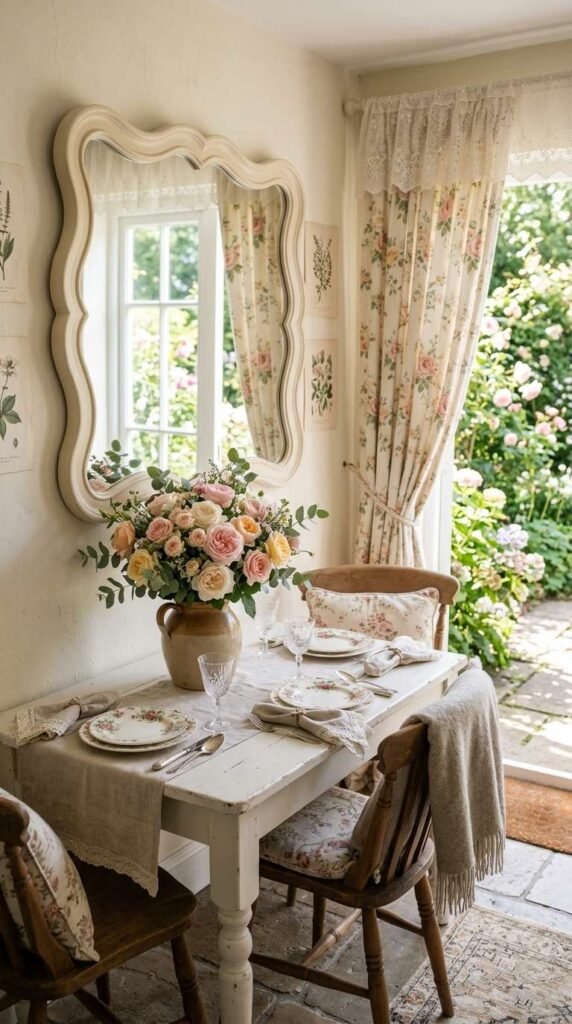
A scalloped edge is the softest frame on this list. The rippled border, usually cut from painted wood or molded resin, adds texture without color, so it suits a cottage or coastal dining room where a gold frame would feel formal. Choose a 24 to 30 inch round or oval, with scallops 1 to 2 inches deep.
Keep the wall around it plain, because the wavy edge is already doing the decorating. A cream scalloped frame can disappear on a white wall, so pick sage, dusty blue, or natural wood if the paint is pale. Pair it with a linen runner and rattan chairs to repeat the soft lines nearby.
Edge and colour: 24 to 30 inches across, scallops 1 to 2 inches deep. Frame: painted wood or resin, sage, dusty blue, or natural wood. Height: center 60 inches from the floor. Pair with: linen, rattan, plain pale paint.
9. Black Framed Mirror Trio
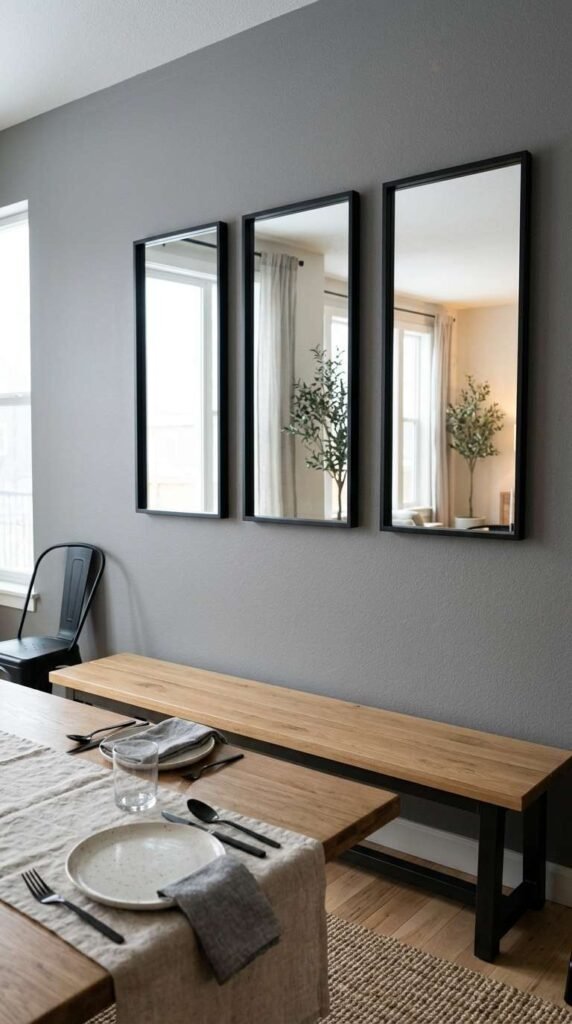
Three identical mirrors in a row are the most graphic statement on this list. Use three rounds or rectangles, each 18 to 24 inches across, in slim black frames 1/2 to 1 inch wide, and space them 3 to 4 inches apart. The repeated shape reads as one long artwork, and the black frames tie the wall to black hardware, a black pendant, or black chair legs.
Measure the row before you hang it: three 20 inch mirrors with 3 inch gaps span 66 inches, which suits a wall above a long table or sideboard. Use a level and a tape measure, not your eye, because a trio that is off by 1 inch looks crooked from the table. Hang the center mirror first, then the outer two.
Row math: three mirrors, 18 to 24 inches each, gaps 3 to 4 inches. Total span: 60 to 72 inches. Height: centers 58 inches from the floor. Frame: slim black steel, 1/2 to 1 inch wide.
10. Rattan Framed Mirror
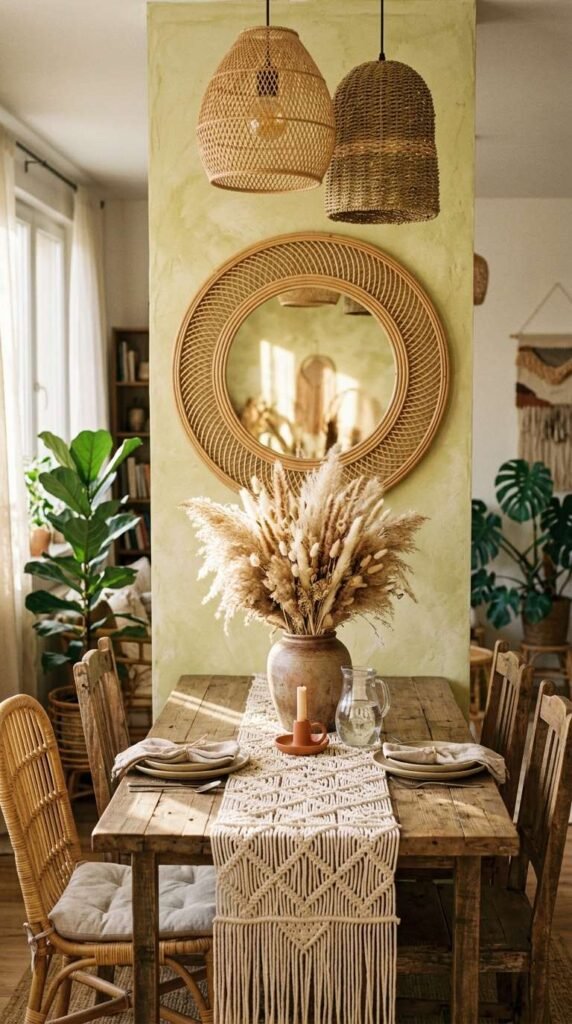
Rattan is the lightest frame here, in both weight and look. A woven border 2 to 3 inches wide around a 24 to 30 inch round mirror adds texture that smooth metal or painted wood cannot match. It suits a boho or coastal dining room, and because the frame is light, the whole piece often weighs under 10 pounds.
Round and oval shapes suit the weave better than sharp rectangles, since the rattan bends around a curve. Keep the wall pale and the furniture in natural wood, and avoid mixing rattan with a carved gold frame in the same room. One hook rated for 15 pounds is usually enough, but check the label first.
Texture check: 24 to 30 inches across, woven border 2 to 3 inches wide. Weight: usually under 10 pounds. Fixing: one hook rated for 15 pounds. Pair with: natural wood, linen, pale walls.
11. Antique Mercury Glass Mirror
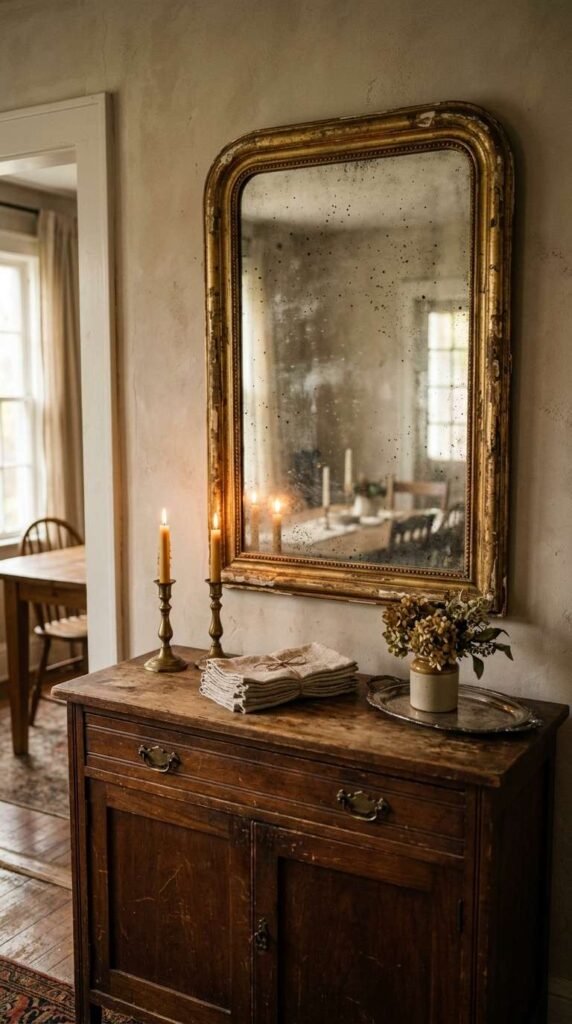
Mercury glass gives a smoky, cloudy reflection instead of a sharp one. The mottled silvering hides fingerprints, which is useful over a sideboard that is used every day, and the soft gray glass suits candlelight better than clear glass does. Choose a 28 by 36 inch piece in a dark wood or black frame for a traditional or glam room.
Genuine antique mercury glass is dear, but reproduction glass gives the same cloudy finish for far less. Hang it where a warm lamp or candles can reach it, because cold daylight flattens the mottling. A 2700K bulb in the nearest lamp brings out the gray and silver tones at dinner.
Age check: 28 by 36 inches, dark wood or black frame. Glass: mercury or antiqued finish. Light: 2700K warm white nearby. Care: dust with a dry cloth, no spray cleaner on old silvering.
Aging Glass Naturally
If you own a plain mirror and want the aged look, you can weather the glass yourself. Mix one part white vinegar with one part water, spray the back of the glass lightly, and blot with a cloth until cloudy patches form. Work in a ventilated room, wear gloves, and test on a small corner first, because the effect is hard to undo once the silvering lifts.
12. Mirrored Shelf Display
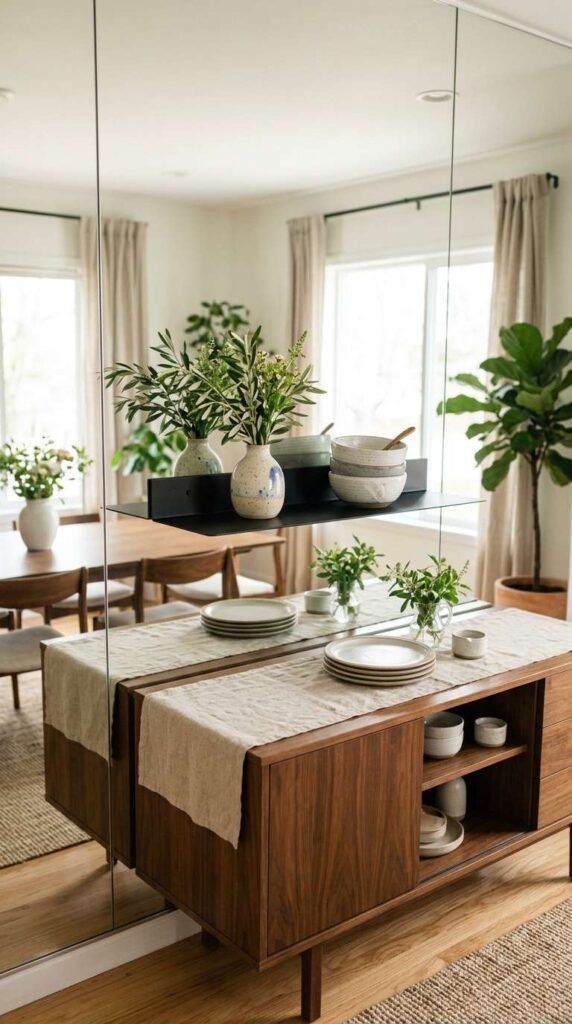
A mirror behind a floating shelf doubles everything on the shelf. Cut the glass to the exact width of the shelf run, usually 36 to 48 inches, and fix it first, before the shelf brackets go on. Two shelves 10 to 12 inches deep, set 14 inches apart, then sit in front of the glass, and every plate and glass appears twice.
Keep the display to three or four objects per shelf: plates 10 inches across, glasses 4 inches tall, one small vase. More than that and the reflection turns busy. A plain wood shelf in front of the mirror reads clean; a black metal bracket adds a sharper line. For more home decor ideas, browse the rest of the site before you style the shelves.
Shelf load: mirror cut to shelf width, 36 to 48 inches. Shelves: 10 to 12 inches deep, 14 inches apart. Display: three to four objects per shelf. Fixing: mirror adhesive, then brackets into studs.
13. Full-Length Wall Mirror
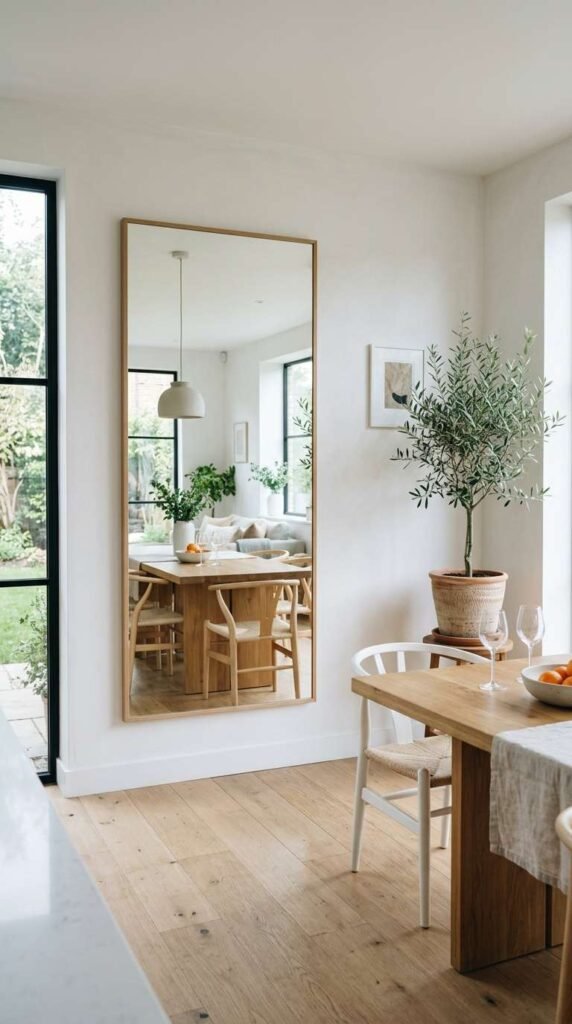
A full length mirror is the boldest single piece on this list. A panel 24 to 30 inches wide and 65 to 72 inches tall, hung vertically, reflects the whole room from floor to ceiling and makes a low ceiling feel taller. It suits a modern or minimalist dining room where one clean vertical line is enough.
This is the heaviest mirror on the list, often 35 to 50 pounds, so the fixings matter more than the frame. Use two wall anchors rated for 60 pounds, or a French cleat screwed into two studs, and check the floor below is clear of chairs that could swing into the glass. Keep the bottom edge 4 to 6 inches above the floor.
Height and fixings: 65 to 72 inches tall, 24 to 30 inches wide. Weight: 35 to 50 pounds. Fixing: two anchors rated for 60 pounds, or a two stud French cleat. Clearance: 36 inches of floor in front.
14. Mirror Above a Buffet Table
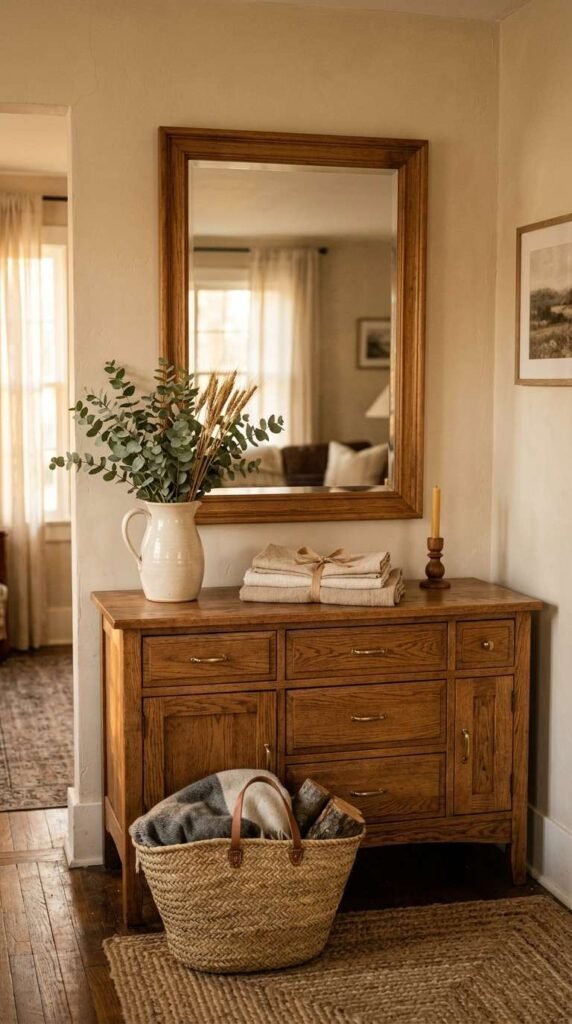
A mirror above a buffet gives the wall a clear job. Size it to about two thirds of the buffet width, so a 60 inch buffet takes a 40 inch mirror, and hang it 4 to 6 inches above the buffet top. The glass will reflect the serving dishes, the centerpiece, and the window across the room at the same time.
Set the buffet display before you fix the height. A pair of candlesticks 10 inches tall and a bowl of fruit 12 inches across will both appear in the glass, so keep the display low and neat. If your dining room is small, read our small dining room decor ideas guide before you choose the mirror width.
Buffet math: mirror two thirds of buffet width, 4 to 6 inches above the top. Height: center 58 inches from the floor. Frame: match the buffet wood or use plain black steel. Display: keep serving pieces under 12 inches tall.
15. Hexagon Mirror Set
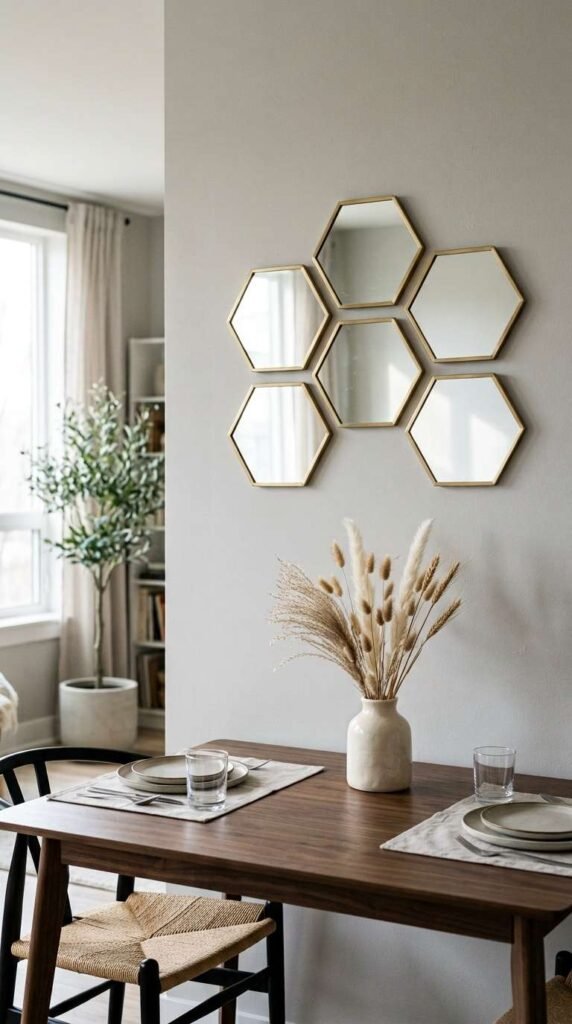
Hexagons turn a mirror into a geometric artwork. Five to seven pieces, each 10 to 12 inches across, arranged as a honeycomb, reflect light in several directions at once, so the wall changes as you walk past. The flat edges and points give a modern line that a round cluster cannot match.
Draw the honeycomb on paper and tape paper hexagons to the wall before you drill. Keep the total group 36 to 48 inches wide and center it 58 inches from the floor. A pre packed set keeps the sizes matched and usually costs less than buying the pieces one by one.
Honeycomb plan: five to seven pieces, 10 to 12 inches each. Span: 36 to 48 inches wide. Gaps: 1 to 2 inches. Frame: matte black or brushed brass.
16. Venetian Glass Mirror
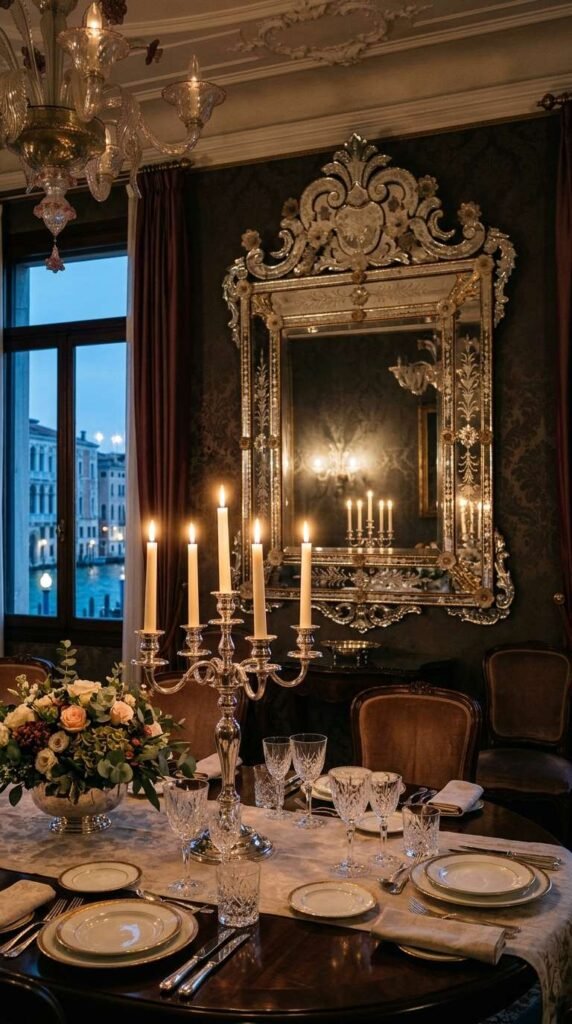
A Venetian mirror needs no frame, because the glass is the decoration. Layers of etched and cut glass build a border 2 to 4 inches wide around a clear center, and the etched edges catch light the way a cut crystal does. A 30 by 40 inch Venetian piece suits a formal dining room, hung alone on a pale wall.
These pieces are the dearest on this list, because the etching is hand worked. Venetian glass has been made on the island of Murano for centuries, and the same etched borders still define the style today. Keep the wall plain and the lighting warm, so the etched edges glow at dinner.
Etching detail: 30 by 40 inches, etched border 2 to 4 inches wide. Glass: clear center, cut and etched edge. Fixing: two anchors rated for 30 pounds. Pair with: pale walls, warm 2700K light.
17. Mirrored Wall Panel Feature
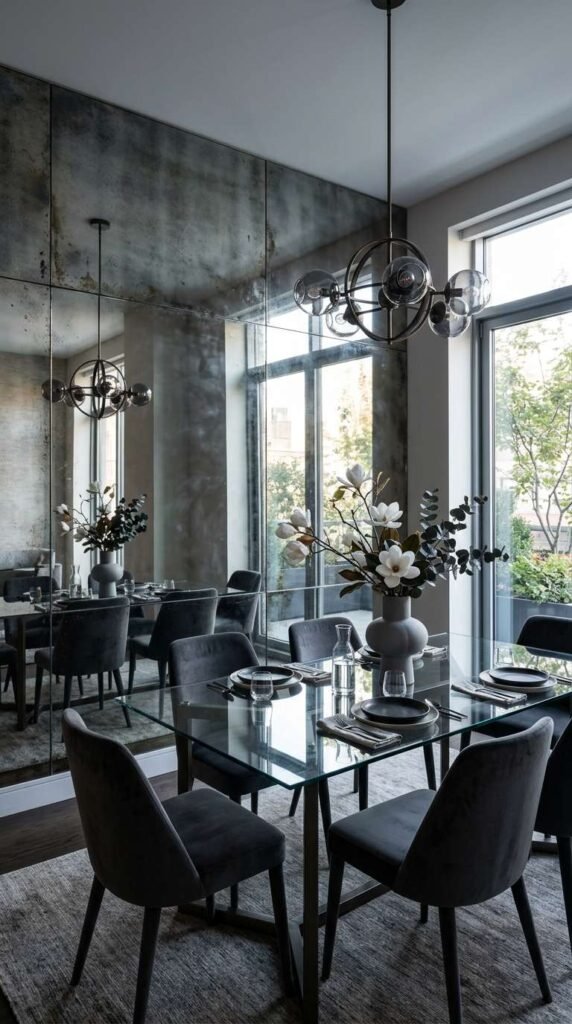
Panels take the mirror from a piece of art to a wall finish. Twelve inch wide panels, cut to the full wall height of about 96 inches and butted tight, cover the wall behind a long table and double the whole room. Smoked glass suits a glam room; antiqued glass suits a traditional one.
Leave the panels to an installer. They weigh 8 to 12 pounds per square foot, and the adhesive and clips need a flat, primed wall. Keep the table 36 inches from the glass so chairs pull out freely, and finish the outer edges with a slim wood trim so the joint lines look deliberate.
Panel plan: 12 inch panels, full wall height. Weight: 8 to 12 pounds per square foot. Fixing: adhesive plus clips, installer fitted. Clearance: 36 inches between table and glass.
18. Vintage Window-Style Mirror
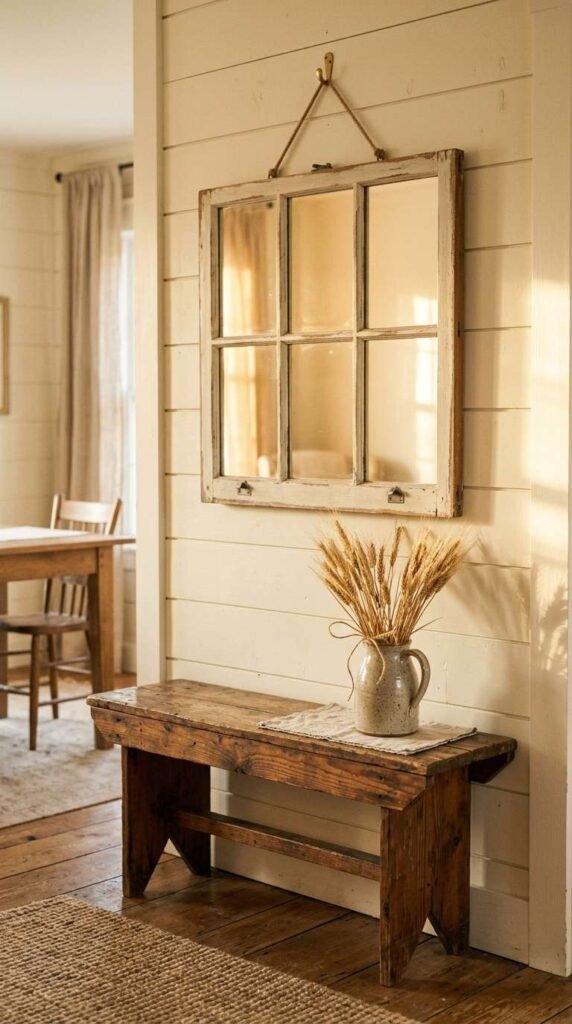
A window style mirror turns a plain wall into architecture. The frame is divided into six or eight panes, each 8 to 12 inches across, with mirrored glass in place of window glass, so the wall reads as if a window had been cut into it. A 36 by 48 inch piece suits the wall at the end of the table.
Salvaged window frames carry real age, but check them before you buy: press the joints, look for rot at the bottom corners, and make sure every pane is mirror, not old glass. A reproduction in painted wood gives the same look with a sound frame. Hang it on two anchors rated for 35 pounds.
Pane count: six to eight panes, 8 to 12 inches each. Size: 36 by 48 inches. Frame: salvaged wood or painted reproduction. Fixing: two anchors rated for 35 pounds.
19. Mirror with Built-In Shelf
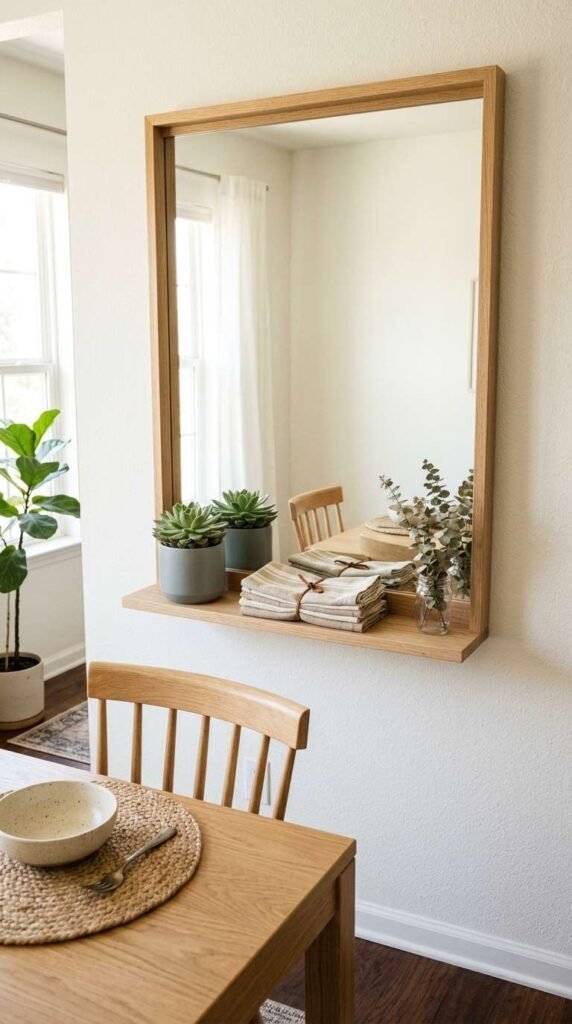
A mirror with a shelf is art that also holds things. Choose a mirror 20 to 24 inches wide with a shelf 4 to 6 inches deep, and hang it 57 inches to the center on a narrow wall where a console would not fit. The shelf holds two candlesticks 8 inches tall and a small vase, and the glass doubles them.
The shelf adds weight, so check its rating: most built in shelves hold 5 pounds, which covers candles and a vase with water, but not books. A wood shelf in walnut warms a white wall; a glass shelf keeps a small wall light. Keep the shelf clear at dinner, since anything on it will sit in the reflection.
Shelf depth: 4 to 6 inches, load under 5 pounds. Mirror: 20 to 24 inches wide. Height: center 57 inches from the floor. Fixing: two anchors rated for 30 pounds.
20. Two-Tier Mirror Gallery
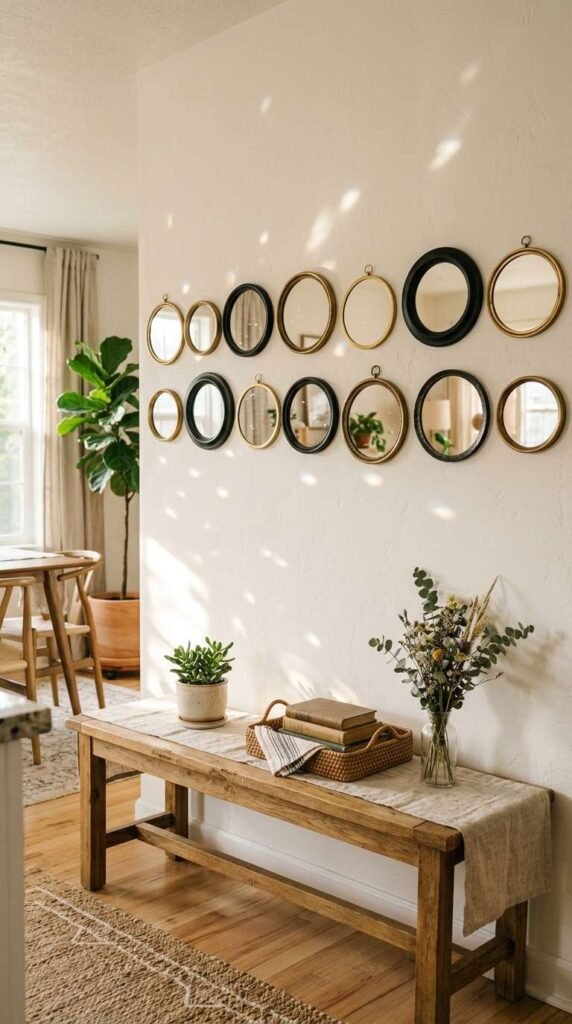
Two rows of mirrors fill a tall wall the way one row cannot. Hang three mirrors in a lower row and three in an upper row, all the same shape and frame finish, with the whole group spanning 60 to 72 inches wide. The repeated shapes draw the eye up and make a high ceiling feel part of the room.
Keep the rows honest: same shape, same frame, same size in both rows, usually 14 to 18 inches per mirror. The gap between rows does the work, so measure it with a ruler rather than by eye.
Spacing the Tiers: Leave 8 to 10 inches of vertical space between the bottom of the top row and the top of the bottom row. Set the lower row center at 54 inches from the floor and the upper row center at 78 inches, so the group reads as one tall artwork.
21. Layered Mirror Duo
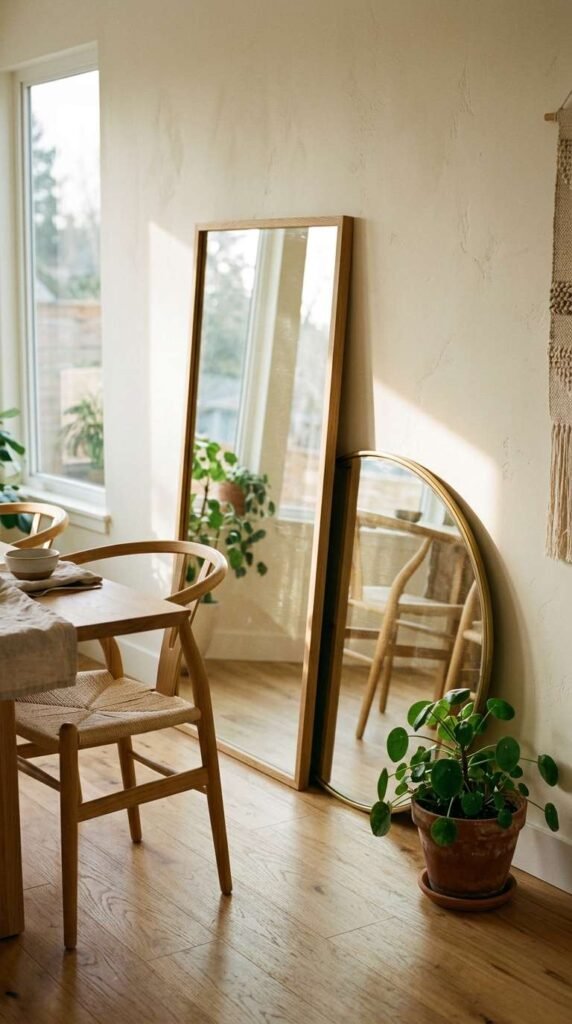
Layering is the simplest gallery idea on this list. Hang a large mirror 30 to 36 inches across, then hang a smaller one 16 to 20 inches across so it overlaps the larger one’s lower corner by 2 to 3 inches. The overlap adds depth that a single mirror cannot give, and the pairing reads collected rather than bought as a set.
Use two different frame finishes for the most contrast: a black steel large mirror with a brass small one, or a wood large mirror with a rattan small one. Fix the large mirror first on two anchors, then fit the smaller one on a single offset bracket so it sits just proud of the glass.
Overlap rule: smaller mirror overlaps the larger by 2 to 3 inches. Sizes: 30 to 36 inches and 16 to 20 inches. Frames: two different finishes. Fixing: large mirror on two anchors, small mirror on one offset bracket.
22. Mirror Flanked by Sconces
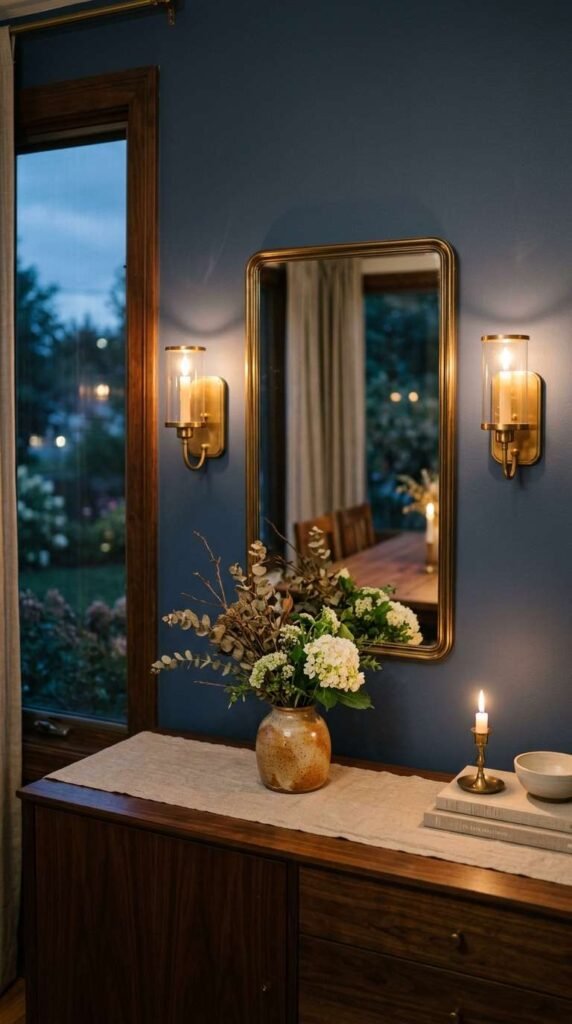
Two sconces turn a single mirror into a balanced composition. Hang a 30 to 36 inch mirror first, then place a sconce 6 to 8 inches out from each side of the frame, with the sconce centers level with the mirror’s midpoint at 60 inches from the floor. The symmetry reads clearly from the table, even before the lights are on.
Choose sconces with a warm 2700K bulb and a shade that throws light up and down, not straight into the glass. If the wall is wired, the sconces can sit 12 inches from a curtain edge; plug in models need a cord channel that runs down to the floor. A slim rectangular mirror makes the symmetry precise; a round mirror softens it.
Sconce spacing: 6 to 8 inches from the frame, centers at 60 inches high. Bulb: 2700K warm white. Mirror: 30 to 36 inches wide. Wiring: plan the route before you hang.
23. Copper Framed Mirror
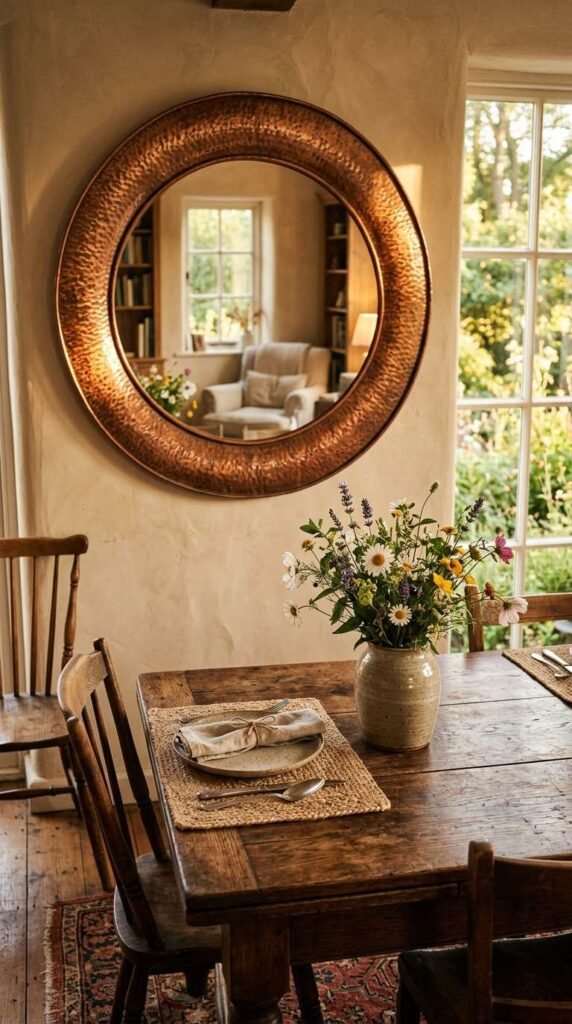
Copper is the warmest metal on this list, redder than gold and softer than brass. A copper frame 1 to 2 inches wide around a 24 to 30 inch round or rectangular mirror adds a warm metallic line that suits wood tables, brick, and warm white walls. It is a less common choice, so it reads as a deliberate pick rather than a default.
Decide before you hang it whether to keep the shine or let it age. A clear lacquer coat holds the bright copper color; left bare, the metal darkens into a deep brown patina over months. Either way, wipe the frame with a dry cloth and skip polish with harsh chemicals, which can strip the lacquer.
Patina choice: lacquer to keep the shine, bare to let it darken. Frame: 1 to 2 inches wide, polished or aged copper. Size: 24 to 30 inches. Height: center 58 inches from the floor. Pair with: wood, brick, warm paint.
24. Oval Statement Mirror
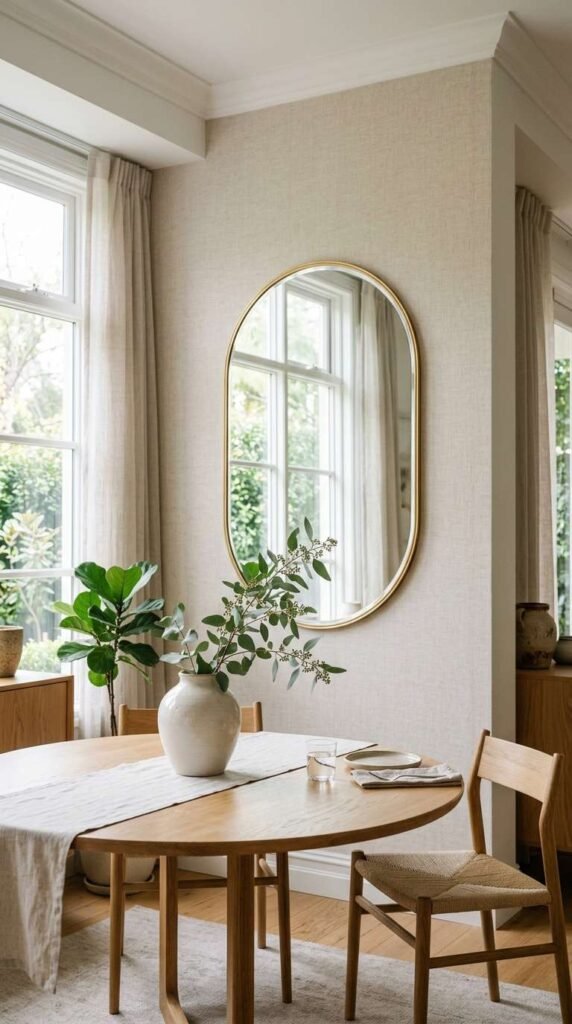
An oval is the most forgiving shape on this list. A piece 30 inches wide and 40 inches tall, hung vertically, elongates the wall the way a circle cannot, and the soft curves suit almost every dining room style. It works over a sideboard, beside a window, or alone on a long wall.
The frame changes the feel more than the shape does here. A slim gold oval reads formal; a black steel oval reads modern; a wood oval reads warm and traditional. Hang it vertically over a 48 inch sideboard, or horizontally above a low console 60 inches wide, and center it 58 inches from the floor.
Orientation: vertical 30 by 40 inches over a sideboard, horizontal over a low console. Frame: gold, black steel, or wood to taste. Height: center 58 inches from the floor. Fixing: two anchors rated for 25 pounds.
Antique or Modern: Choose Your Frame Direction
If you are torn between old and new, look at the table. A dark wood table with carved legs suits antique frames: gilded wood, mercury glass, etched Venetian borders. A pale oak or black steel table suits modern frames: slim black metal, brass, frameless glass. Pick the direction that matches the table, then keep every mirror frame in the room within that family.
You can mix one antique piece into a modern room, or one modern piece into a traditional room, but keep the rest of the wall in the main direction. Two directions at once reads as a mistake; one deliberate contrast reads as a choice.
Mirror Wall Decor Ideas: Questions People Ask
What size mirror works best for a dining room wall?
About two thirds of the furniture below it. A 60 inch sideboard takes a 40 inch mirror, and a 48 inch console takes a 32 inch one. A single mirror over a long table can be wider, up to 36 to 42 inches across.
Where is the best place to hang a mirror in a dining room?
On the wall opposite the window, or above the sideboard or buffet. Both spots put the mirror where it reflects light and the meal. Keep the center 57 to 60 inches from the floor.
What mirror shape suits a modern dining room?
Round, oval, and hexagon shapes with slim black or brushed metal frames. Keep the frame under 1 inch wide and the glass clear for the cleanest modern line.
Can I mix a mirror with other wall art?
Yes, if one finish or one shape ties the group together. A brass framed mirror sits well beside brass framed prints, and a round mirror sits well beside round woven art.
How high should a dining room mirror be hung?
Center it 57 to 60 inches from the floor, which is eye level for seated guests. Above a sideboard, keep the bottom edge 4 to 6 inches above the furniture instead.
What is a good mirror style for a small dining room?
One oversized round or oval mirror, 30 to 36 inches across, hung opposite the window. One clear reflection does more for a small room than a cluster of small pieces.
Are sunburst mirrors still in style for dining rooms?
Yes, in mid century and eclectic rooms, especially in brass or matte black. Choose rays 30 to 36 inches across and hang the piece alone, so the rays have clear wall around them.
How do I create a gallery wall using multiple mirrors?
Lay five to seven mirrors on the floor first, inside a 48 to 60 inch taped rectangle. Hang the largest piece first, slightly left of center, then fill outward with 2 to 3 inch gaps.
Can a mirror be leaned instead of hung on the wall?
Yes. A tall mirror 65 to 72 inches high leans well in a corner or behind a console. Fix an anti tip strap into a stud behind the top edge and keep 36 inches of clear floor in front.
What frame finish works best for a warm, elegant dining room?
Brass, gold, and copper all add warmth. Brass suits a modern warm room, gold suits a traditional one, and copper suits wood and brick. Keep the finish consistent across the room.
Conclusion
A mirror is the one piece of dining room art that also changes the light. Pick the shape that suits the room, the frame that matches the table, and the size that fits the wall, then hang it at 57 to 60 inches to the center and check the reflection from a seated chair. Save this guide to Pinterest before you shop, and if you want the same ideas organised by placement instead, read our dining room mirror ideas guide for heights and spots above the sideboard, opposite a window, and in dark corners.
Before You Buy: A Quick Mirror Wall Decor Ideas Checklist
Use this checklist with any of the mirror wall decor ideas above, before you spend anything. Measure the wall, note the width of the furniture below it, and write down the mirror width you need. Check that the wall can take the weight, and buy the anchors at the same time as the mirror. Hold the mirror up with a helper and check the reflection from a seated chair, because that is the view you will live with. Finally, save the look to Pinterest, note the frame finish, and compare it against one other material in the room, such as the wood of the table or the metal of the pendant.
If the mirror you love fails any one of these checks, change the size or the spot rather than forcing it onto the wrong wall. A smaller mirror in the right place always beats a larger one that does not fit the wall or the furniture below it.