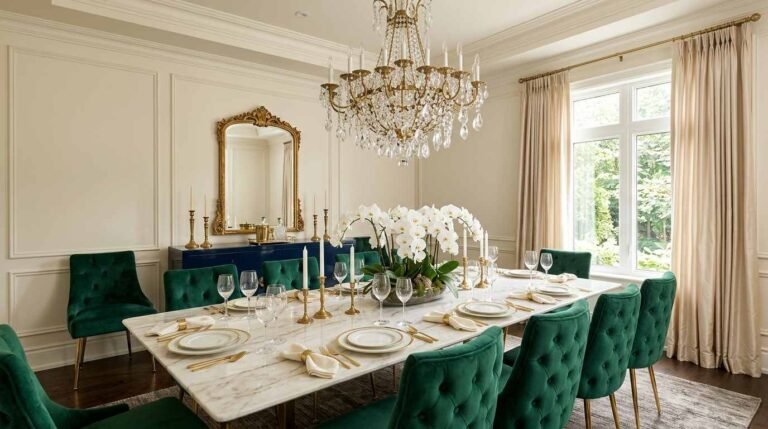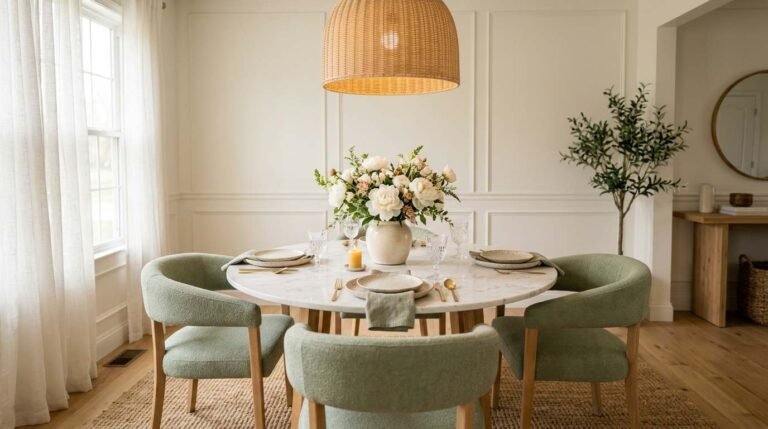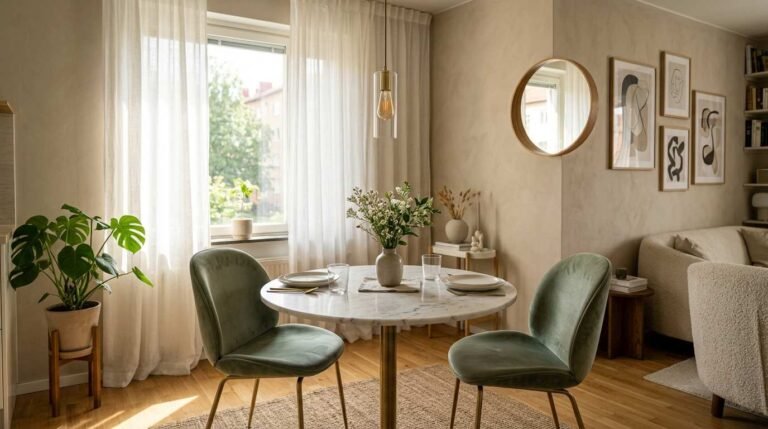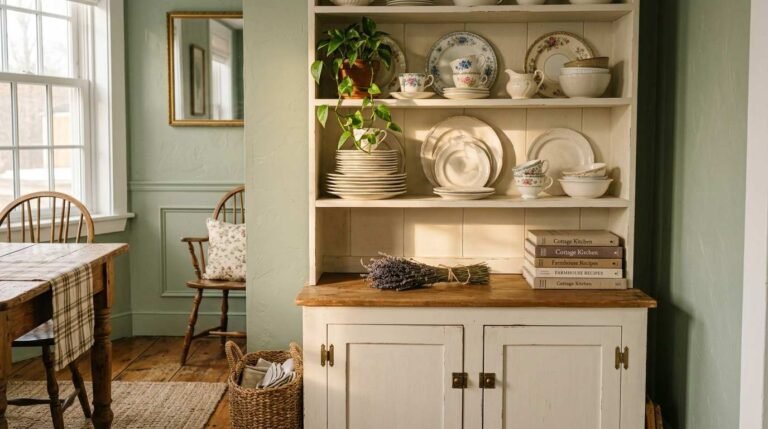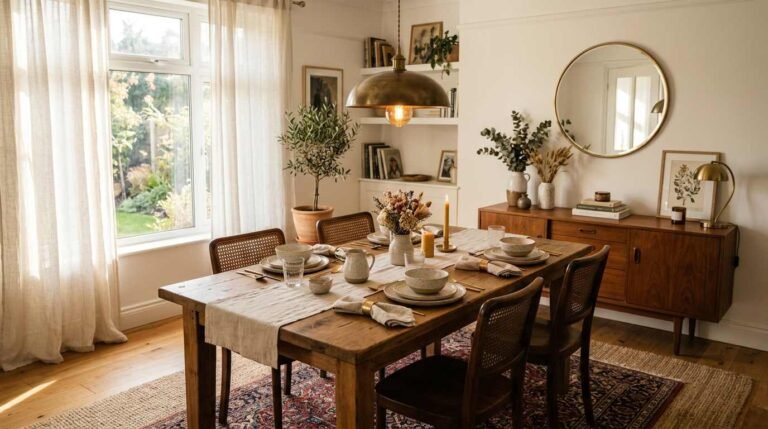
Eight feet of dining space doesn’t have to feel like a squeeze every time someone pulls out a chair. Small dining room decor ideas exist for exactly this problem, turning tight, awkward corners into spots people actually want to sit and linger in. Most small rooms don’t need more square footage, they need smarter choices, from the shape of the table to where the light hangs above it. I’ve noticed that homeowners often blame the room itself when the real issue is a table or chair set built for a much bigger space. This guide walks through 20 practical swaps, from a round pedestal table to layered textiles, that change how the room functions and feels. Save it to Pinterest, and start with whichever idea fits your space today.
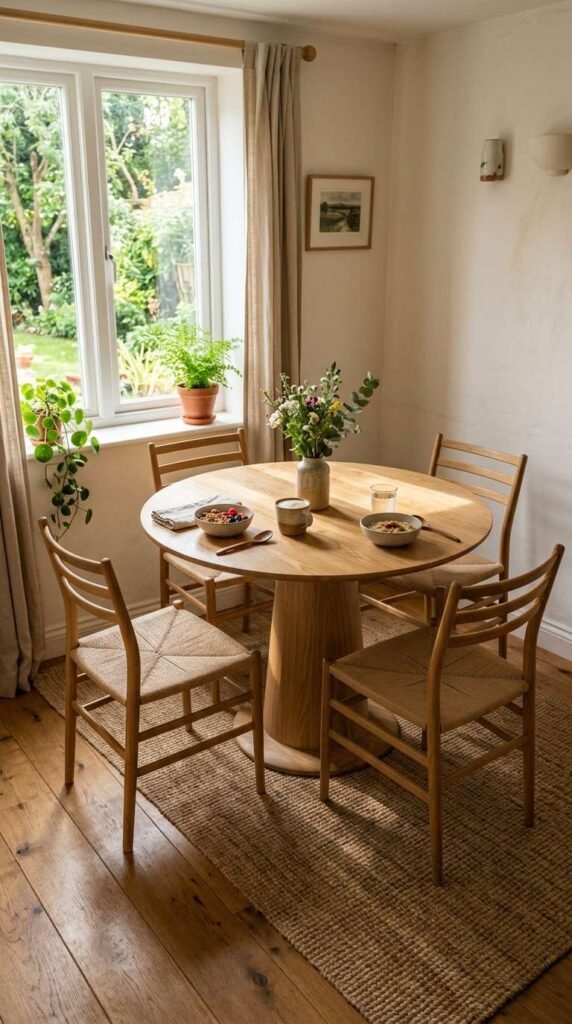
1. Round Pedestal Table to Save Space
- No sharp corners to bump into during tight squeezes
- Single center leg means more legroom for everyone
- Easier to add an extra chair when guests drop by
- Softens a boxy room with straight walls
- Works in rooms as narrow as 8 feet wide
Corners are the enemy in a cramped dining area. Four table legs planted at the edges eat into walking space, and sharp 90-degree points catch hips and elbows every time someone squeezes past. A round pedestal table solves both problems with one center support, freeing up the floor beneath and around it. Most small dining room decor ideas focus on furniture that does double duty, and a pedestal base does exactly that by acting as both structure and style. A 42-inch round top comfortably seats four, and squeezing in a fifth chair for an unexpected guest becomes far less awkward than shuffling around a rectangular table’s fixed legs.
Measure your room before falling in love with a size online. Leave at least 36 inches between the table edge and the nearest wall so chairs can slide out without scraping paint or knocking into a sideboard. A pale wood top, like ash or whitewashed oak, reflects more light than a dark walnut finish, which matters in rooms with only one window. Pair it with chairs that tuck fully under the apron, so the table reads as compact when not in use but expands socially the moment people gather around it for dinner.
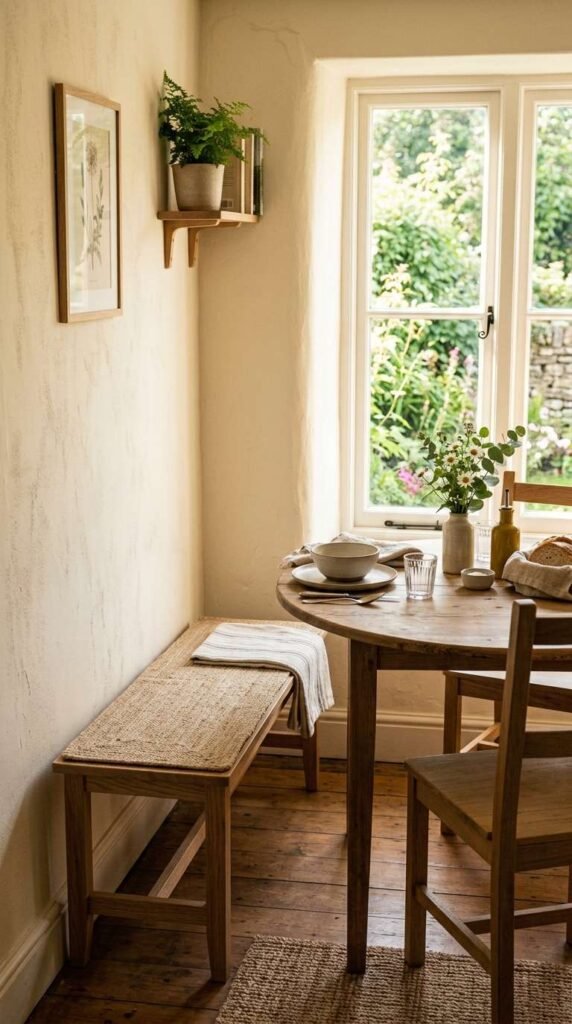
2. Bench Seating Along One Wall
- Slides flush against the wall when not seating people
- Fits more guests per linear foot than individual chairs
- Doubles as a landing spot for bags or coats
- Removes the bulk of chair backs and arms
- Easy to tuck kids in without pulling out a chair
Chairs need clearance to pull out, but a bench doesn’t. Push one against the longest wall in the room, and it becomes a fixed seating edge that never intrudes on the walkway behind it. This single swap can free up nearly two feet of floor space compared to a row of chairs on that same side. A bench also seats more people shoulder to shoulder, which comes in handy the one night a year extended family shows up unannounced for dinner. Kids especially like sliding in and out without wrestling a heavy chair, and a cushion on top keeps the wooden surface from feeling like a park bench.
Choose a bench without a back if the wall behind it is plain, since a backless design keeps sightlines open across the room. If the wall has a window, a low-backed bench lets daylight pour past it uninterrupted. Upholstered tops in a washable fabric handle spilled juice better than raw wood, and a bench roughly 12 inches shorter than the table itself leaves enough room at both ends for a standard chair, balancing the layout instead of overwhelming one side of the table.
3. Large Mirror to Expand the Room
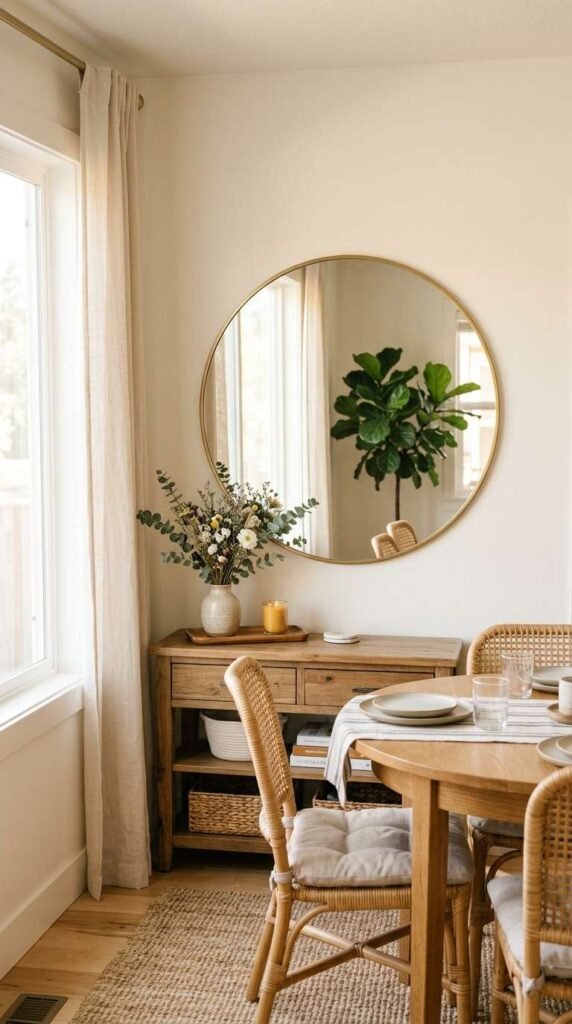
- Bounces daylight from a window across the whole room
- Makes an 8-by-10 room read closer to twice that size
- Reflects existing decor, adding style without buying more
- Works better than several small mirrors grouped together
- Costs less than most structural renovations
A window only lights the wall it faces unless something sends that light further. Hang a large mirror directly across from your main window, and daylight bounces deep into the room instead of stopping at the first few feet. This trick has more impact on how small a dining room feels than almost anything else on this list, because the brain reads reflected space as real space. A single oversized mirror, say 30 by 40 inches or larger, does more for the illusion than a cluster of small ones, since one continuous reflection reads as a window rather than a wall decoration.
Position matters as much as size. A mirror facing a blank wall accomplishes little beyond reflecting emptiness, so check what it will actually show before drilling. Aim it toward a chandelier, a window, or a colorful piece of art so the reflection adds depth rather than repeating dead space. A slim gold or black frame keeps the piece from feeling heavy on a small wall, and hanging the bottom edge roughly 6 inches above a console or sideboard ties the mirror visually to the furniture beneath it.
4. Slim Profile Chairs
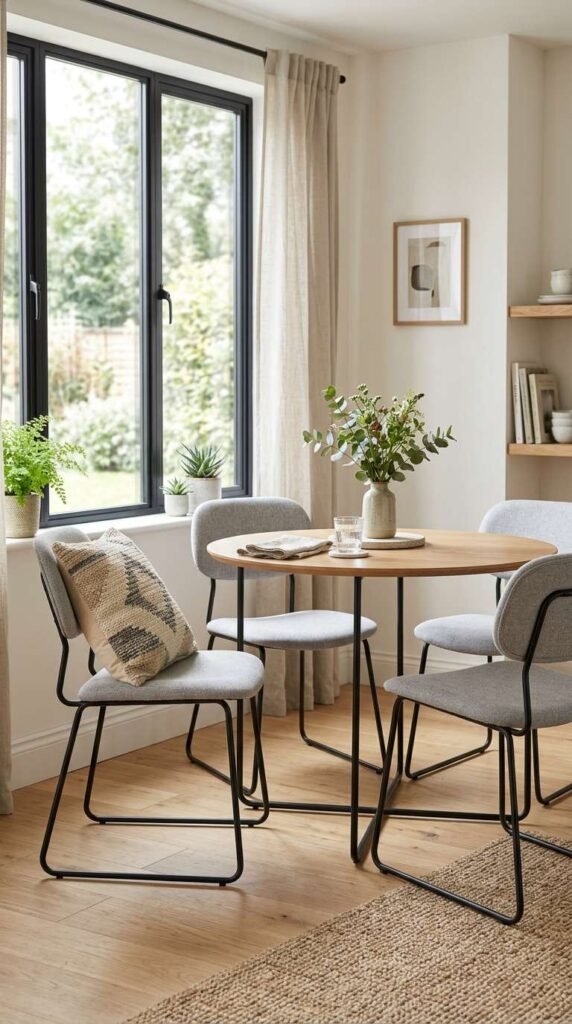
- Takes up less visual and physical space than upholstered arms
- Stacks or tucks fully under the table when not needed
- Lighter weight makes rearranging the room easier
- See-through materials like acrylic disappear against the floor
- Costs less than bulky upholstered dining sets
Bulky armchairs look inviting in a showroom, but six of them around a small table turn dinner into an obstacle course. Slim-profile chairs, whether in molded plastic, thin metal, or simple wood spindles, take up a fraction of the visual weight while still offering a comfortable seat. Because they lack wide arms, guests can scoot closer together when the table fills up, something padded armchairs never allow. A set of six slim chairs also weighs less collectively than four bulky ones, which matters the next time you need to rearrange furniture for a party or deep clean the floor underneath.
Clear acrylic chairs take this idea a step further by disappearing almost entirely against the floor and walls, creating a light and open feel that works beautifully with farmhouse dining room wall decor. The eye reads straight through them, so even a full set of six feels lighter than four solid wood chairs would in the same footprint. If acrylic feels too modern for your taste, a simple ladder-back chair in a pale wood tone achieves a similar effect. Either way, check that the seat height matches your table, generally 10 to 12 inches below the tabletop, so knees have proper clearance during meals.
5. Light, Airy Color Palette
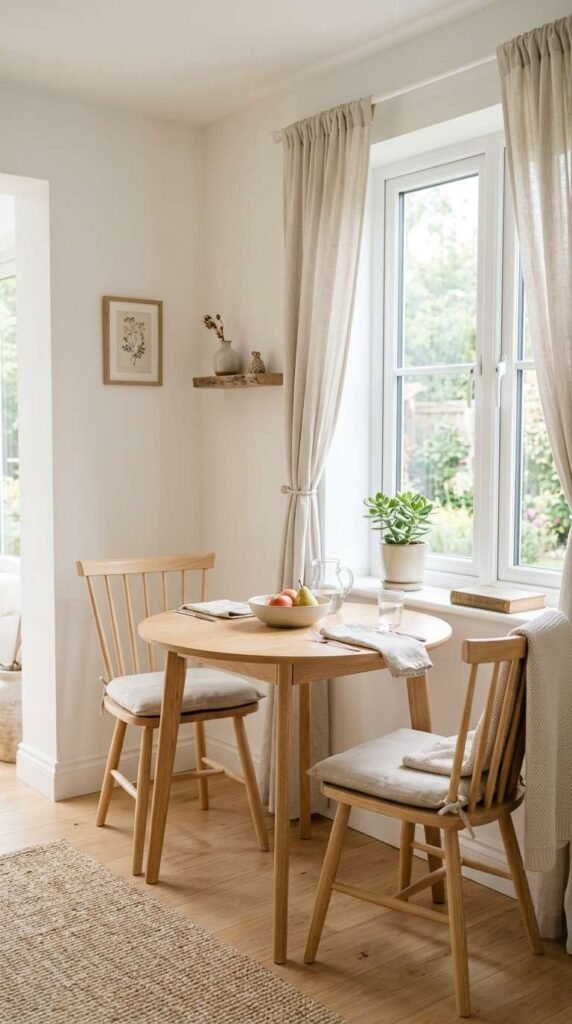
- Reflects more daylight than dark, saturated walls
- Makes low ceilings feel taller by default
- Costs nothing beyond a can of paint
- Creates a calm backdrop for bolder furniture choices
- Works especially well in rooms with only one window
Dark, moody walls look gorgeous in a spacious dining room with three windows and a chandelier, but they swallow light in a small one. A pale palette of off-white, soft gray, or warm beige bounces whatever daylight exists around the room instead of absorbing it into shadow. This single choice often matters more than the furniture arranged inside it, since wall color affects how the entire room reads before anyone notices the table or chairs at all. Ceilings painted the same shade as the walls, rather than stark white, also blur the line where wall meets ceiling, tricking the eye into perceiving more height than actually exists.
Test paint swatches at different times of day before committing, since a color that looks warm at noon can turn cold and gray by evening under artificial light. A satin or eggshell finish reflects slightly more light than flat matte paint, which helps in rooms without much natural sun. If plain white feels sterile, a warm cream or the palest blush pink still keeps the room feeling open while adding a touch of personality that stark white sometimes lacks entirely.
6. Wall-Mounted Drop-Leaf Table
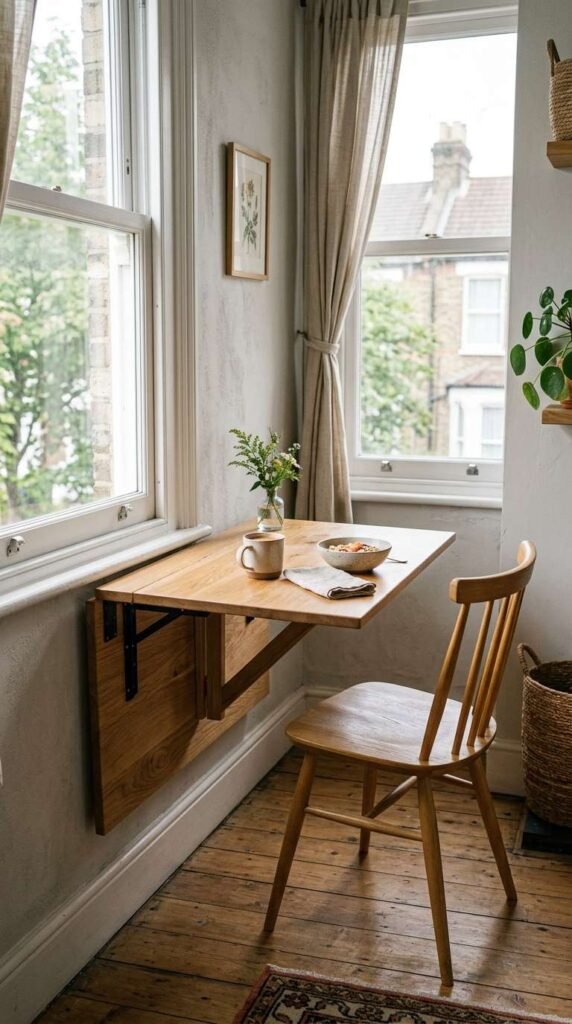
- Folds flat against the wall when not in use
- Frees the entire floor for other purposes
- Expands to seat guests only when needed
- Ideal for rooms doing double duty as a hallway or office
- Simple to install with basic wall anchors
A table that disappears when dinner is over solves the biggest problem in a truly cramped dining nook: the table itself. A wall-mounted drop-leaf folds down flat, hinges tucked against the wall, freeing the floor completely for walking through, rolling out a yoga mat, or setting up a laptop during the day. Flip it up and lock the support leg into place, and it becomes a full dining surface again in under a minute. This works particularly well in studio apartments or narrow hallway-adjacent nooks where a permanent table would block movement entirely for most of the day.
Check the weight rating before installing, since a flimsy hinge will sag under a full dinner setting for four. Mount it into wall studs rather than drywall alone, using at least two anchor points spaced along the width of the tabletop. A folding leg near the outer edge adds stability without requiring a second wall mount. Paint the folded panel to match the wall so it blends in seamlessly when down, creating a practical and subtle addition to cozy home decor rather than announcing itself as furniture waiting to unfold.
7. Vertical Wall Shelving for Storage
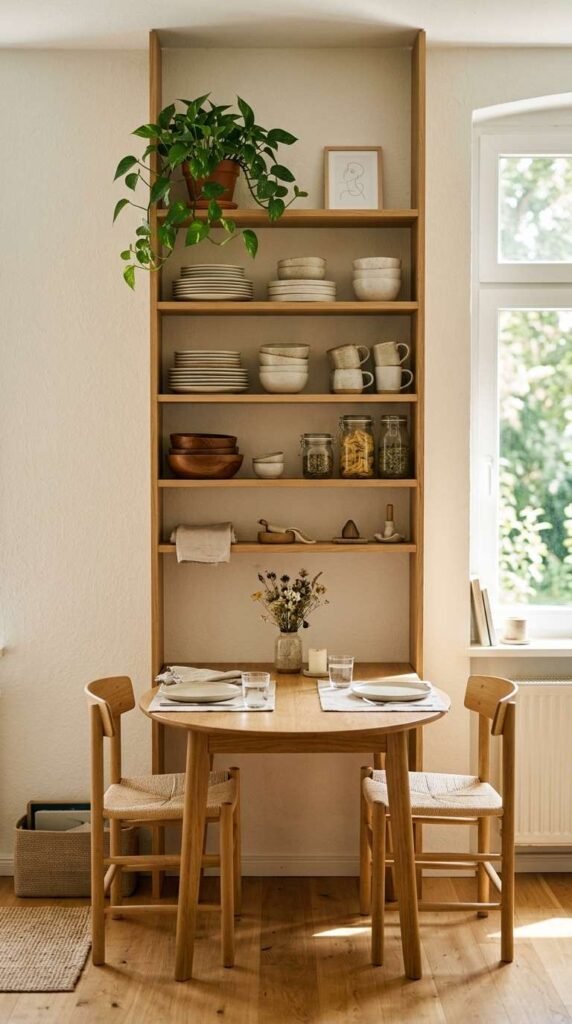
- Uses height instead of floor footprint
- Keeps dishware accessible without a bulky hutch
- Draws the eye upward, making ceilings feel taller
- Works in corners other furniture can’t reach
- Inexpensive compared to built-in cabinetry
Floor space is the scarcest resource in a small dining room, but wall space above eye level usually sits empty. A tall, narrow shelving unit mounted vertically stores dishes, glassware, and serving pieces without the footprint of a traditional buffet or hutch. Because the unit is thin, often less than 10 inches deep, it fits into gaps a standard cabinet never could, including the sliver of wall beside a doorway or window. Stacking storage vertically also pulls the eye upward, which subtly stretches the perceived height of the room, something a wide, low piece of furniture can never accomplish.
Anchor taller units securely into studs, since a fully loaded shelf carries real weight and a tip-over risk in a room with foot traffic nearby. Leave the top shelf slightly less full than the lower ones, both for visual balance and because reaching high items daily gets tiresome. A unit in the same tone as your walls recedes visually, while a contrasting wood finish turns it into a feature. Either approach works, but matching the wall color is the safer choice in rooms already feeling tight.
8. Small-Scale Pendant Light
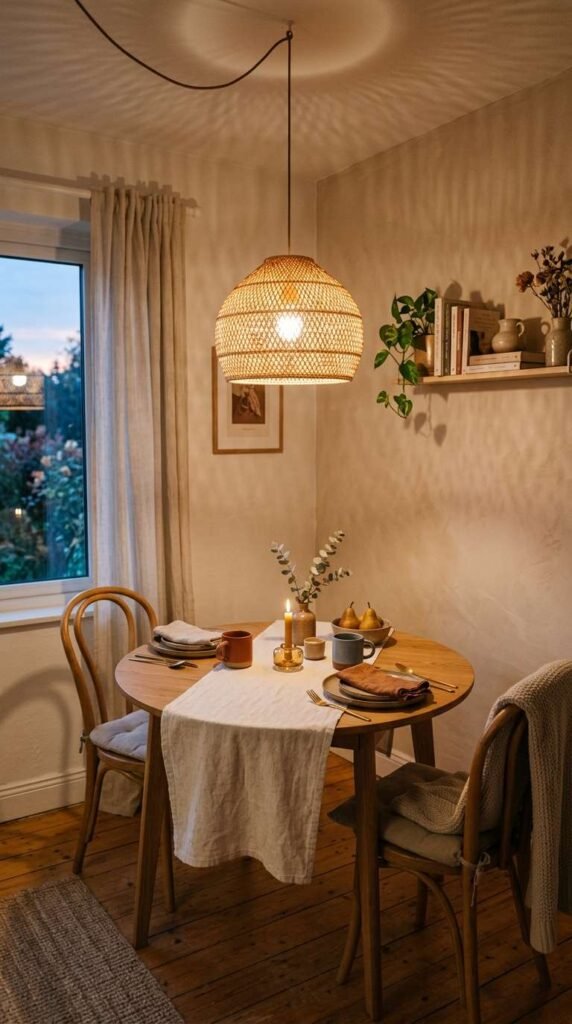
- Replaces the need for a floor or table lamp
- Casts light directly where meals happen
- Takes up zero floor or table space
- A single fixture can double as the room’s focal point
- Available in sizes proportioned for narrow tables
A floor lamp in a small dining room becomes another obstacle to walk around, and a table lamp steals surface space meant for plates. A pendant hung above the table solves both issues by putting the light source overhead, out of the way entirely. Scale matters here more than in a larger room, since an oversized fixture meant for a great room will visually crush a table meant for four. Look for pendants roughly 12 to 18 inches in diameter, sized to about half the width of the tabletop beneath them, so the light feels proportional rather than dominant.
Hanging height affects both function and feel. Keep the bottom of the fixture around 30 to 34 inches above the tabletop so it lights the surface without blocking sightlines across the table during conversation. A single bulb in a simple glass or metal shade tends to work better in tight rooms than a multi-arm chandelier, since fewer visual elements read as calmer in a space where every inch already competes for attention.
9. Stackable or Folding Chairs
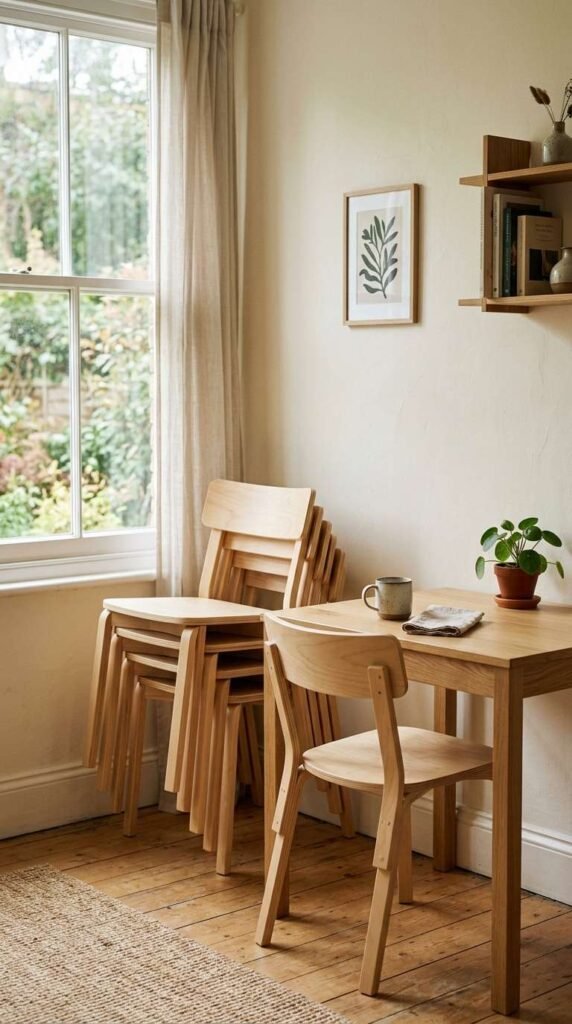
- Store flat or stacked when not hosting a crowd
- Let you seat extra guests without permanent clutter
- Lightweight enough for one person to move solo
- Available in styles that don’t scream “folding chair”
- Budget-friendly way to handle occasional overflow seating
Most days, a small dining room seats two to four people comfortably. Once a year, it needs to seat eight. Rather than cramming permanent chairs into corners for months at a time, stackable or folding chairs solve the overflow problem without demanding storage space year-round. A set of four can live flat in a closet, under a bed, or stacked in a corner, appearing only when guests actually need them. Modern folding chairs in molded wood or padded upholstery have moved well past the flimsy metal cafeteria look, so guests won’t clock them as an afterthought pulled from storage.
Buy a matching set rather than mismatched extras, so the room still looks intentional even when every seat is filled. Check the weight capacity and hinge quality before buying cheap versions, since a wobbly folding chair undermines the polish of an otherwise well-decorated room. Keep them stored somewhere genuinely convenient, like a coat closet near the dining area, so pulling them out for unexpected company takes seconds rather than becoming its own project.
10. Multi-Functional Console Table
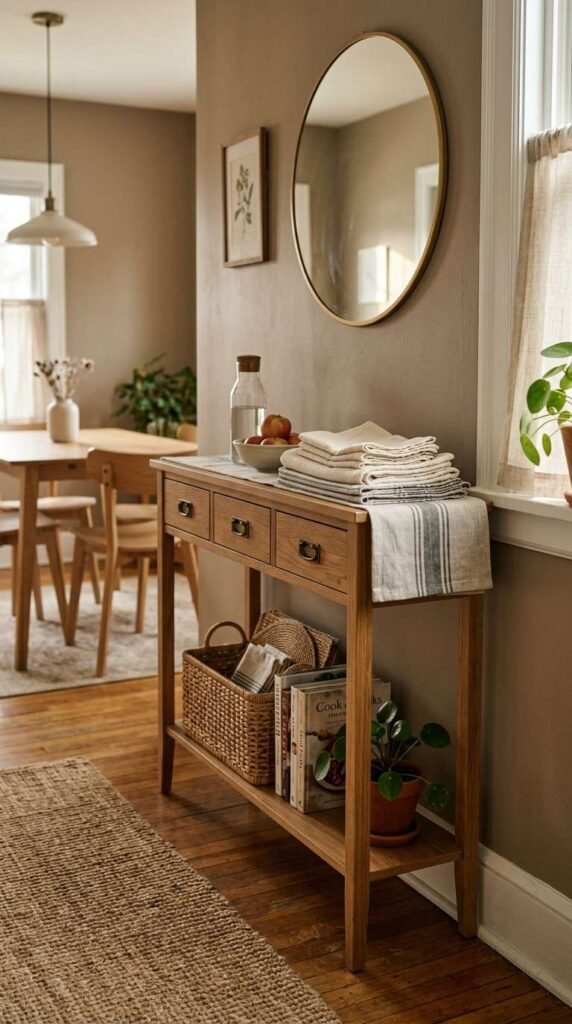
- Serves as a sideboard during meals, a desk between them
- Narrow depth fits against walls without blocking traffic
- Adds storage drawers without the bulk of a full buffet
- Doubles as a bar setup for entertaining
- Works in hallways that double as dining entry points
A console table earns its keep by never doing just one job. Push it against the wall for everyday use as a spot to drop keys and mail, then clear the surface before guests arrive and it becomes serving space for extra dishes. Because most consoles run just 12 to 16 inches deep, they slide against a wall without narrowing a walkway the way a full-depth sideboard would. In small dining room decor ideas built around flexibility, a piece like this matters more than a single-purpose buffet that only earns its space during holiday dinners.
Look for a console with at least one drawer, which hides table linens, extra silverware, or serving utensils without requiring a separate cabinet elsewhere. A shelf underneath adds space for stacked serving trays or a couple of decorative baskets. Choose a length roughly two-thirds the width of your dining table, which keeps the piece proportional rather than either dwarfing the table or looking undersized against it once both pieces sit in the same sightline.
11. Built-In Corner Banquette
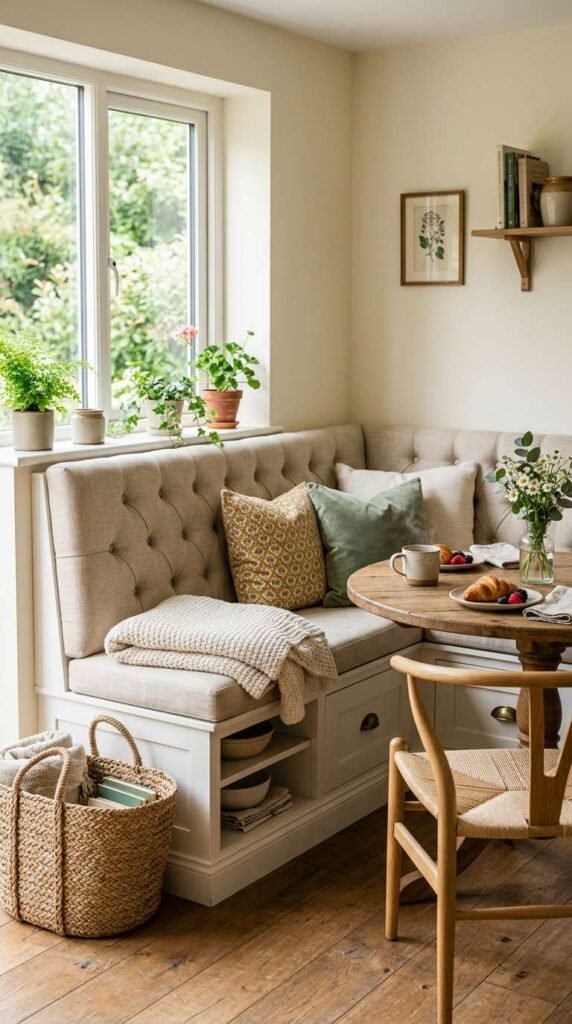
- Maximizes seating in the room’s most awkward corner
- Adds hidden storage beneath the bench seat
- Removes the need for chairs on two sides of the table
- Creates a cozy, booth-like dining experience
- Works well with a round or square table nearby
Corners rarely earn their keep in furniture planning, since most chairs and cabinets are built for straight walls. A built-in banquette changes that by wrapping bench seating around the corner itself, turning dead space into genuine seating capacity. This setup removes the need for chairs along two sides of the table entirely, which can save more floor space than almost any other single change on this list. The L-shaped bench also creates a cozy, restaurant-booth feel that makes even a tiny nook feel like a defined, purposeful dining spot rather than a leftover corner of a larger room.
A lift-up seat or drawers built into the base turn wasted under-bench space into storage for table linens, seasonal dishware, or serving pieces rarely used. Pair the banquette with a round table rather than a rectangular one, since the curved edge avoids awkward gaps where the bench meets a straight table corner. Cushion the seat in a durable, wipeable fabric, since banquettes see more consistent daily use than individual chairs typically do.
12. Sheer Curtains for Soft Light
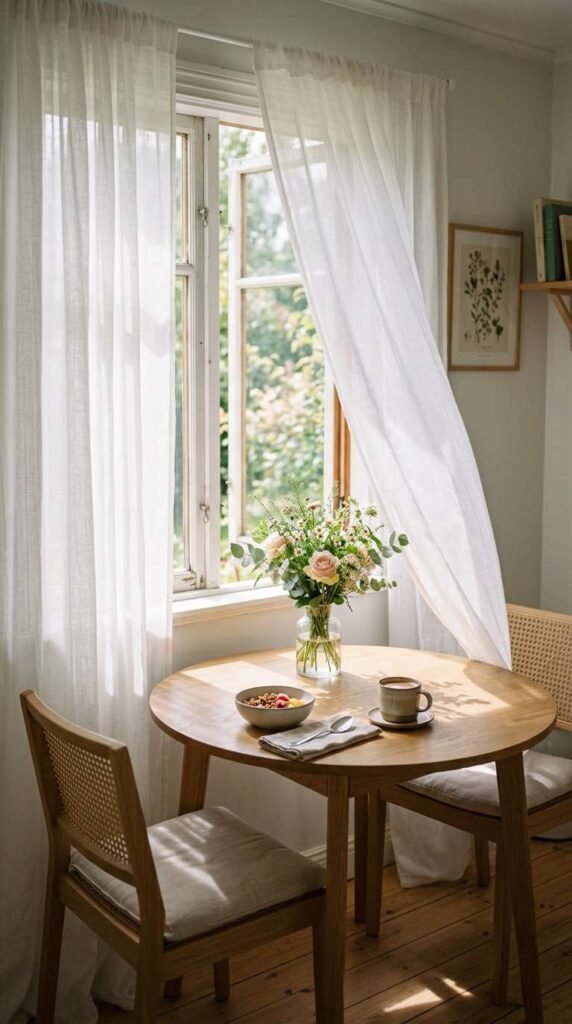
- Filters daylight without blocking it entirely
- Keeps the window as a visual focal point
- Lighter weight than heavy drapes, so the room feels less closed in
- Adds softness without eating into wall space
- Inexpensive compared to structural window treatments
Heavy drapes look elegant in a formal dining room with high ceilings, but in a small space, they can swallow both light and visual room. Sheer curtains filter harsh daylight into something softer while still letting most of the light through, which keeps the room bright rather than dimming it. Because sheers hang lighter and thinner than blackout or velvet panels, they don’t visually crowd the window the way heavier fabric does. This matters in rooms where the window is one of the only sources of natural light, since blocking even part of it noticeably darkens the space.
Hang the curtain rod a few inches above the window frame and slightly wider than the window itself, so the fabric doesn’t cover any actual glass when pulled to the sides. This trick makes the window appear larger than it physically is, borrowing a technique often used in small bedrooms. A simple white or ivory linen sheer suits most color palettes without introducing a bold new pattern, and the fabric is typically machine washable, unlike many heavier drapery materials that require dry cleaning.
13. Small-Scale Area Rug
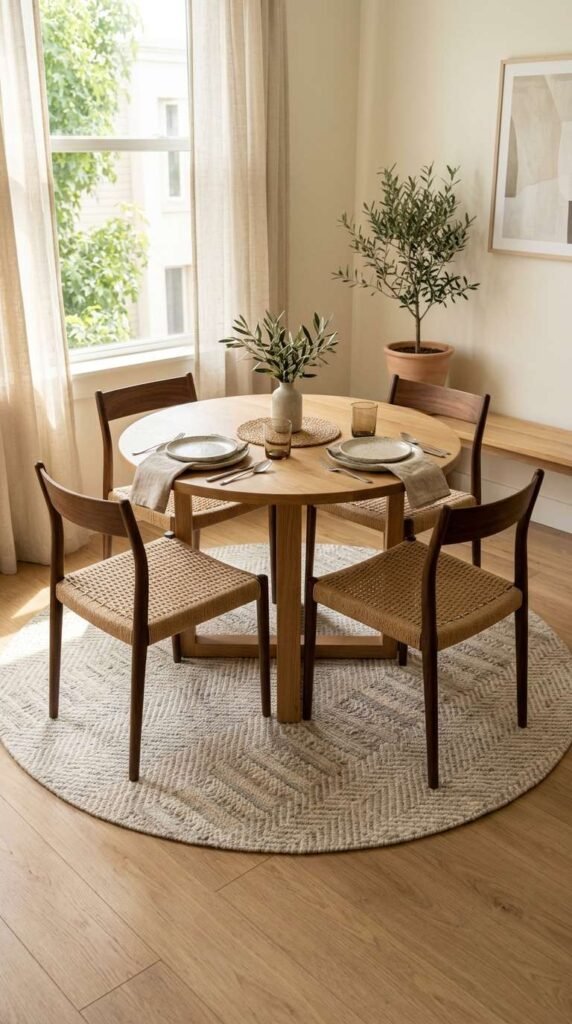
- Defines the dining zone without overwhelming the floor
- Adds softness underfoot on hard flooring
- Easier to clean than a room-sized rug
- Works well in open-concept layouts
- Available in sizes made specifically for smaller tables
A full-sized area rug meant for a living room often overwhelms a small dining space, but a rug sized specifically for a compact table defines the eating area without taking over the floor. This matters most in open-concept homes, where the dining zone often blends into the kitchen or living room with no walls to mark where one space ends and the next begins. A rug roughly 6 by 9 feet suits a table seating four, leaving enough border for chairs to sit fully on the rug even when pulled out during a meal.
Choose a low-pile or flat-weave rug over a plush shag style, since thick pile makes chairs harder to push in and out smoothly. A busy pattern hides crumbs and minor stains better than a solid pale color, which matters in a room used daily for meals. Vacuum without a beater bar if the rug has any fringe, and add a thin non-slip pad underneath to keep it from bunching or sliding whenever a chair gets pulled back quickly.
14. Extendable or Foldable Table
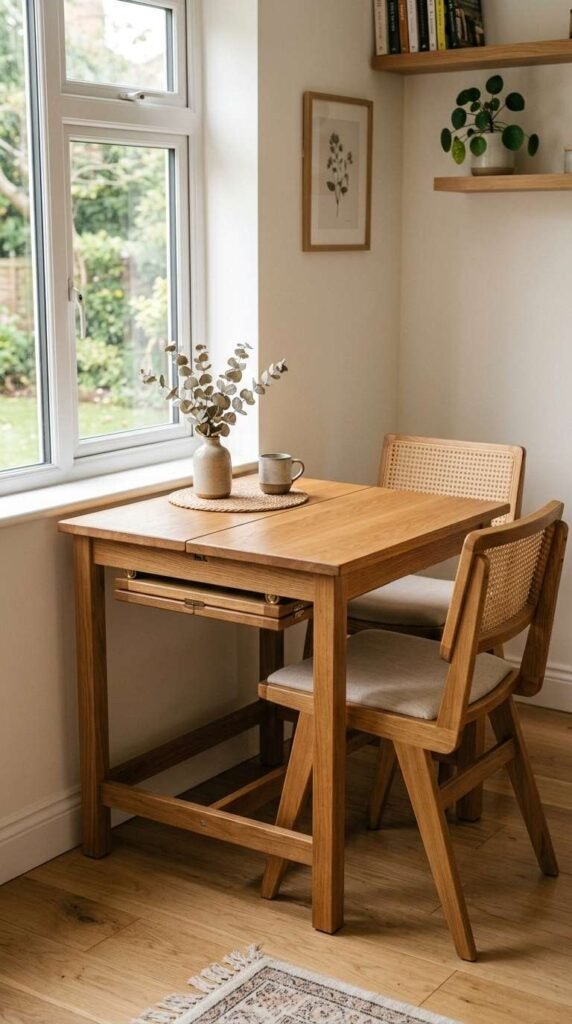
- Seats two comfortably, expands for six when needed
- Folds down for everyday use in tight quarters
- One purchase covers two different seating needs
- Butterfly leaves store inside the table itself
- Practical for rooms that double as workspaces
Buying a table sized for your biggest possible dinner party means living with a too-large table every single ordinary Tuesday. An extendable table flips that trade-off, staying compact for daily use and expanding only when the guest list grows. A butterfly-leaf design hides the extra panel inside the table itself, so there’s no separate leaf to store in a closet or garage. Drop-leaf styles work similarly, folding down on one or both sides to shrink the footprint by nearly half when not entertaining, then unfolding in seconds when company arrives.
Test the mechanism in person if possible, since cheaper extension hardware can stick or wobble over time. A table that extends from 36 inches to 60 inches roughly doubles its seating capacity, going from a cozy two-person setup to a full table for six. This flexibility suits homes where the dining area also serves as a workspace or craft table during the day, since the smaller footprint keeps the room functional when a full dinner spread isn’t the priority.
15. Open Shelving Instead of Bulky Cabinets
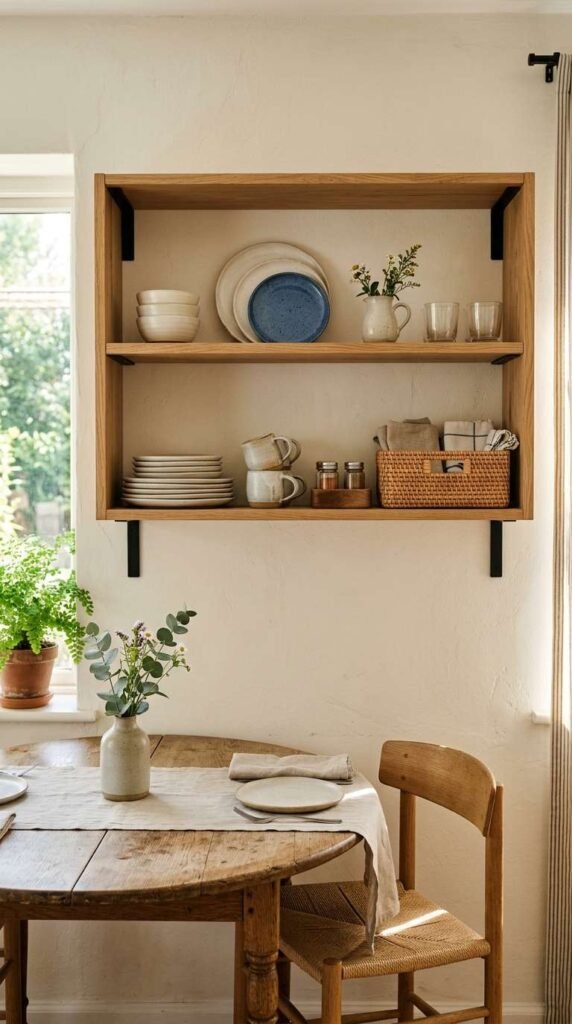
- Shows off dishware instead of hiding it behind doors
- Costs less than built-in cabinetry
- Keeps the room feeling open rather than boxed in
- Easy to restyle without buying new furniture
- Works on narrow walls where cabinets won’t fit
A closed cabinet blocks light and visually reads as a solid, heavy object, even when it’s not particularly large. Open shelving achieves the same storage goal while letting the wall behind it, and any light passing near it, remain visible. This single swap keeps a small dining room from feeling boxed in, since the eye can see through and past the shelving rather than stopping at a solid door. Displaying dishware also turns storage into decor, meaning a plain white plate collection becomes part of the room’s visual interest rather than something hidden away until dinner.
Style the shelves with restraint, since open storage that’s too full starts to look cluttered rather than curated. Leave roughly a third of each shelf empty, and group items in odd numbers for a more natural, less rigid arrangement. Choose shelves no deeper than 10 inches if the wall sits close to the table, so nothing juts out far enough to catch a shoulder while someone’s pulling out a chair.
16. Monochromatic Color Scheme
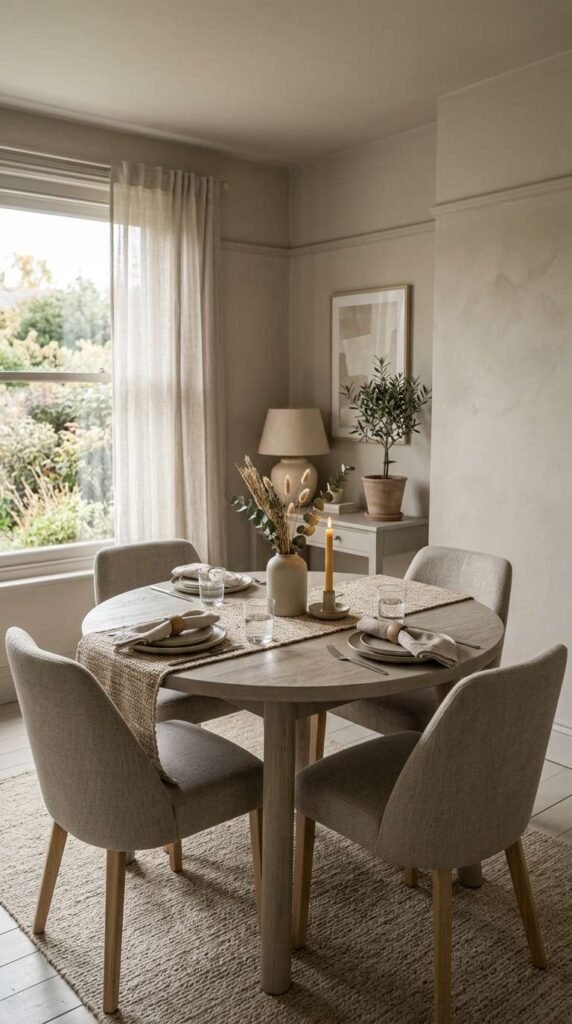
- Removes the visual noise of contrasting colors
- Makes a room feel larger by keeping the eye moving smoothly
- Simplifies decorating decisions
- Lets texture carry visual interest instead of color
- Easy to accessorize since most pieces already match
Contrasting colors create visual stops, points where the eye pauses because something looks different from what surrounds it. In a small room, every one of those pauses can make the space feel busier and, paradoxically, smaller. A monochromatic scheme, built from various shades of a single color family like warm white through soft beige, removes those visual interruptions almost entirely. The eye glides across walls, table, and chairs without stopping, which reads subconsciously as more spacious than a room chopped up by clashing tones.
This approach also simplifies shopping, since nearly anything within the chosen color family works together automatically. Layer in texture, like a woven placemat against a smooth table or a nubby linen cushion on a wood chair, so the room doesn’t feel flat despite the limited color range. A single accent color, used sparingly in a vase or a few cushions, keeps the scheme from feeling sterile while still preserving the calm, expansive effect a full neutral palette provides.
17. Glass-Top Table for Visual Lightness
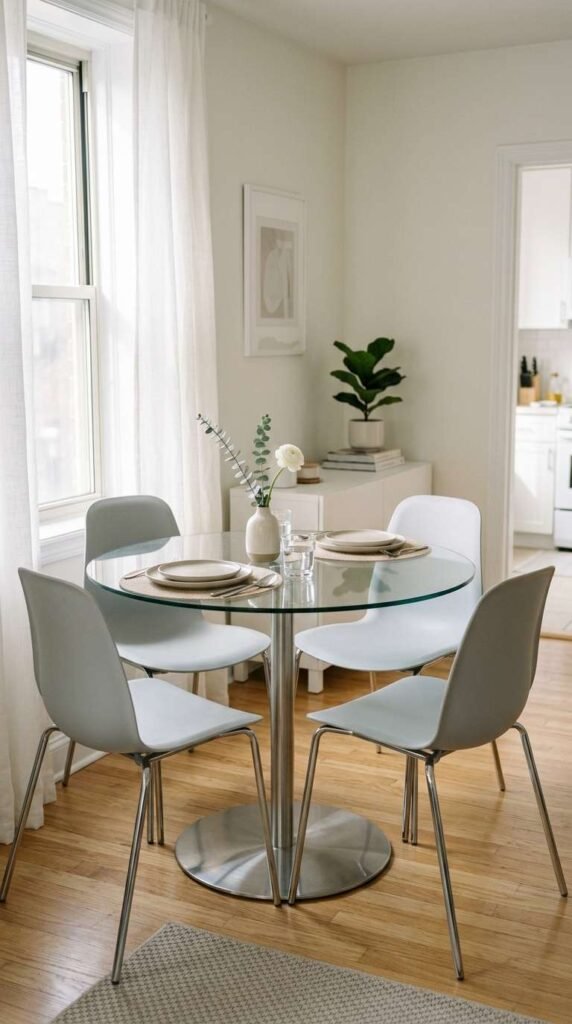
- Lets the eye pass through rather than stopping at a solid surface
- Reflects light rather than absorbing it
- Shows off flooring or a rug underneath
- Pairs well with bold chairs since the table itself stays understated
- Easier to keep looking uncluttered than a solid wood top
A solid wood tabletop, however beautiful, occupies visual space the same way a wall does. A glass top reads almost as absence, letting the eye travel straight through to whatever sits beneath it, whether that’s a patterned rug or simple wood flooring. This visual trick matters more in small rooms, where every piece of furniture either adds to or subtracts from how spacious the room feels. Paired with a slim metal base rather than a chunky wood pedestal, a glass table becomes one of the lightest-feeling pieces you can put in a tight dining area.
Glass also bounces available light around the room rather than absorbing it, which helps in spaces without abundant natural sun. Choose tempered glass at least three-eighths of an inch thick for safety and durability, and expect to wipe fingerprints more often than you would with wood. Pairing the table with a bold rug or colorful chairs works particularly well here, since the understated top leaves room for other elements to carry the room’s personality.
18. Wall-Mounted Sconces Instead of Floor Lamps
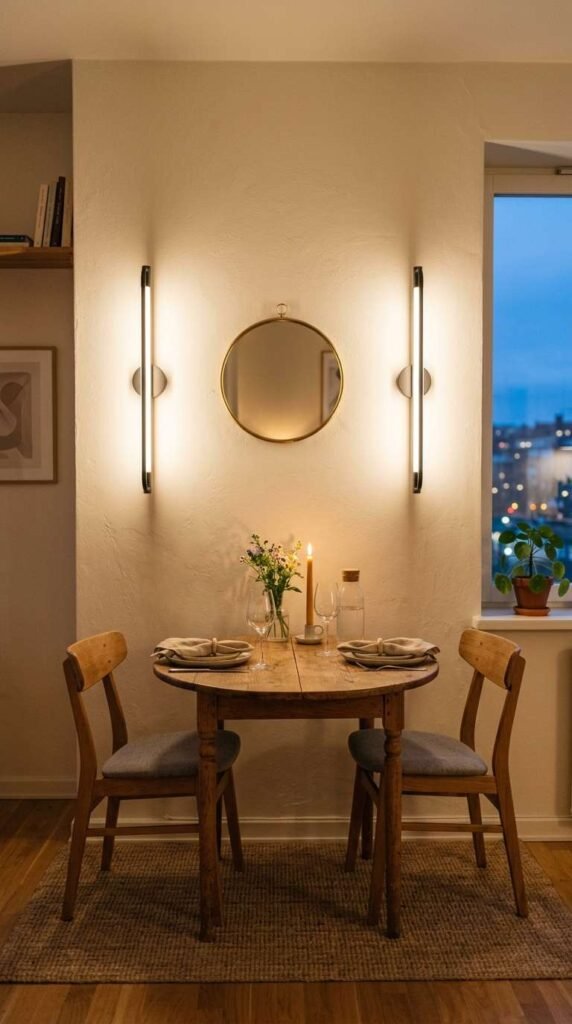
- Frees the floor from lamp bases and cords
- Adds warm light without using table space
- Creates symmetry when installed in pairs
- Works well flanking a mirror or piece of art
- Dimmable versions add flexibility for different occasions
A floor lamp in a small dining room takes up square footage that’s already scarce, and its cord often becomes a tripping hazard along a wall. Wall-mounted sconces solve both problems by moving the light source directly onto the wall itself, where it takes zero floor space and needs no visible cord if wired properly. Installed in a pair flanking a mirror or piece of art, sconces also create instant symmetry, which reads as intentional and calming even in a room with few other design elements. The warm glow sits at a comfortable height for evening meals without competing with an overhead fixture.
Mount sconces around 60 to 66 inches from the floor, roughly eye level for someone standing nearby, so the light flatters faces without glaring directly into anyone’s eyes while seated. Battery-operated or plug-in versions work well for renters who can’t run new wiring, since many modern designs disguise the cord along the baseboard. Choose a warm bulb around 2700K rather than a cooler white tone, which tends to feel more flattering in a space meant for relaxed conversation over dinner.
19. Vertical Paneling for a Taller Feel
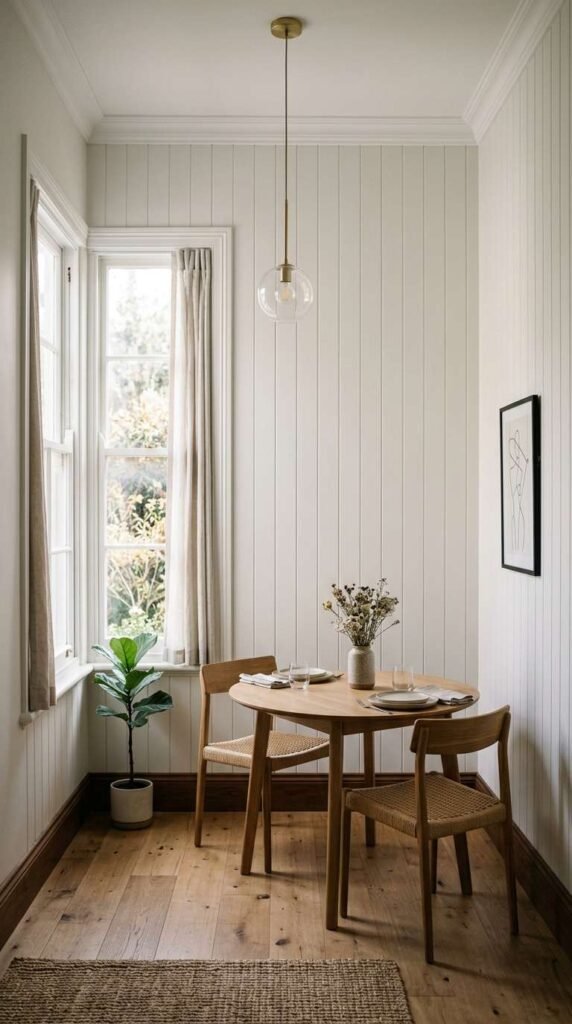
- Draws the eye upward instead of side to side
- Adds architectural detail without changing the room’s footprint
- Works well painted a single tone, including the paneling itself
- Suits both traditional and modern dining rooms
- A DIY-friendly weekend project for most homeowners
A room with low ceilings often gets worse, not better, when decorated with horizontal lines, like a long console or a wide piece of art. Vertical paneling flips that effect by installing narrow strips of trim running floor to ceiling, which pulls the eye upward and makes the room read as taller than its actual measurements suggest. This detail also adds genuine architectural interest to a plain, builder-grade wall, giving the room a sense of intention that flat drywall alone rarely achieves, regardless of how nicely it’s painted or decorated elsewhere.
Paint the paneling and the wall behind it the same color for the most seamless, elongating effect, since contrasting the two often flattens the vertical illusion rather than enhancing it. Space the strips evenly, typically 12 to 16 inches apart, and use lightweight MDF trim rather than solid wood to keep the project affordable and manageable for a DIY weekend. This update works especially well on the wall behind a table, becoming a backdrop that feels custom-built rather than an afterthought.
20. Layered Textiles for a Cozy Small Space
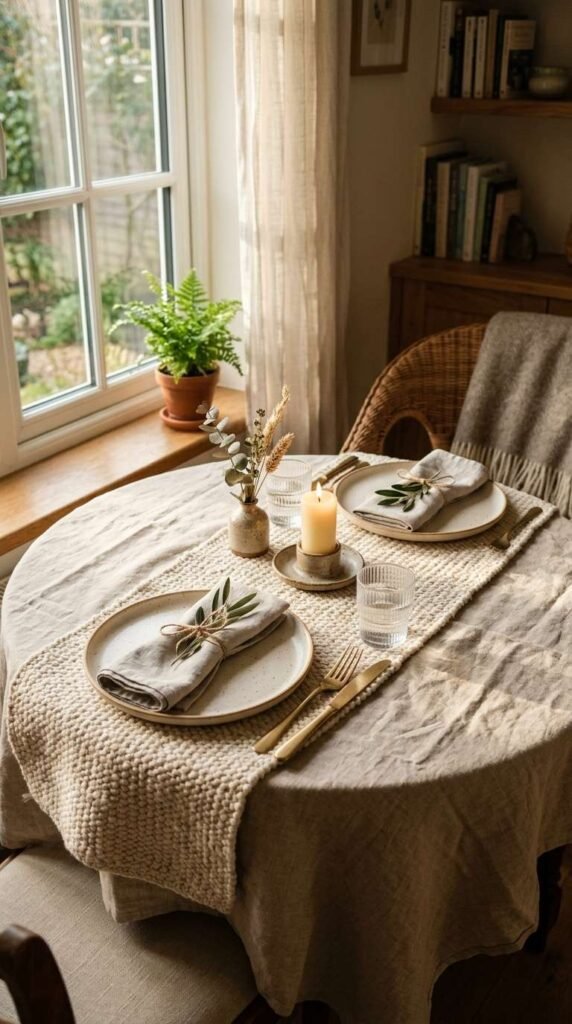
- Adds warmth without requiring more furniture
- Softens hard surfaces like wood floors and glass tables
- Easy to swap seasonally for a quick refresh
- Uses cushions, runners, and throws rather than bulky pieces
- Keeps the room feeling intimate rather than empty
A small dining room can feel sparse rather than cozy if every surface stays hard and bare. Layering textiles, like a linen runner down the table, cushions tied to chair seats, and a folded throw over a bench, softens the room without adding a single piece of actual furniture. This approach works especially well in rooms already stripped down for space-saving reasons, since fabric fills in warmth that a mostly empty floor plan might otherwise be missing. A room with the right textiles feels intentionally minimal rather than simply under-furnished, which is the difference between a stylish small space and one that reads as unfinished.
Stick to washable fabrics given how close textiles sit to food and drink during meals. Rotate lighter linen and cotton pieces in warmer months, then swap in heavier wool or velvet cushions once the weather turns cooler, giving the room a seasonal refresh without spending on new furniture. Keep the color palette within two or three shades so the layers feel coordinated rather than like a collection of mismatched leftovers pulled from different rooms of the house.
FAQs
1. What furniture works best in a small dining room?
Round tables, slim chairs, and multi-functional pieces like a console or drop-leaf table work best. Avoid anything with bulky arms or a wide base, since these details eat into walking space that a small room can’t spare.
2. How can I make a small dining room feel bigger?
A large mirror across from a window, a light color palette, and a glass-top table all help. These choices work by reflecting light and reducing visual weight, rather than by adding actual square footage to the room.
3. What’s the best table shape for a small space?
Round or oval tables generally work better than rectangular ones, since they lack sharp corners that catch hips and block walkways. A round pedestal base also frees up legroom that four separate table legs would otherwise take.
4. How do I add storage without taking up floor space?
Vertical wall shelving, wall-mounted cabinets, and a multi-functional console table all add storage without a floor footprint. Look for pieces under 12 inches deep so they don’t narrow the room’s usable walking space.
5. What lighting works best in a small dining room?
A small-scale pendant hung above the table and wall-mounted sconces both keep the floor and table surfaces clear. Choose fixtures proportioned to the room, since an oversized chandelier will visually overwhelm a compact space.
6. Should I use a rug in a small dining room?
Yes, a rug sized specifically for the table helps define the dining zone, especially in open-concept layouts. Choose a size that keeps all four chair legs on the rug even when pulled out during meals.
7. What seating works best for hosting guests in a small space?
Bench seating along one wall and stackable or folding chairs both handle overflow guests well. Benches maximize seating per linear foot, while folding chairs store away completely when not needed for a crowd.
8. Are extendable tables a good choice for small dining rooms?
Yes, an extendable or drop-leaf table stays compact for daily use and expands only when guests arrive. This flexibility means one table can handle both a quiet weeknight dinner and a larger holiday gathering.
9. What color scheme works best for a small dining room?
A light, airy palette or a monochromatic scheme both help a small room feel more open. Sticking to shades within one color family keeps the eye moving smoothly instead of stopping on contrasting tones.
10. How do I add coziness without making the room feel cluttered?
Layer in textiles like cushions, a table runner, or a throw rather than adding more furniture. Fabric adds warmth and softness without taking up floor space the way an extra chair or side table would.
Conclusion
A cramped dining room isn’t a permanent problem, it’s usually just a mismatch between the furniture and the space. The right small dining room decor ideas, whether that’s a slim chair, a well-placed mirror, or a table that folds away, can turn a tight corner into somewhere people genuinely want to gather. I’ve seen how one or two thoughtful swaps make a bigger difference than a full furniture overhaul ever could. Save this list on Pinterest, try an idea in your own space this week, and share it with anyone else working with a dining room that’s short on room but not on charm.